







Question: Question 1 (4 points) Listen A zero coupon bond is a bond that pays no interest and is offered (and initially sells) at par. These
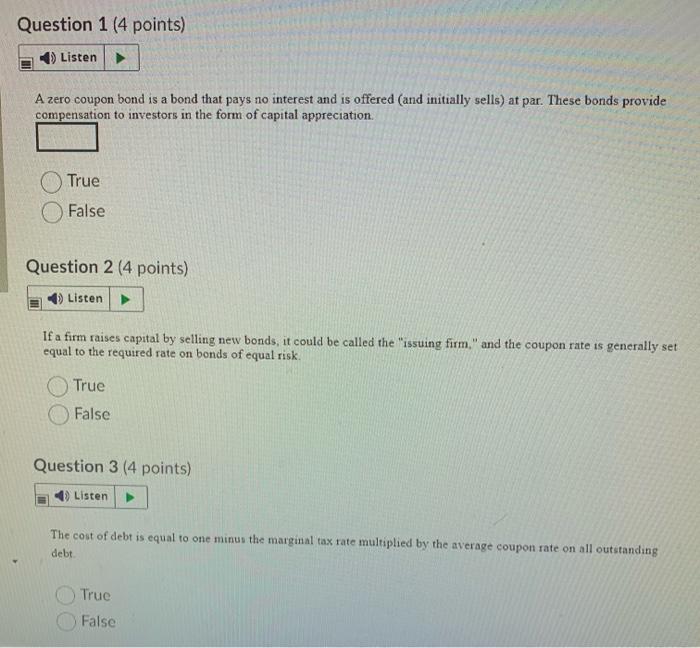

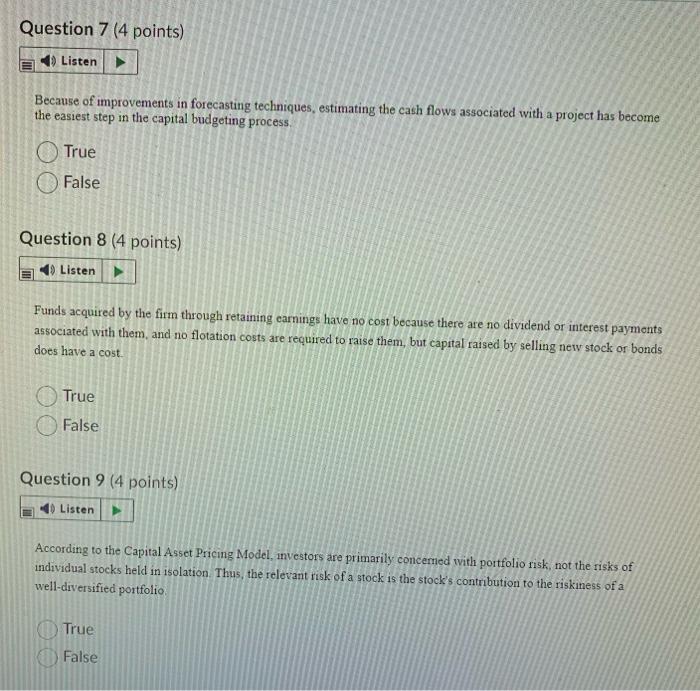
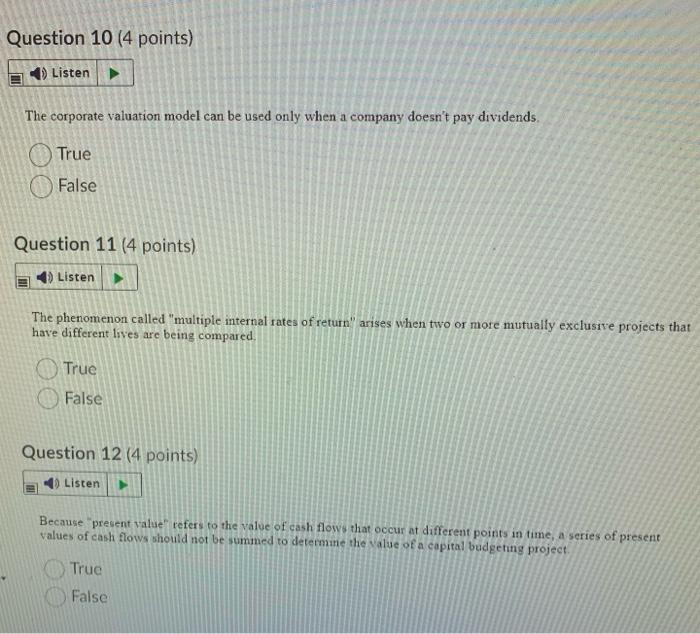
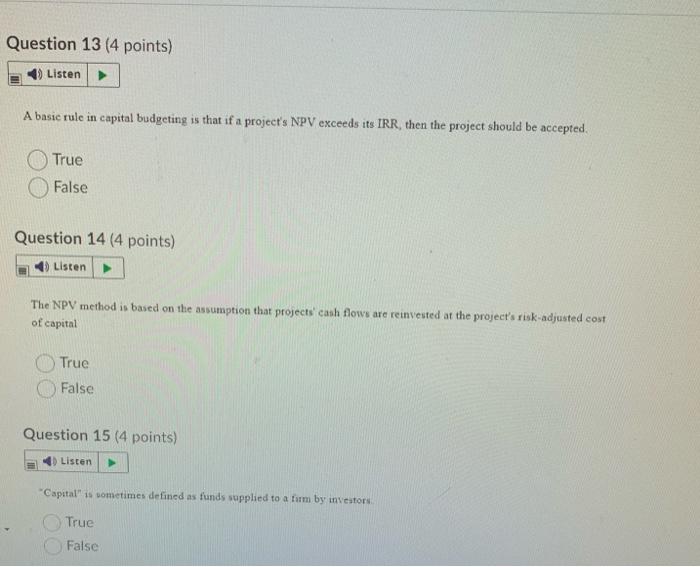
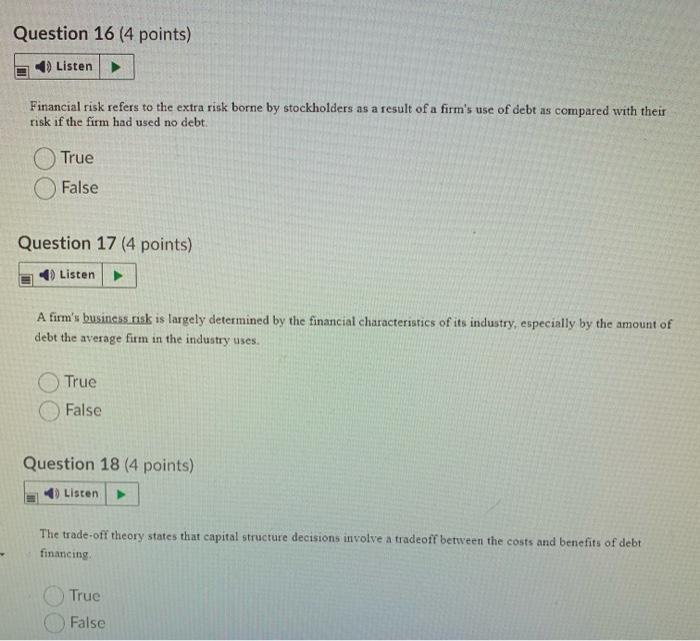
Question 1 (4 points) Listen A zero coupon bond is a bond that pays no interest and is offered (and initially sells) at par. These bonds provide compensation to investors in the form of capital appreciation. True False Question 2 (4 points) Listen If a firm raises capital by selling new bonds, it could be called the issuing firm," and the coupon rate is generally set equal to the required rate on bonds of equal risk. True False Question 3 (4 points) Listen The cost of debt is equal to one minus the marginal tax rate multiplied by the average coupon rate on all outstanding debt True False Question 4 (4 points) Listen Other things held constant, the higher a firm's target payout ratio, the higher its expected growth rate should be True False Question 5 (4 points) Listen If a firm's stockholders are given the preemptive right, then they can call for a meeting to vote to replace the management. Without the preemptive right dissident stockholders must seek a change in management through a proxy fight True False Question 6 (4 points) Listen Variance is a measure of the variability of retums, and since it involves squaring the deviation of each actual return from the expected return, it is always larger than its square root the standard deviation True False Question 7 (4 points) Listen Because of improvements in forecasting techniques, estimating the cash flows associated with a project has become the easiest step in the capital budgeting process. True False Question 8 (4 points) Listen Funds acquired by the firm through retaining earnings have no cost because there are no dividend or interest payments associated with them, and no flotation costs are required to raise them, but capital raised by selling new stock or bonds does have a cost True False Question 9 (4 points) Listen According to the Capital Asset Pricing Model, investors are primarily concemed with portfolio risk, not the risks of individual stocks held in isolation. Thus, the relevant risk of a stock is the stock's contribution to the riskiness of a well-diversified portfolio True False Question 10 (4 points) Listen The corporate valuation model can be used only when a company doesn't pay dividends. True False Question 11 (4 points) 1) Listen The phenomenon called "multiple internal rates of return" arises when two or more mutually exclusive projects that have different lives are being compared True False Question 12 (4 points) Listen Because "present value' refers to the value of cash flows that occur at different points in time, a series of present values of cash flows should not be summed to determine the value of a capital budgeting project. True False Question 13 (4 points) Listen A basic rule in capital budgeting is that if a project's NPV exceeds its IRR, then the project should be accepted. True False Question 14 (4 points) Listen The NPV method is based on the assumption that projects' cash flows are reinvested at the project's risk-adjusted cost of capital True False Question 15 (4 points) Listen "Capital" is sometimes defined as funds supplied to a fum by investors True False Question 16 (4 points) Listen Financial risk refers to the extra risk borne by stockholders as a result of a firm's use of debt as compared with their risk if the firm had used no debt True False Question 17 (4 points) Listen A firm's business risk is largely determined by the financial characteristics of its industry, especially by the amount of debt the average firm in the industry uses. True False Question 18 (4 points) Listen The trade-off theory states that capital structure decisions involve a tradeoff between the costs and benefits of debt financing True False
Step by Step Solution
There are 3 Steps involved in it

Get step-by-step solutions from verified subject matter experts
 Study Help