







Question: Question 1 (5 points) A is an obligation for a receivable, bank receivable, business credit transaction, business payable, business Question 2 ( 3 points) Debits
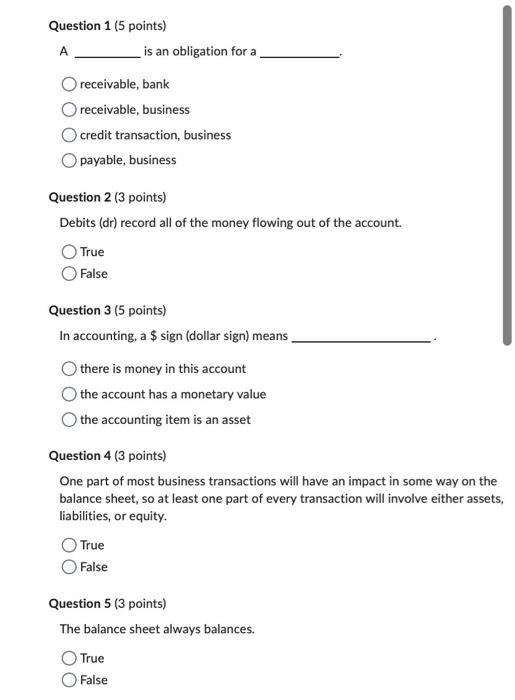
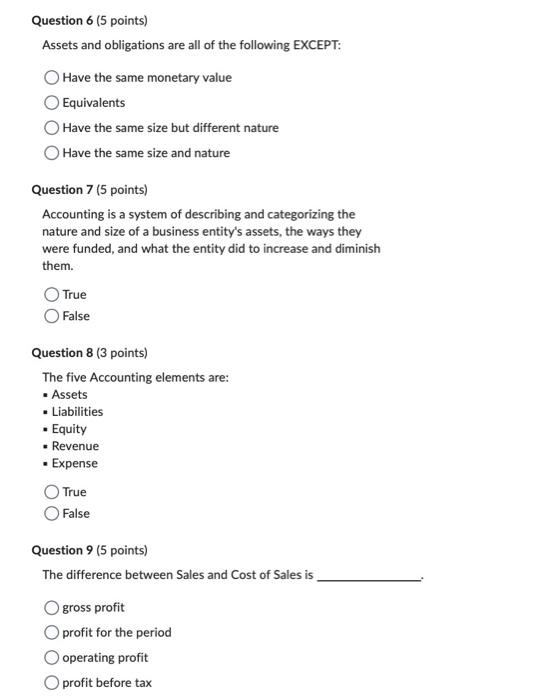

Question 1 (5 points) A is an obligation for a receivable, bank receivable, business credit transaction, business payable, business Question 2 ( 3 points) Debits (dr) record all of the money flowing out of the account. True False Question 3 (5 points) In accounting, a $ sign (dollar sign) means there is money in this account the account has a monetary value the accounting item is an asset Question 4 (3 points) One part of most business transactions will have an impact in some way on the balance sheet, so at least one part of every transaction will involve either assets, liabilities, or equity. True False Question 5 (3 points) The balance sheet always balances. True False Assets and obligations are all of the following EXCEPT: Have the same monetary value Equivalents Have the same size but different nature Have the same size and nature Question 7 (5 points) Accounting is a system of describing and categorizing the nature and size of a business entity's assets, the ways they were funded, and what the entity did to increase and diminish them. True False Question 8 (3 points) The five Accounting elements are: - Assets - Liabilities - Equity - Revenue - Expense True False Question 9 (5 points) The difference between Sales and Cost of Sales is gross profit profit for the period operating profit profit before tax Question 10 (3 points) Obligations are sources of funds. True False
Step by Step Solution
There are 3 Steps involved in it

Get step-by-step solutions from verified subject matter experts
 Study Help