







Question: Question 1. (5 points) If the merging algorithm used in mergesorting is implemented inefficiently and makes N log N comparisons rather than V, then the
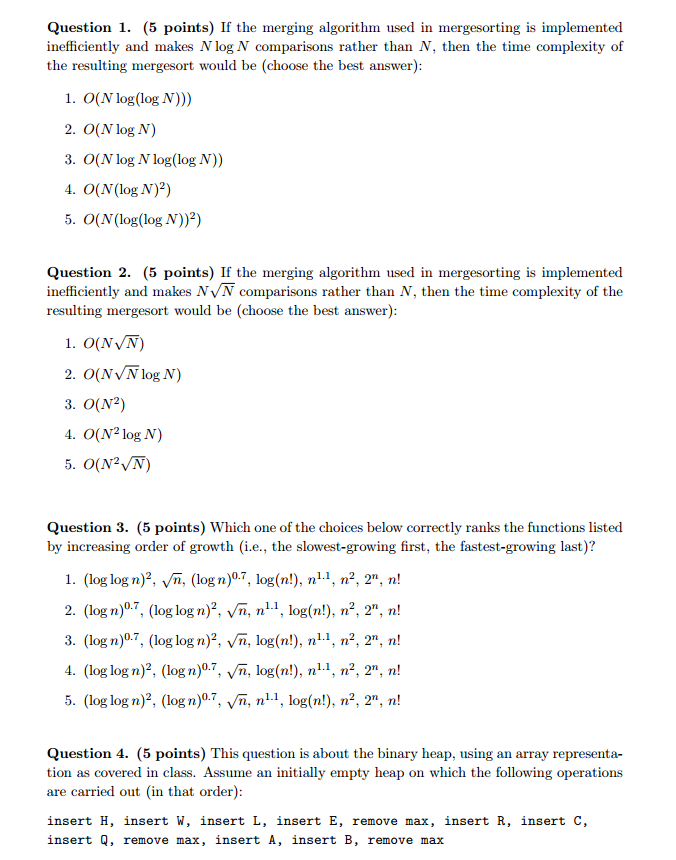
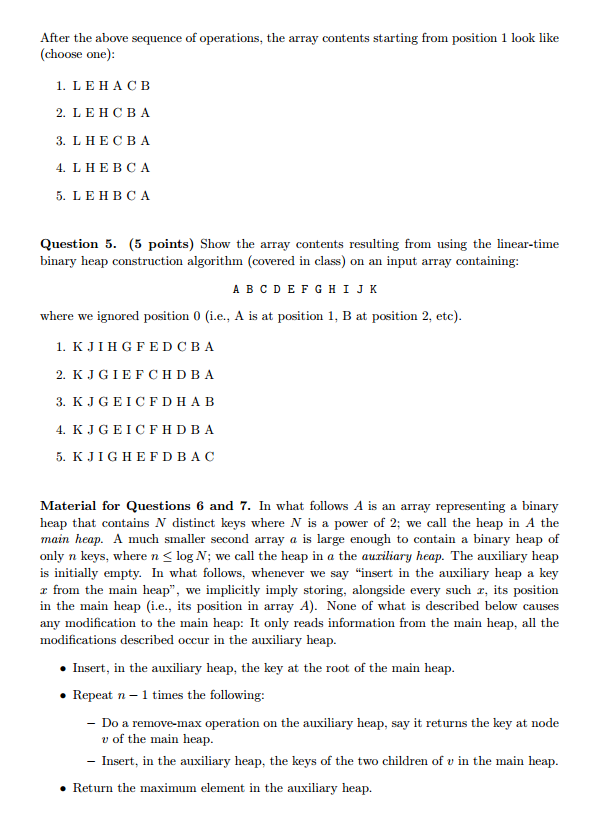
Question 1. (5 points) If the merging algorithm used in mergesorting is implemented inefficiently and makes N log N comparisons rather than V, then the time complexity of the resulting mergesort would be (choose the best answer) 1. O(Nlog(log N))) 2. O(N log N) 3. O(Nlog N log(log N)) 4. O(N(log N)2) 5. O(N(log(log N))2) Question 2. (5 points) If the merging algorithm used in mergesorting is implemented inefficiently and makes NVN comparisons rather than N, then the time complexity of the resulting mergesort would be (choose the best answer) 3. O(N2) 4. O(N2 log N) Question 3. (5 points) Which one of the choices below correctly ranks the functions listed by increasing order of growth (i.e., the slowest-growing first, the fastest-growing last)? I. (log logn)ym (log n)0.7, log(n!), nl.l, n2, 2n, n! 2. (log n)0.7, (log logn)2n, nl.l, log(n!), , 2", n! 3. (log n)0.7, (log log n)2, vT, log(n!), n11, n2, 2", n! 4. (log log n)2, (log n)0.7, Vn, log(n!), ni.l, n2, 2n, n! 5. (log log n)2, (log n)0.7, vT, n11, log(n!), n2, 2", n! Question 4. (5 points) This question is about the binary heap, using an array representa- tion as covered in class. Assume an initially empty heap on which the following operations are carried out (in that order) insert H, insert W, insert L, insert E, remove max, insert R, insert C, insert Q, remove max, insert A, insert B, remove mazx
Step by Step Solution
There are 3 Steps involved in it

Get step-by-step solutions from verified subject matter experts
 Study Help