







Question: Question 1 ) ( 5 pts . ) Here's a scenario: You are asked to choose a sorting algorithm for a set of data, but
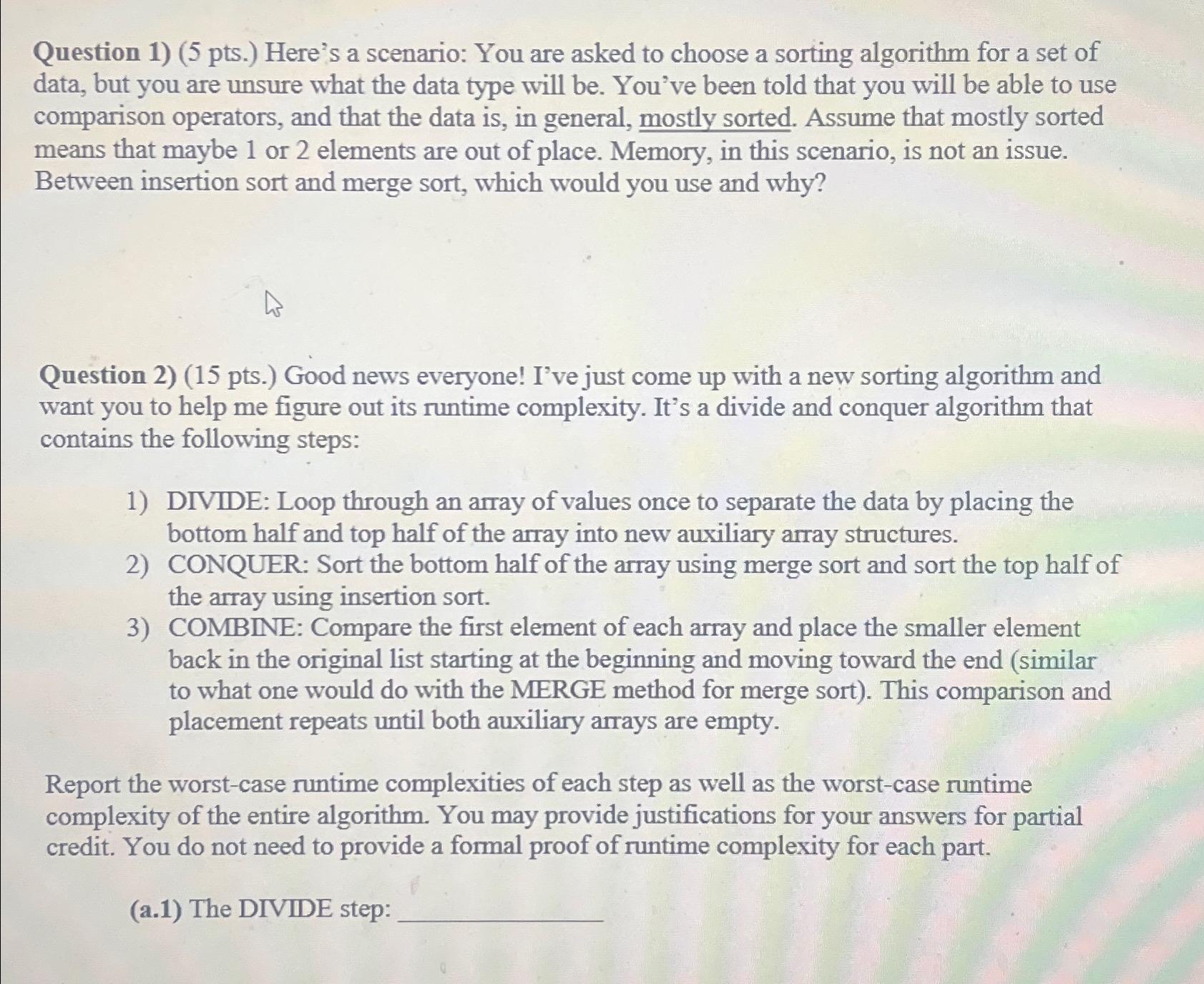
Question pts Here's a scenario: You are asked to choose a sorting algorithm for a set of data, but you are unsure what the data type will be You've been told that you will be able to use comparison operators, and that the data is in general, mostly sorted. Assume that mostly sorted means that maybe or elements are out of place. Memory, in this scenario, is not an issue. Between insertion sort and merge sort, which would you use and why?
Question pts Good news everyone! I've just come up with a new sorting algorithm and want you to help me figure out its runtime complexity. It's a divide and conquer algorithm that contains the following steps:
DIVIDE: Loop through an array of values once to separate the data by placing the bottom half and top half of the array into new auxiliary array structures.
CONQUER: Sort the bottom half of the array using merge sort and sort the top half of the array using insertion sort.
COMBINE: Compare the first element of each array and place the smaller element back in the original list starting at the beginning and moving toward the end similar to what one would do with the MERGE method for merge sort This comparison and placement repeats until both auxiliary arrays are empty.
Report the worstcase runtime complexities of each step as well as the worstcase runtime complexity of the entire algorithm. You may provide justifications for your answers for partial credit. You do not need to provide a formal proof of runtime complexity for each part.
a The DIVIDE step:
Step by Step Solution
There are 3 Steps involved in it
1 Expert Approved Answer
Step: 1 Unlock

Question Has Been Solved by an Expert!
Get step-by-step solutions from verified subject matter experts
Step: 2 Unlock
Step: 3 Unlock
 Study Help