







Question: Question 1 (50 marks + 5 bonus marks): Skip has the following utility function: U(x, y) = x(y1), where x and y are quantities of
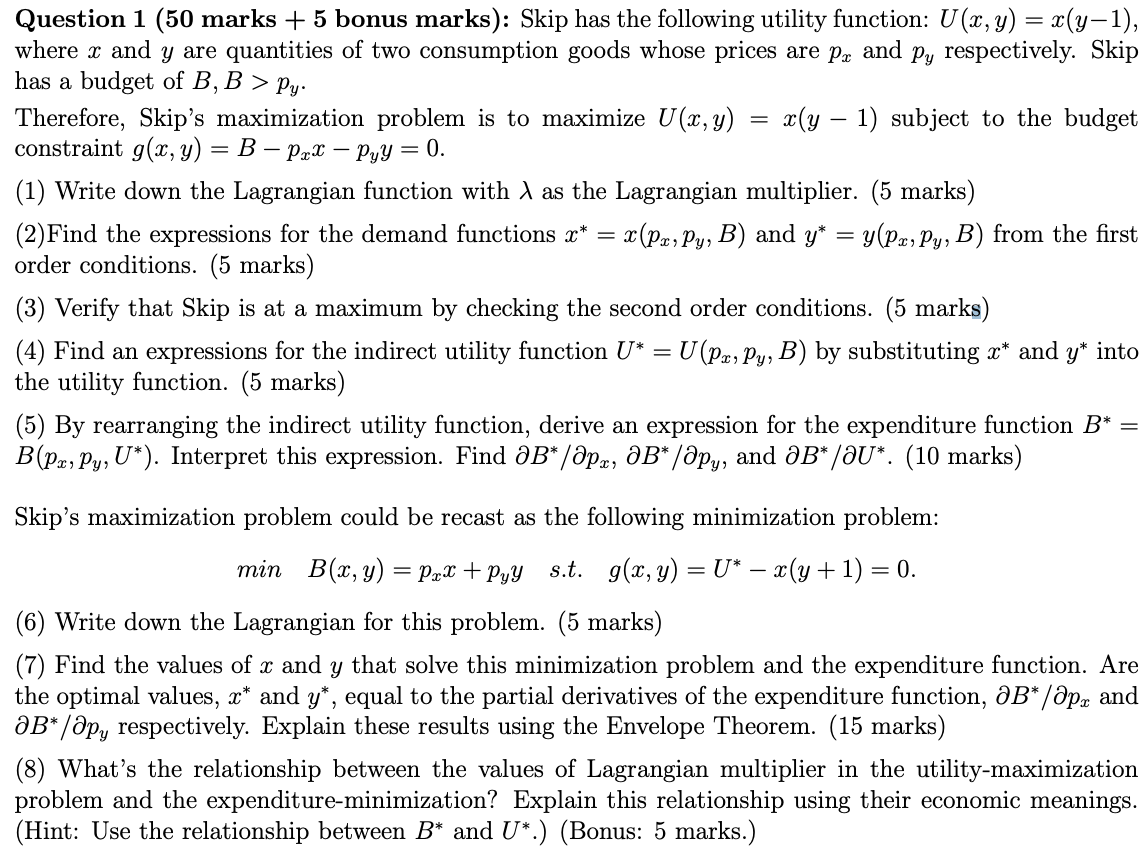
Question 1 (50 marks + 5 bonus marks): Skip has the following utility function: U(x, y) = x(y1), where x and y are quantities of two consumption goods whose prices are px and py respectively. Skip has a budget of B, B > py.
Therefore, Skips maximization problem is to maximize U(x, y) = x(y 1) subject to the budget constraint g(x, y) = B pxx pyy = 0.
(1) Write down the Lagrangian function with as the Lagrangian multiplier. (5 marks)
(2)Find the expressions for the demand functions x = x(px, py, B) and y = y(px, py, B) from the first order conditions. (5 marks)
(3) Verify that Skip is at a maximum by checking the second-order conditions. (5 marks)
(4) Find an expression for the indirect utility function U = U(px, py, B) by substituting x and y into the utility function. (5 marks)
(5) By rearranging the indirect utility function, derive an expression for the expenditure function B = B(px, py, U ). Interpret this expression. Find B/px, B/py, and B/U . (10 marks) Skips maximization problem could be recast as the following minimization problem: min B(x, y) = pxx + pyy s.t. g(x, y) = U x(y + 1) = 0. (6) Write down the Lagrangian for this problem. (5 marks)
(7) Find the values of x and y that solve this minimization problem and the expenditure function. Are the optimal values, x and y , equal to the partial derivatives of the expenditure function, B/px and B/py respectively. Explain these results using the Envelope Theorem. (15 marks)
(8) Whats the relationship between the values of the Lagrangian multiplier in the utility-maximization problem and the expenditure-minimization? Explain this relationship using their economic meanings. (Hint: Use the relationship between B and U .) (Bonus: 5 marks.)
Question 1 (50 marks + 5 bonus marks): Skip has the following utility function: U(x, y) = x(y-1), where x and y are quantities of two consumption goods whose prices are pc and Py respectively. Skip has a budget of B, B > Py. Therefore, Skip's maximization problem is to maximize U(x, y) x(y 1) subject to the budget constraint g(x, y) = B PrX Pyy = 0. (1) Write down the Lagrangian function with as the Lagrangian multiplier. (5 marks) (2)Find the expressions for the demand functions x* = x(Px, Py, B) and y* y(Px, Py, B) from the first order conditions. (5 marks) (3) Verify that Skip is at a maximum by checking the second order conditions. (5 marks) (4) Find an expressions for the indirect utility function U* = U(Pc, Py, B) by substituting x* and y* into the utility function. (5 marks) (5) By rearranging the indirect utility function, derive an expression for the expenditure function B* B(Pc, Py, U*). Interpret this expression. Find 8B* /Opz, OB*/@py, and 8B* /aU*. (10 marks) = = Skip's maximization problem could be recast as the following minimization problem: min B(x, y) = Pxx +Pyy sit. g(x, y) = U* x(y + 1) = 0. (6) Write down the Lagrangian for this problem. (5 marks) (7) Find the values of x and y that solve this minimization problem and the expenditure function. Are the optimal values, x* and y*, equal to the partial derivatives of the expenditure function, B*/Opx and B*/@py respectively. Explain these results using the Envelope Theorem. (15 marks) (8) What's the relationship between the values of Lagrangian multiplier in the utility-maximization problem and the expenditure-minimization? Explain this relationship using their economic meanings. (Hint: Use the relationship between B* and U*.) (Bonus: 5 marks.)
Step by Step Solution
There are 3 Steps involved in it

Get step-by-step solutions from verified subject matter experts
 Study Help