







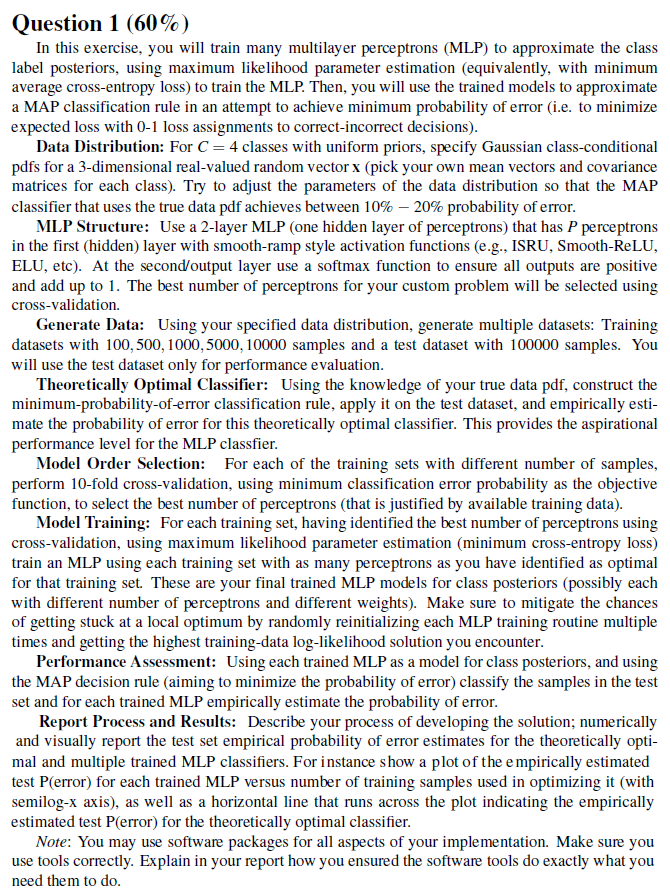
Question: Question 1 ( 6 0 % ) MUST have comprehensive code, thorough maths with explanations. In this exercise, you will train many multilayer perceptrons (
Question MUST have comprehensive code, thorough maths with explanations.
In this exercise, you will train many multilayer perceptrons MLP to approximate the class
label posteriors, using maximum likelihood parameter estimation equivalently with minimum
average crossentropy loss to train the MLP Then, you will use the trained models to approximate
a MAP classification rule in an attempt to achieve minimum probability of error ie to minimize
expected loss with loss assignments to correctincorrect decisions
Data Distribution: For C classes with uniform priors, specify Gaussian classconditional
pdfs for a dimensional realvalued random vector x pick your own mean vectors and covariance
matrices for each class Try to adjust the parameters of the data distribution so that the MAP
classifier that uses the true data pdf achieves between probability of error.
MLP Structure: Use a layer MLP one hidden layer of perceptrons that has P perceptrons
in the first hidden layer with smoothramp style activation functions eg ISRU, SmoothReLU,
ELU, etc At the secondoutput layer use a softmax function to ensure all outputs are positive
and add up to The best number of perceptrons for your custom problem will be selected using
crossvalidation.
Generate Data: Using your specified data distribution, generate multiple datasets: Training
datasets with samples and a test dataset with samples. You
will use the test dataset only for performance evaluation.
Theoretically Optimal Classifier: Using the knowledge of your true data pdf construct the
minimumprobabilityoferror classification rule, apply it on the test dataset, and empirically esti
mate the probability of error for this theoretically optimal classifier. This provides the aspirational
performance level for the MLP classfier.
Model Order Selection: For each of the training sets with different number of samples,
perform fold crossvalidation, using minimum classification error probability as the objective
function, to select the best number of perceptrons that is justified by available training data
Model Training: For each training set, having identified the best number of perceptrons using
crossvalidation, using maximum likelihood parameter estimation minimum crossentropy loss
train an MLP using each training set with as many perceptrons as you have identified as optimal
for that training set. These are your final trained MLP models for class posteriors possibly each
with different number of perceptrons and different weights Make sure to mitigate the chances
of getting stuck at a local optimum by randomly reinitializing each MLP training routine multiple
times and getting the highest trainingdata loglikelihood solution you encounter.
Performance Assessment: Using each trained MLP as a model for class posteriors, and using
the MAP decision rule aiming to minimize the probability of error classify the samples in the test
set and for each trained MLP empirically estimate the probability of error.
Report Process and Results: Describe your process of developing the solution; numerically
and visually report the test set empirical probability of error estimates for the theoretically opti
mal and multiple trained MLP classifiers. For instance show a plot of the e mpirically estimated
test P error for each trained MLP versus number of training samples used in optimizing it with
semilogx axis as well as a horizontal line that runs across the plot indicating the empirically
estimated test P error for the theoretically optimal classifier.
Note: You may use software packages for all aspects of your implementation. Make sure you
use tools correctly. Explain in your report how you ensured the software tools do exactly what you
need them to do
Step by Step Solution
There are 3 Steps involved in it
1 Expert Approved Answer
Step: 1 Unlock

Question Has Been Solved by an Expert!
Get step-by-step solutions from verified subject matter experts
Step: 2 Unlock
Step: 3 Unlock
 Study Help