







Question: Question #1 - 8 Marks Consider a quaternary, normalized floating-point number system that is base 4. Analogous to a bit, a quaternary digit is a
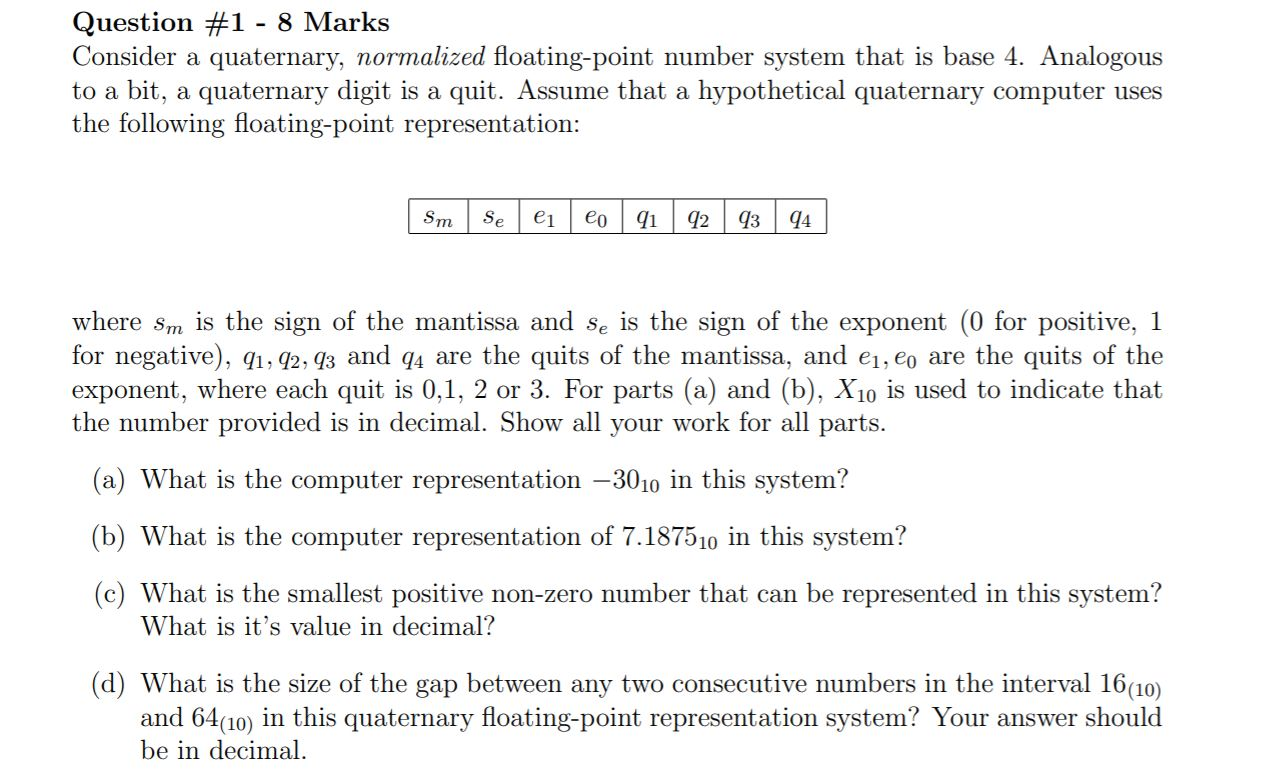
Question #1 - 8 Marks Consider a quaternary, normalized floating-point number system that is base 4. Analogous to a bit, a quaternary digit is a quit. Assume that a hypothetical quaternary computer uses the following floating-point representation: Se Sm e1 eo 91 92 9 94 where sm is the sign of the mantissa and se is the sign of the exponent (0 for positive, 1 for negative), 91, 42, 93 and q4 are the quits of the mantissa, and e1, eo are the quits of the exponent, where each quit is 0,1, 2 or 3. For parts (a) and (b), X10 is used to indicate that the number provided is in decimal. Show all your work for all parts. (a) What is the computer representation -3010 in this system? (b) What is the computer representation of 7.187510 in this system? (c) What is the smallest positive non-zero number that can be represented in this system? What is it's value in decimal? (d) What is the size of the gap between any two consecutive numbers in the interval 16(10) and 64(10) in this quaternary floating-point representation system? Your answer should be in decimal. Question #1 - 8 Marks Consider a quaternary, normalized floating-point number system that is base 4. Analogous to a bit, a quaternary digit is a quit. Assume that a hypothetical quaternary computer uses the following floating-point representation: Se Sm e1 eo 91 92 9 94 where sm is the sign of the mantissa and se is the sign of the exponent (0 for positive, 1 for negative), 91, 42, 93 and q4 are the quits of the mantissa, and e1, eo are the quits of the exponent, where each quit is 0,1, 2 or 3. For parts (a) and (b), X10 is used to indicate that the number provided is in decimal. Show all your work for all parts. (a) What is the computer representation -3010 in this system? (b) What is the computer representation of 7.187510 in this system? (c) What is the smallest positive non-zero number that can be represented in this system? What is it's value in decimal? (d) What is the size of the gap between any two consecutive numbers in the interval 16(10) and 64(10) in this quaternary floating-point representation system? Your answer should be in decimal
Step by Step Solution
There are 3 Steps involved in it

Get step-by-step solutions from verified subject matter experts
 Study Help