







Question: QUESTION 1 A bank makes a 30 year Fully Amortizing FRM for $2,000,000 at an annual interest rate of 4.75% compounded monthly, with monthly payments.
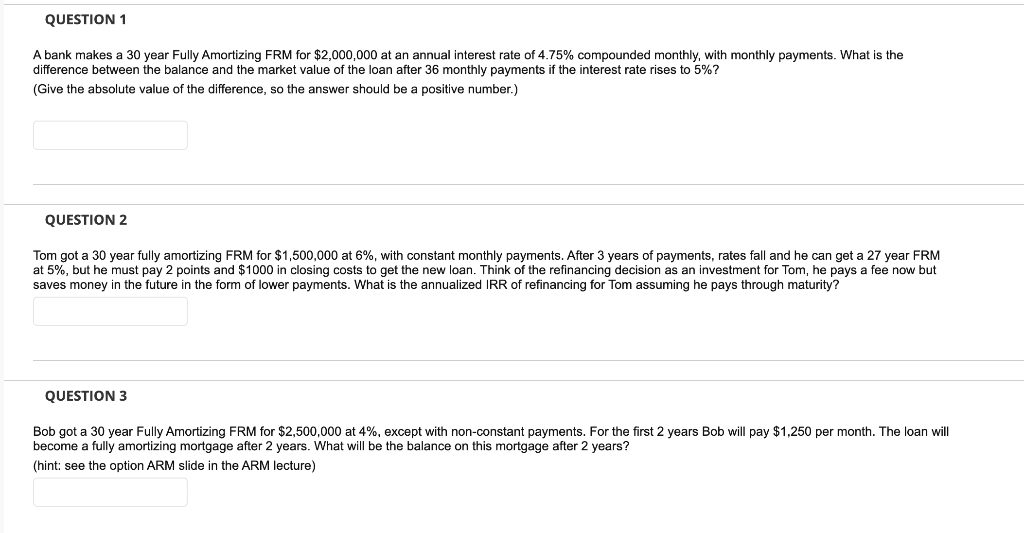
QUESTION 1 A bank makes a 30 year Fully Amortizing FRM for $2,000,000 at an annual interest rate of 4.75% compounded monthly, with monthly payments. What is the difference between the balance and the market value of the loan after 36 monthly payments if the interest rate rises to 5%? (Give the absolute value of the difference, so the answer should be a positive number.) QUESTION 2 Tom got a 30 year fully amortizing FRM for $1,500,000 at 6%, with constant monthly payments. After 3 years of payments, rates fall and he can get a 27 year FRM at 5%, but he must pay 2 points and $1000 in closing costs to get the new loan. Think of the refinancing decision as an investment for Tom, he pays a fee now but saves money in the future in the form of lower payments. What is the annualized IRR of refinancing for Tom assuming he pays through maturity? QUESTION 3 Bob got a 30 year Fully Amortizing FRM for $2,500,000 at 4%, except with non-constant payments. For the first 2 years Bob will pay $1,250 per month. The loan will become a fully amortizing mortgage after 2 years. What will be the balance on this mortgage after 2 years? (hint: see the option ARM slide in the ARM lecture) QUESTION 1 A bank makes a 30 year Fully Amortizing FRM for $2,000,000 at an annual interest rate of 4.75% compounded monthly, with monthly payments. What is the difference between the balance and the market value of the loan after 36 monthly payments if the interest rate rises to 5%? (Give the absolute value of the difference, so the answer should be a positive number.) QUESTION 2 Tom got a 30 year fully amortizing FRM for $1,500,000 at 6%, with constant monthly payments. After 3 years of payments, rates fall and he can get a 27 year FRM at 5%, but he must pay 2 points and $1000 in closing costs to get the new loan. Think of the refinancing decision as an investment for Tom, he pays a fee now but saves money in the future in the form of lower payments. What is the annualized IRR of refinancing for Tom assuming he pays through maturity? QUESTION 3 Bob got a 30 year Fully Amortizing FRM for $2,500,000 at 4%, except with non-constant payments. For the first 2 years Bob will pay $1,250 per month. The loan will become a fully amortizing mortgage after 2 years. What will be the balance on this mortgage after 2 years? (hint: see the option ARM slide in the ARM lecture)
Step by Step Solution
There are 3 Steps involved in it

Get step-by-step solutions from verified subject matter experts
 Study Help