







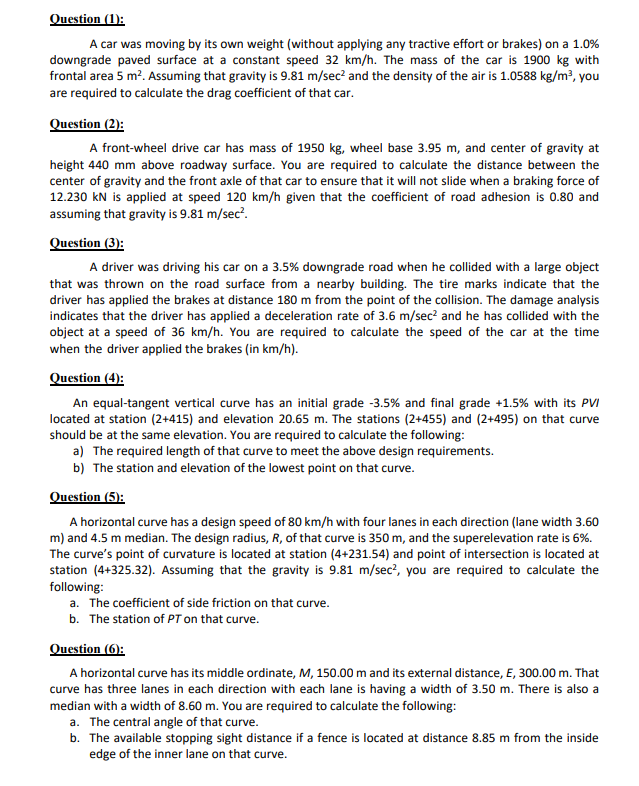
Question: Question ( 1 ) : A car was moving by its own weight ( without applying any tractive effort or brakes ) on a 1
Question :
A car was moving by its own weight without applying any tractive effort or brakes on a downgrade paved surface at a constant speed mathrm~kmmathrmh The mass of the car is kg with frontal area mathrm~m Assuming that gravity is mathrm~mmathrmsec and the density of the air is mathrm~kgmathrmm you are required to calculate the drag coefficient of that car.
Question :
A frontwheel drive car has mass of kg wheel base m and center of gravity at height mm above roadway surface. You are required to calculate the distance between the center of gravity and the front axle of that car to ensure that it will not slide when a braking force of kN is applied at speed mathrm~kmmathrmh given that the coefficient of road adhesion is and assuming that gravity is mathrm~mmathrmsec
Question :
A driver was driving his car on a downgrade road when he collided with a large object that was thrown on the road surface from a nearby building. The tire marks indicate that the driver has applied the brakes at distance m from the point of the collision. The damage analysis indicates that the driver has applied a deceleration rate of mathrm~mmathrmsec and he has collided with the object at a speed of mathrm~kmmathrmh You are required to calculate the speed of the car at the time when the driver applied the brakes in kmh
Question :
An equaltangent vertical curve has an initial grade and final grade with its PVI located at station and elevation m The stations and on that curve should be at the same elevation. You are required to calculate the following:
a The required length of that curve to meet the above design requirements.
b The station and elevation of the lowest point on that curve.
Question :
A horizontal curve has a design speed of mathrm~kmmathrmh with four lanes in each direction lane width m and m median. The design radius, R of that curve is m and the superelevation rate is The curve's point of curvature is located at station and point of intersection is located at station Assuming that the gravity is mathrm~mmathrmsec you are required to calculate the following:
a The coefficient of side friction on that curve.
b The station of P T on that curve.
Question :
A horizontal curve has its middle ordinate, Mmathrm~m and its external distance, Emathrm~m That curve has three lanes in each direction with each lane is having a width of m There is also a median with a width of m You are required to calculate the following:
a The central angle of that curve.
b The available stopping sight distance if a fence is located at distance m from the inside edge of the inner lane on that curve.
Step by Step Solution
There are 3 Steps involved in it
1 Expert Approved Answer
Step: 1 Unlock

Question Has Been Solved by an Expert!
Get step-by-step solutions from verified subject matter experts
Step: 2 Unlock
Step: 3 Unlock
 Study Help