



Question: Question 1: a) Consider a subroutine Line (xlist, ylist, n, slope, intercept) that accepts two list pointers and three values. The subroutine assumes that n
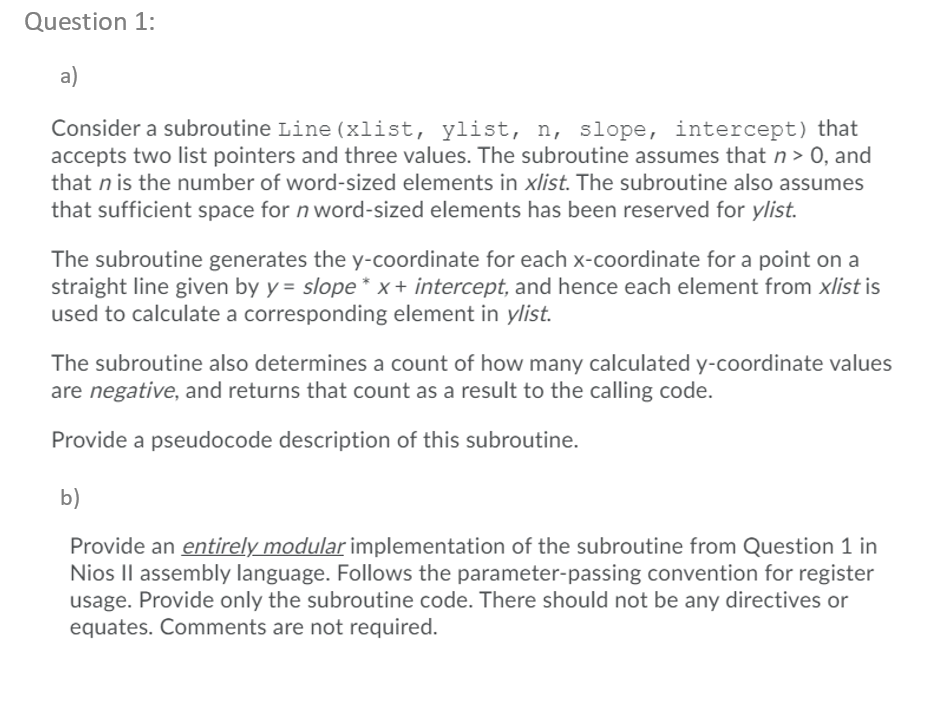
Question 1: a) Consider a subroutine Line (xlist, ylist, n, slope, intercept) that accepts two list pointers and three values. The subroutine assumes that n > 0, and that n is the number of word-sized elements in xlist. The subroutine also assumes that sufficient space for n word-sized elements has been reserved for ylist. The subroutine generates the y-coordinate for each x-coordinate for a point on a straight line given by y = slope * x + intercept, and hence each element from xlist is used to calculate a corresponding element in ylist. The subroutine also determines a count of how many calculated y-coordinate values are negative, and returns that count as a result to the calling code. Provide a pseudocode description of this subroutine. b) Provide an entirely modular implementation of the subroutine from Question 1 in Nios II assembly language. Follows the parameter-passing convention for register usage. Provide only the subroutine code. There should not be any directives or equates. Comments are not required. Question 1: a) Consider a subroutine Line (xlist, ylist, n, slope, intercept) that accepts two list pointers and three values. The subroutine assumes that n > 0, and that n is the number of word-sized elements in xlist. The subroutine also assumes that sufficient space for n word-sized elements has been reserved for ylist. The subroutine generates the y-coordinate for each x-coordinate for a point on a straight line given by y = slope * x + intercept, and hence each element from xlist is used to calculate a corresponding element in ylist. The subroutine also determines a count of how many calculated y-coordinate values are negative, and returns that count as a result to the calling code. Provide a pseudocode description of this subroutine. b) Provide an entirely modular implementation of the subroutine from Question 1 in Nios II assembly language. Follows the parameter-passing convention for register usage. Provide only the subroutine code. There should not be any directives or equates. Comments are not required
Step by Step Solution
There are 3 Steps involved in it

Get step-by-step solutions from verified subject matter experts