







Question: Question 1. a. Declare a 32-bit signed integer variable and initialize it with the smallestpossible negative decimal value. b. Declare an uninitialized array of 100
Question 1.
a. Declare a 32-bit signed integer variable and initialize it with the smallestpossible negative decimal value.
b. Declare an uninitialized array of 100 16-bit unsigned integers.
c. Declare a string variable containing the word DVCrepeated 20 times, and terminated with the null char.
Program:
TITLE Add and Subtract (AddSum.asm)
;This program adds and subtracts 32-bit integers
; Caterina Pentcheva
INCLUDE Irvine32.inc
.code
main PROC
mov eax, 10000h ; EAX = 10000h
add eax, 40000h ; EAX = 50000h
sub
eax, 20000h ; EAX = 30000h
call DumpRegs ; display registers
exit
main ENDP
END main
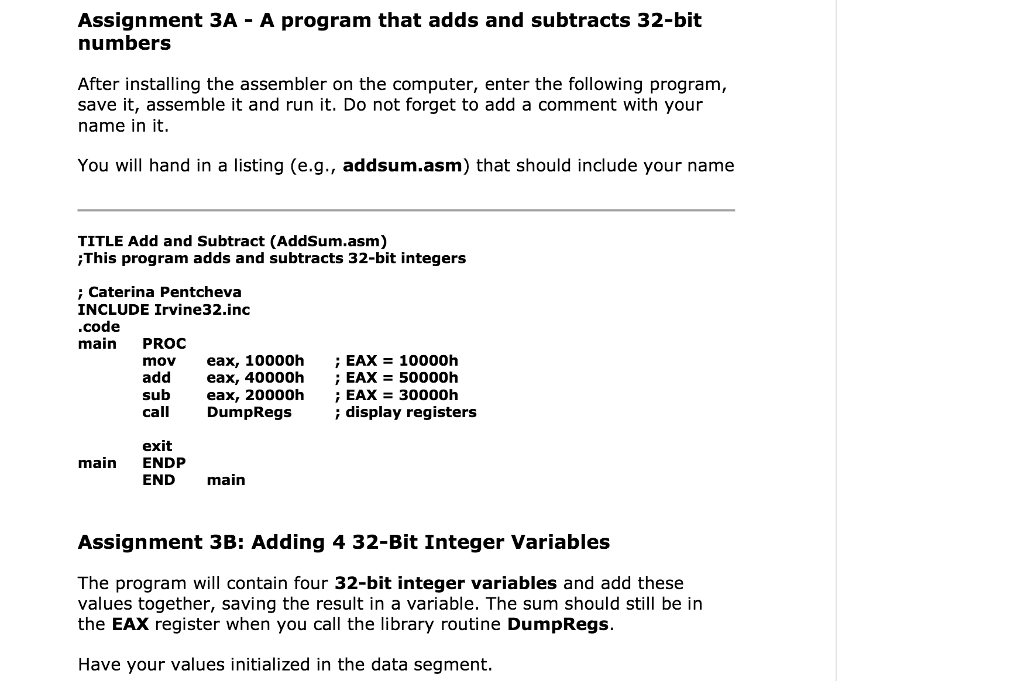
Assignment 3A - A program that adds and subtracts 32-bit numbers After installing the assembler on the computer, enter the following program, save it, assemble it and run it. Do not forget to add a comment with your name in it You will hand in a listing (e.g., addsum.asm) that should include your name TITLE Add and Subtract (AddSum.asm) This program adds and subtracts 32-bit integers Caterina Pentcheva INCLUDE Irvine32.inc code main PROC eax, 10000h 40000h ; EAX=10000h ; EAX=50000h eax, 20000h EA30000h mov add eax, call exit END main DumpRegs display registers main ENDP Assignment 3B: Adding 4 32-Bit Integer Variables The program will contain four 32-bit integer variables and add these values together, saving the result in a variable. The sum should still be in the EAX register when you call the library routine DumpRegs Have your values initialized in the data segment
Step by Step Solution
There are 3 Steps involved in it

Get step-by-step solutions from verified subject matter experts
 Study Help