







Question: QUESTION 1 (a) Explain how distributed hash tables work. Detail an example containing 16 nodes. Be sure to create finger tables for at least 2
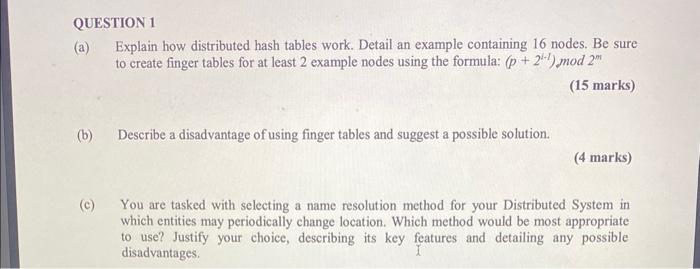
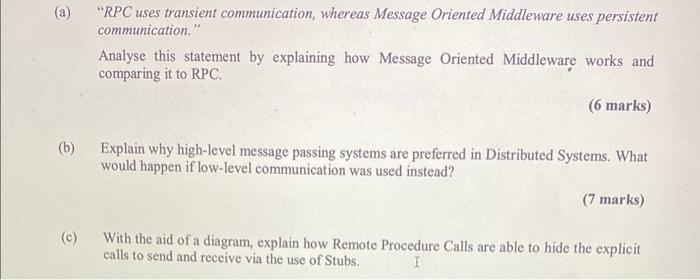
QUESTION 1 (a) Explain how distributed hash tables work. Detail an example containing 16 nodes. Be sure to create finger tables for at least 2 example nodes using the formula: (p+211)mod2m (15 marks) (b) Describe a disadvantage of using finger tables and suggest a possible solution. (4 marks) (c) You are tasked with selecting a name resolution method for your Distributed System in which entities may periodically change location. Which method would be most appropriate to use? Justify your choice, describing its key features and detailing any possible disadvantages. (a) "RPC uses transient communication, whereas Message Oriented Middleware uses persistent communication." Analyse this statement by explaining how Message Oriented Middleware works and comparing it to RPC. (6 marks) (b) Explain why high-level message passing systems are preferred in Distributed Systems. What would happen if low-level communication was used instead? (7 marks) (c) With the aid of a diagram, explain how Remote Procedure Calls are able to hide the explicit calls to send and receive via the use of Stubs
Step by Step Solution
There are 3 Steps involved in it

Get step-by-step solutions from verified subject matter experts
 Study Help