







Question: Question 1): a) If X, is driven by a geometric Brownian motion, what is the probability distribution of In(X.)? What is the expected value of
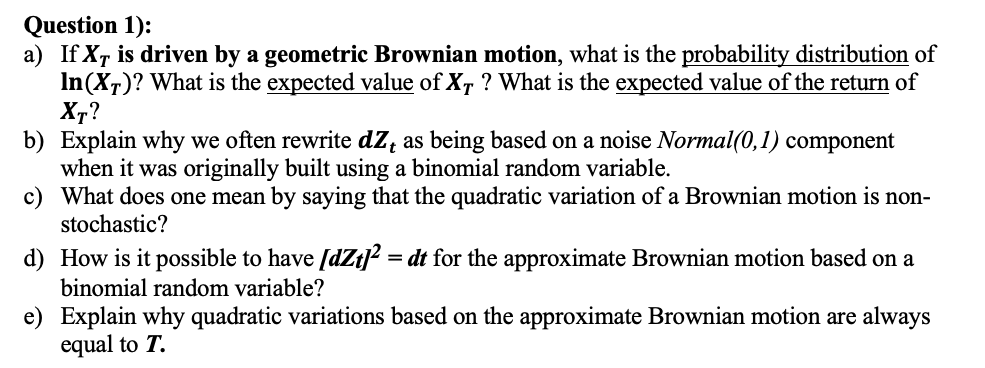
Question 1): a) If X, is driven by a geometric Brownian motion, what is the probability distribution of In(X.)? What is the expected value of X, ? What is the expected value of the return of X,? b) Explain why we often rewrite dZ as being based on a noise Normal(0,1) component when it was originally built using a binomial random variable. c) What does one mean by saying that the quadratic variation of a Brownian motion is non- stochastic? d) How is it possible to have [dZ+]2 = dt for the approximate Brownian motion based on a binomial random variable? e) Explain why quadratic variations based on the approximate Brownian motion are always equal to T. == Question 1): a) If X, is driven by a geometric Brownian motion, what is the probability distribution of In(X.)? What is the expected value of X, ? What is the expected value of the return of X,? b) Explain why we often rewrite dZ as being based on a noise Normal(0,1) component when it was originally built using a binomial random variable. c) What does one mean by saying that the quadratic variation of a Brownian motion is non- stochastic? d) How is it possible to have [dZ+]2 = dt for the approximate Brownian motion based on a binomial random variable? e) Explain why quadratic variations based on the approximate Brownian motion are always equal to T. ==
Step by Step Solution
There are 3 Steps involved in it

Get step-by-step solutions from verified subject matter experts
 Study Help