







Question: question #1 A production plant has two complex fabricating systems, both of which are maintained at 2-week intervals. However, one system is twice as old
question #1
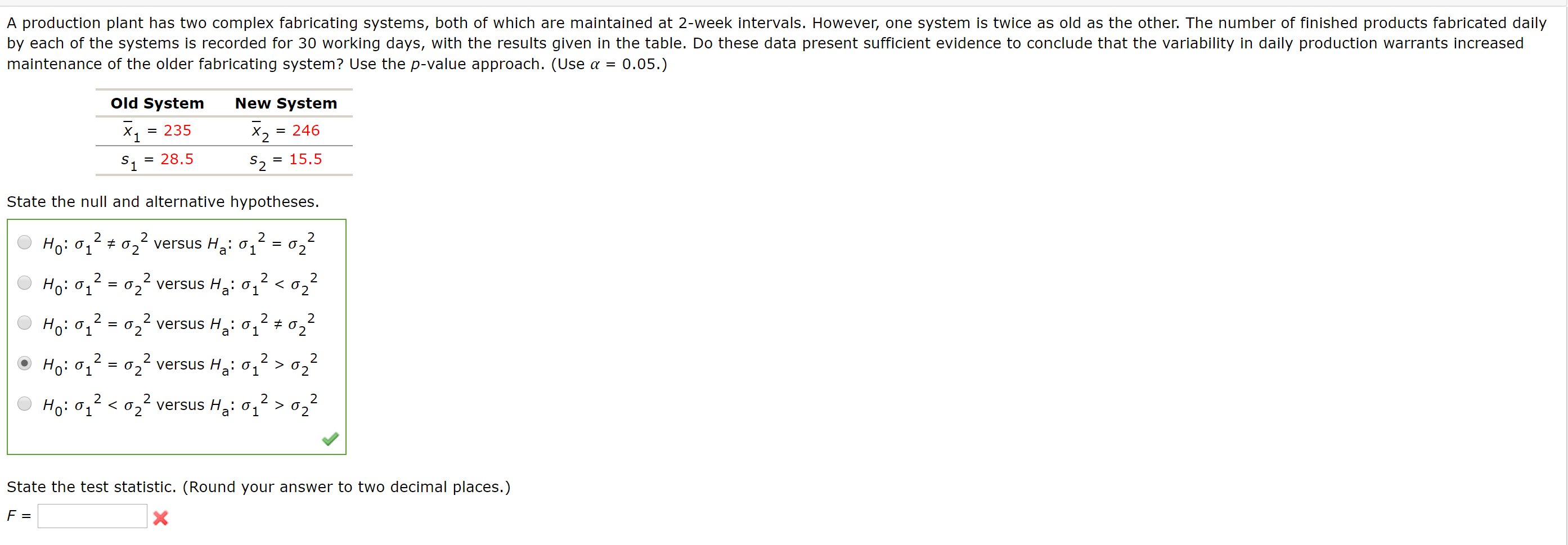
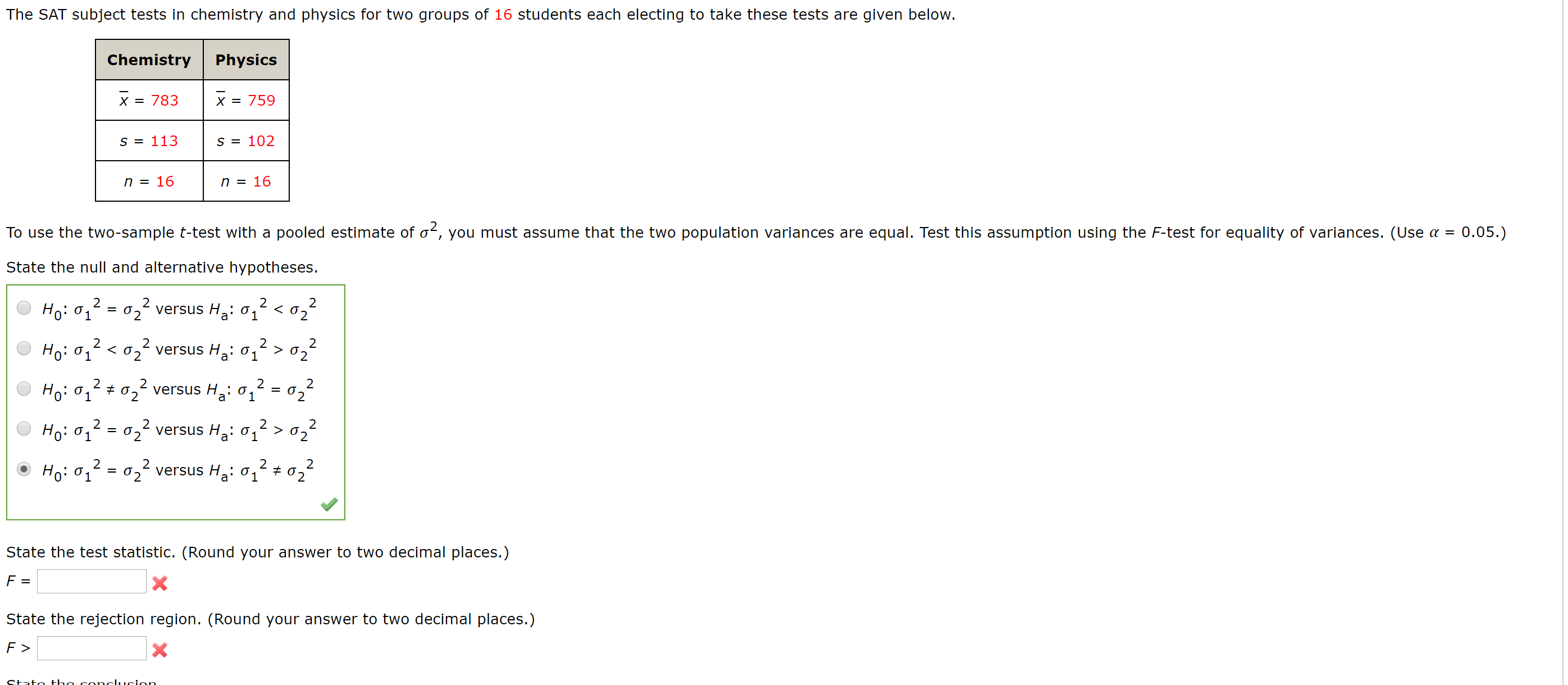
A production plant has two complex fabricating systems, both of which are maintained at 2-week intervals. However, one system is twice as old as the other. The number of finished products fabricated daily by each of the systems is recorded for 30 working days, with the results given in the table. Do these data present sufficient evidence to conclude that the variability in daily production warrants increased maintenance of the older fabricating system? Use the p-value approach. (Use a = 0.05.) Old System New System X1 = 235 * 2 = 246 S1 = 28.5 S, = 15.5 State the null and alternative hypotheses. Ho: 012 # 022 versus Ha: 012 = 022 O Ho: 012 = 022 versus Ha: 012 2 O Ho: 012 02 State the test statistic. (Round your answer to two decimal places.) F = XThe SAT subject tests In chemistry and physics for two groups of 16 students each electing to take these tests are given below. To use the two-sample t-test with a pooled estimate of 02, you must assume that the two populatlon variances are equal. Test this assumption using the Ftest for equality of variances. (Use a = 0.05.) State the null and alternative hypotheses. / . 2 _ 2 0 Ho. 01 '72 versus Ha C . 2 2 HO' 0'1 02 . 2 .111 >172 . 2 .0'1 #02 2 2 J State the test statistic. (Round your answer to two decimal places.) F=x State the rejection region. (Round your answer to two decimal places.) F> x cm. H... \"mam-um
Step by Step Solution
There are 3 Steps involved in it

Get step-by-step solutions from verified subject matter experts
 Study Help