



Question: Question # 1 A residential development is proposed in the eastern part of New Territories, Hong Kong. The development consists of 5 tower buildings, each
Question #
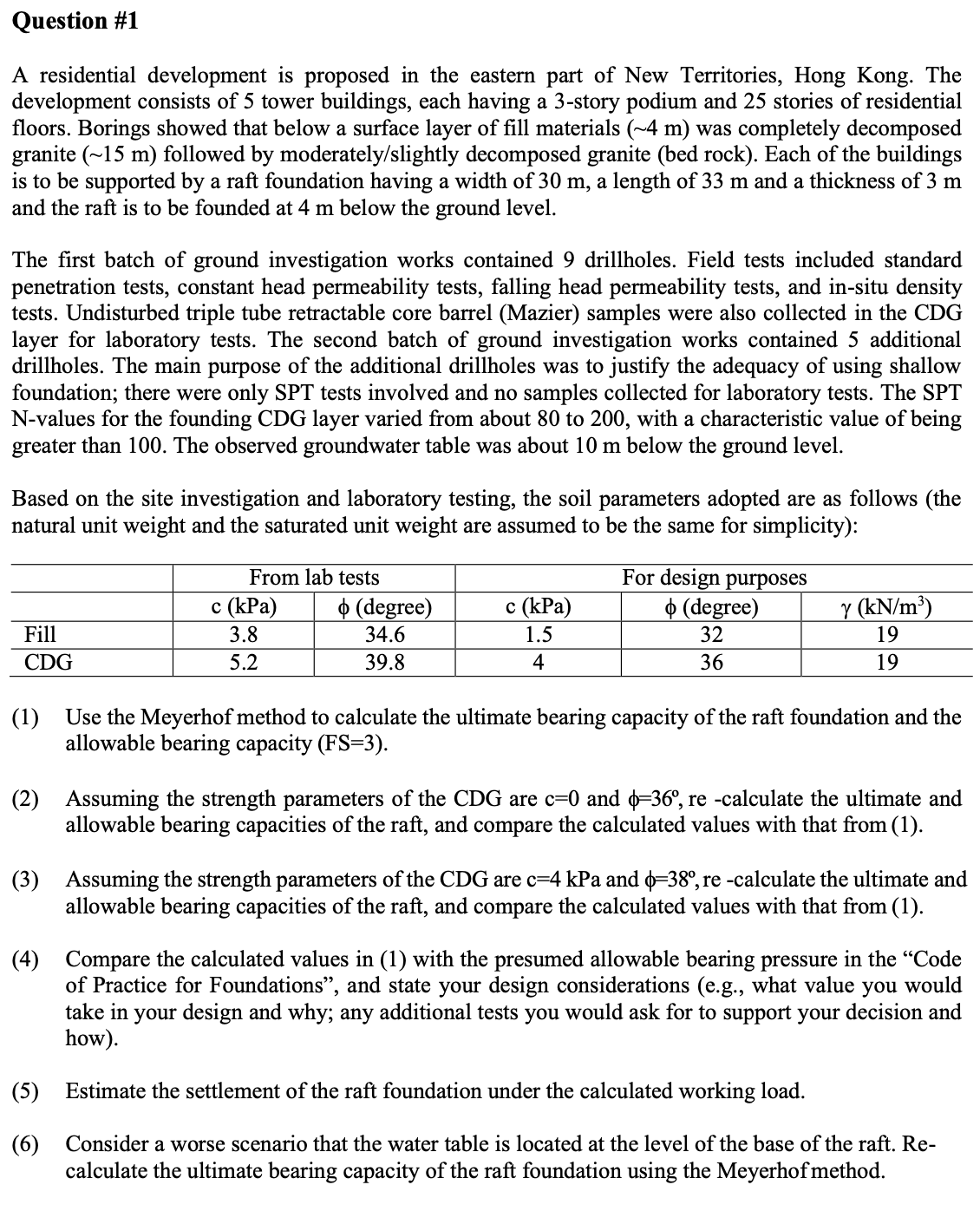
A residential development is proposed in the eastern part of New Territories, Hong Kong. The development consists of tower buildings, each having a story podium and stories of residential floors. Borings showed that below a surface layer of fill materials m was completely decomposed granite followed by moderatelyslightly decomposed granite bed rock Each of the buildings is to be supported by a raft foundation having a width of a length of and a thickness of
and the raft is to be founded at below the ground level.
The first batch of ground investigation works contained drillholes. Field tests included standard penetration tests, constant head permeability tests, falling head permeability tests, and insitu density tests. Undisturbed triple tube retractable core barrel Mazier samples were also collected in the CDG layer for laboratory tests. The second batch of ground investigation works contained additional drillholes. The main purpose of the additional drillholes was to justify the adequacy of using shallow
foundation; there were only SPT tests involved and no samples collected for laboratory tests. The SPT values for the founding CDG layer varied from about to with a characteristic value of being greater than The observed groundwater table was about below the ground level.
Based on the site investigation and laboratory testing, the soil parameters adopted are as follows the natural unit weight and the saturated unit weight are assumed to be the same for simplicity:
Use the Meyerhof method to calculate the ultimate bearing capacity of the raft foundation and the allowable bearing capacity
Assuming the strength parameters of the are and re calculate the ultimate and allowable bearing capacities of the raft, and compare the calculated values with that from
Assuming the strength parameters of the are kPa and re calculate the ultimate and
allowable bearing capacities of the raft, and compare the calculated values with that from
Compare the calculated values in with the presumed allowable bearing pressure in the "Code of Practice for Foundations", and state your design considerations eg what value you would take in your design and why; any additional tests you would ask for to support your decision and how
Estimate the settlement of the raft foundation under the calculated working load.
Consider a worse scenario that the water table is located at the level of the base of the raft. Recalculate the ultimate bearing capacity of the raft foundation using the Meyerhof method.
Step by Step Solution
There are 3 Steps involved in it
1 Expert Approved Answer
Step: 1 Unlock

Question Has Been Solved by an Expert!
Get step-by-step solutions from verified subject matter experts
Step: 2 Unlock
Step: 3 Unlock