







Question: Question #1: A. Sometimes B. Never C. Always modified internal rate of return (MIRR) required rate of return internal rate of return (IRR) modified internal
 Question #1:
A. Sometimes
B. Never
C. Always
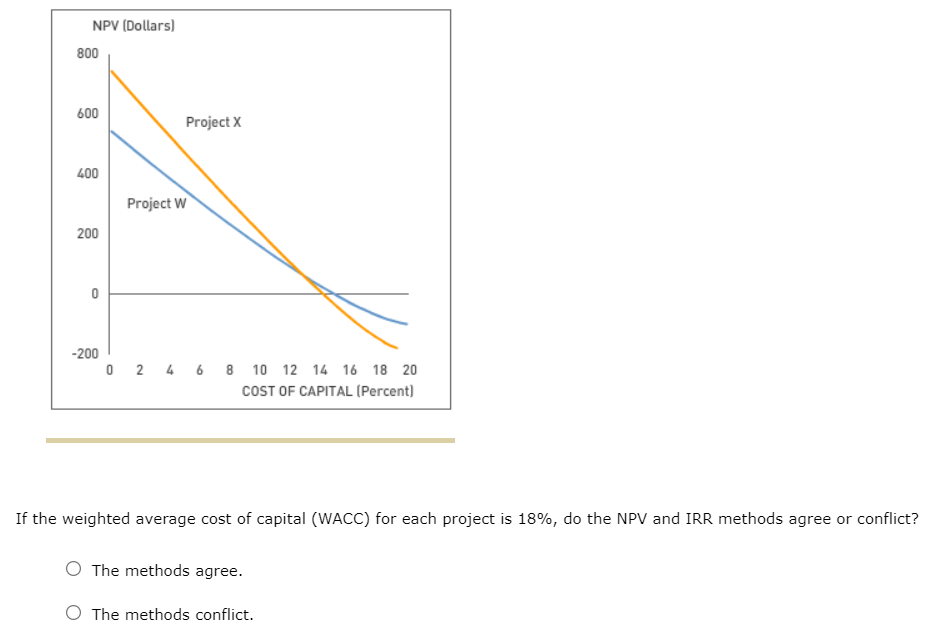




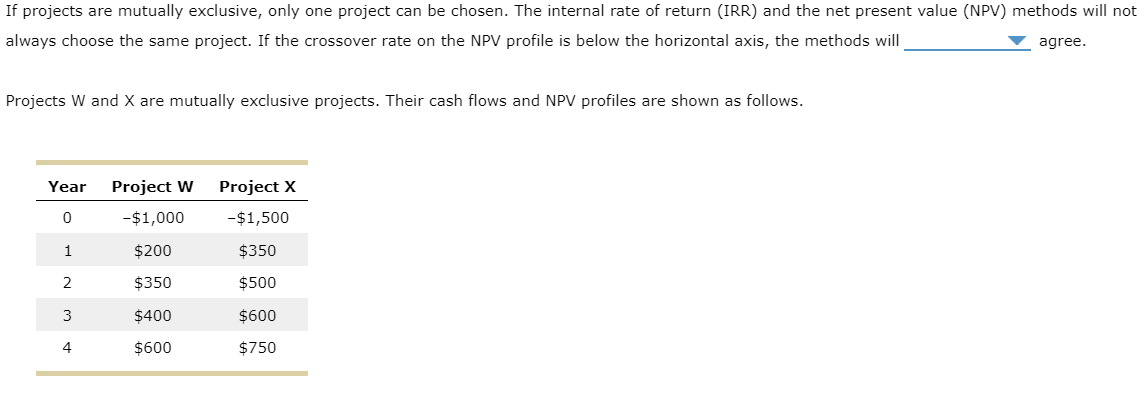
modified internal rate of return (MIRR) required rate of return internal rate of return (IRR) modified internal rate of return (MIRR) required rate of return internal rate of return (IRR) A key to resolving this conflict is the assumed reinvestment rate. The IRR calculation assumes that intermediate cash flows are reinvested at the , and the NPV calculation implicitly assumes that the rate at which cash flows can be reinvested is tr As a result, when evaluating mutually exclusive projects, the is usually the better decision criterion. NPV method IRR method If projects are mutually exclusive, only one project can be chosen. The internal rate of return (IRR) and the net present value (NPV) methods will not always choose the same project. If the crossover rate on the NPV profile is below the horizontal axis, the methods will agree. Projects W and X are mutually exclusive projects. Their cash flows and NPV profiles are shown as follows. modified internal rate of return (MIRR) required rate of return internal rate of return (IRR) If the weighted average cost of capital (WACC) for each project is 18%, do the NPV and IRR methods agree or conflict? The methods agree. The methods conflict
Step by Step Solution
There are 3 Steps involved in it

Get step-by-step solutions from verified subject matter experts
 Study Help