







Question: Question 1. A summer camp that offers 1 -week programs faces the challenges of long queues as parents try to check in their children each
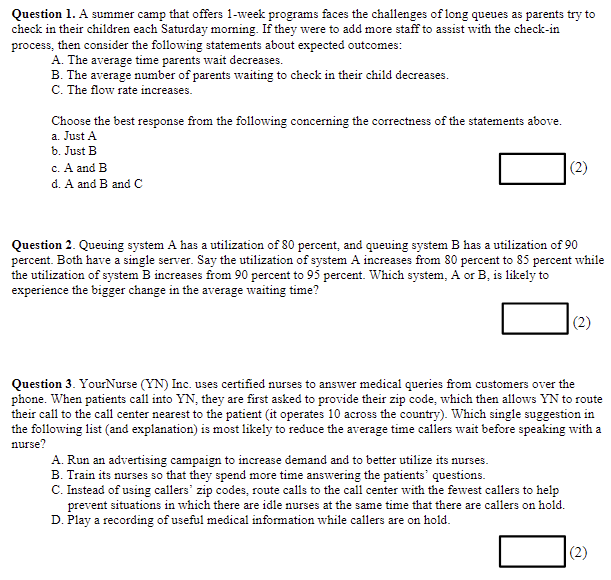
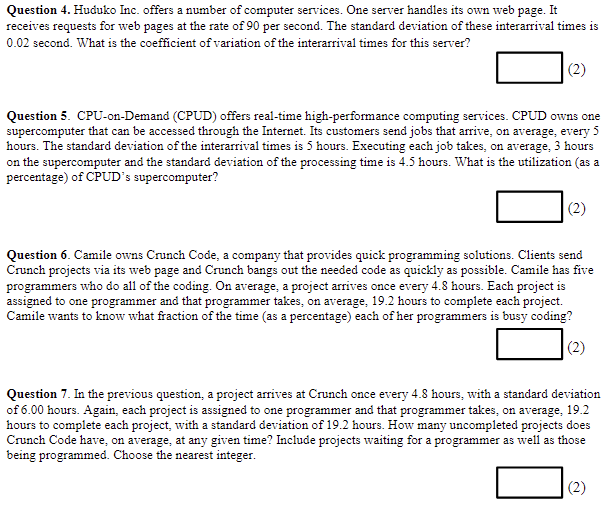
Question 1. A summer camp that offers 1 -week programs faces the challenges of long queues as parents try to check in their children each Saturday morning. If they were to add more staff to assist with the check-in process, then consider the following statements about expected outcomes: A. The average time parents wait decreases. B. The average number of parents waiting to check in their child decreases. C. The flow rate increases. Choose the best response from the following concerning the correctness of the statements above. a. Just A b. Just B c. A and B (2) d. A and B and C Question 2. Queuing system A has a utilization of 80 percent, and queuing system B has a utilization of 90 percent. Both have a single server. Say the utilization of system A increases from 80 percent to 85 percent while the utilization of system B increases from 90 percent to 95 percent. Which system, A or B, is likely to experience the bigger change in the average waiting time? Question 3. YourNurse (YN) Inc. uses certified nurses to answer medical queries from customers over the phone. When patients call into YN, they are first asked to provide their zip code, which then allows YN to route their call to the call center nearest to the patient (it operates 10 across the country). Which single suggestion in the following list (and explanation) is most likely to reduce the average time callers wait before speaking with a nurse? A. Run an advertising campaign to increase demand and to better utilize its nurses. B. Train its nurses so that they spend more time answering the patients' questions. C. Instead of using callers' zip codes, route calls to the call center with the fewest callers to help prevent situations in which there are idle nurses at the same time that there are callers on hold. D. Play a recording of useful medical information while callers are on hold. Question 4. Huduko Inc. offers a number of computer services. One server handles its own web page. It receives requests for web pages at the rate of 90 per second. The standard deviation of these interarrival times is 0.02 second. What is the coefficient of variation of the interarrival times for this server? Question 5. CPU-on-Demand (CPUD) offers real-time high-performance computing services. CPUD owns one supercomputer that can be accessed through the Internet. Its customers send jobs that arrive, on average, every 5 hours. The standard deviation of the interarrival times is 5 hours. Executing each job takes, on average, 3 hours on the supercomputer and the standard deviation of the processing time is 4.5 hours. What is the utilization (as a percentage) of CPUD's supercomputer? Question 6. Camile owns Crunch Code, a company that provides quick programming solutions. Clients send Crunch projects via its web page and Crunch bangs out the needed code as quickly as possible. Camile has five programmers who do all of the coding. On average, a project arrives once every 4.8 hours. Each project is assigned to one programmer and that programmer takes, on average, 19.2 hours to complete each project. Camile wants to know what fraction of the time (as a percentage) each of her programmers is busy coding? (2) Question 7. In the previous question, a project arrives at Crunch once every 4.8 hours, with a standard deviation of 6.00 hours. Again, each project is assigned to one programmer and that programmer takes, on average, 19.2 hours to complete each project, with a standard deviation of 19.2 hours. How many uncompleted projects does Crunch Code have, on average, at any given time? Include projects waiting for a programmer as well as those being programmed. Choose the nearest integer. (2)
Step by Step Solution
There are 3 Steps involved in it

Get step-by-step solutions from verified subject matter experts
 Study Help