





Question: Question 1 - An Alternative Inventory Model A store that stocks a particular laptop model instead of following a (s, S) ordering policy uses a
Question 1 - An Alternative Inventory Model A
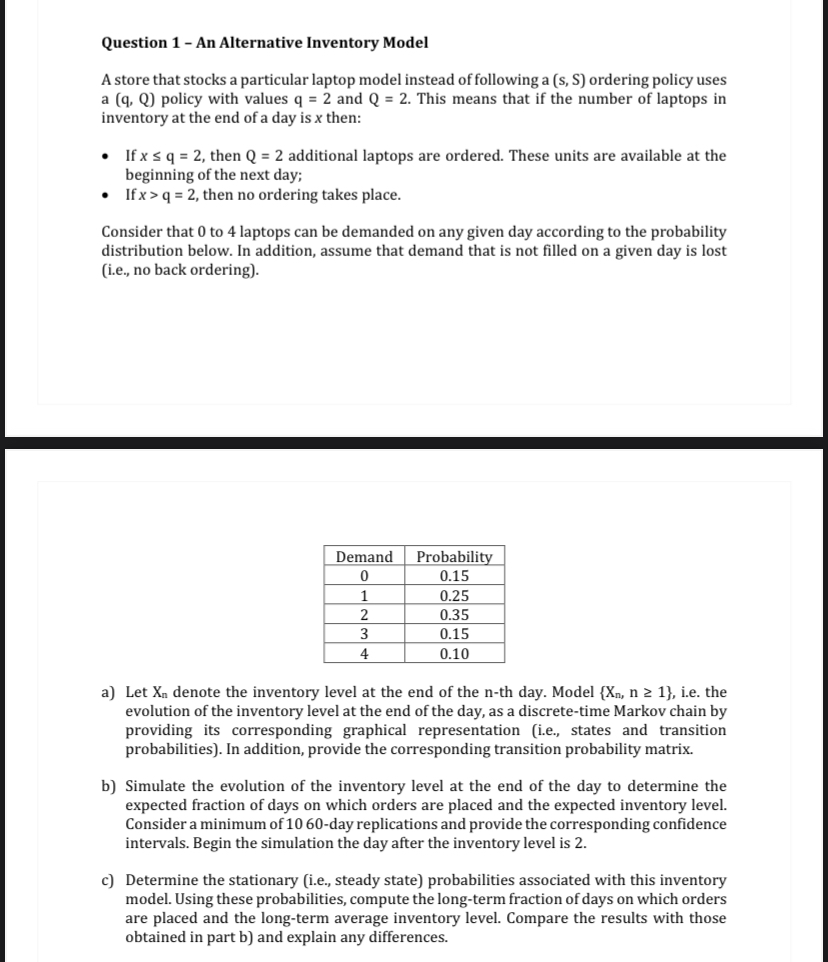
Question 1 - An Alternative Inventory Model A store that stocks a particular laptop model instead of following a (s, S) ordering policy uses a (g, Q) policy with values g = 2 and Q = 2. This means that if the number of laptops in inventory at the end of a day is x then: Ifx=q=2, then Q = 2 additional laptops are ordered. These units are available at the beginning of the next day; = Ifx>q=2,then no ordering takes place. Consider that 0 to 4 laptops can be demanded on any given day according to the probability distribution below. In addition, assume that demand that is not filled on a given day is lost (i.e., no back ordering). ._Demand | Probability 0 0.15 1 0.25 2 0.35 3 0.15 i 0.10 a) Let Xn denote the inventory level at the end of the n-th day. Model {Xn, n = 1}, i.e. the evolution of the inventory level at the end of the day, as a discrete-time Markov chain by providing its corresponding graphical representation (i.e, states and transition probabilities). In addition, provide the corresponding transition probability matrix. b) Simulate the evolution of the inventory level at the end of the day to determine the expected fraction of days on which orders are placed and the expected inventory level. Consider a minimum of 10 60-day replications and provide the corresponding confidence intervals. Begin the simulation the day after the inventory level is 2. ) Determine the stationary (i.e., steady state) probabilities associated with this inventory model. Using these probabilities, compute the long-term fraction of days on which orders are placed and the long-term average inventory level. Compare the results with those obtained in part b) and explain any differences

Step by Step Solution

There are 3 Steps involved in it

1 Expert Approved Answer
Step: 1 Unlock blur-text-image

Question Has Been Solved by an Expert!

Get step-by-step solutions from verified subject matter experts

Step: 2 Unlock
Step: 3 Unlock

Students Have Also Explored These Related Mathematics Questions!