







Question: Question 1: An article in Quality Engineering described an experiment to minimize variations in blood glucose levels. The treatment was the exercise time on a
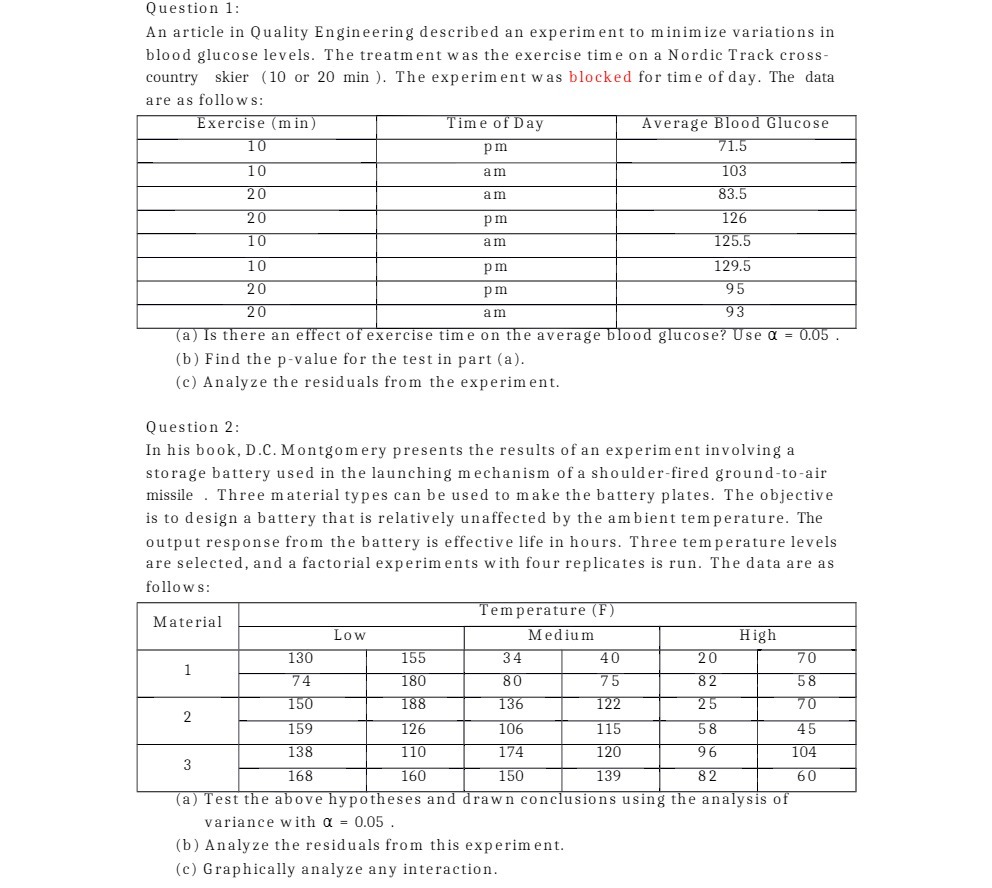
Question 1: An article in Quality Engineering described an experiment to minimize variations in blood glucose levels. The treatment was the exercise time on a Nordic Track cross country skier (10 or 20 min ). The experiment was blocked for time of day. The data are as follows: Exercise (min) Time of Day Average Blood Glucose 10 pm 71.5 10 am 103 20 am 83.5 20 pm 126 10 am 125.5 10 pm 129.5 20 m 95 20 am 93 (a) Is there an effect of exercise time on the average blood glucose? Use a = 0.05 (b) Find the p-value for the test in part (a). (c) Analyze the residuals from the experiment. Question 2: In his book, D.C. Montgomery presents the results of an experiment involving a storage battery used in the launching mechanism of a shoulder-fired ground-to-air missile . Three material types can be used to make the battery plates. The objective is to design a battery that is relatively unaffected by the ambient temperature. The output response from the battery is effective life in hours. Three temperature levels are selected, and a factorial experiments with four replicates is run. The data are as follows: Material Temperature (F) Low Medium High 130 155 34 40 20 70 74 180 80 75 82 58 150 188 2 136 122 25 70 159 126 106 115 58 45 138 3 110 174 120 96 104 168 160 150 139 82 60 (a) Test the above hypotheses and drawn conclusions using the analysis of variance with a = 0.05 (b) Analyze the residuals from this experiment. (c) Graphically analyze any interaction
Step by Step Solution
There are 3 Steps involved in it

Get step-by-step solutions from verified subject matter experts
 Study Help