



Question: Question 1 An equity analyst is valuing a listed company that is expected to generate EBIT from year 1 onwards as given in Table
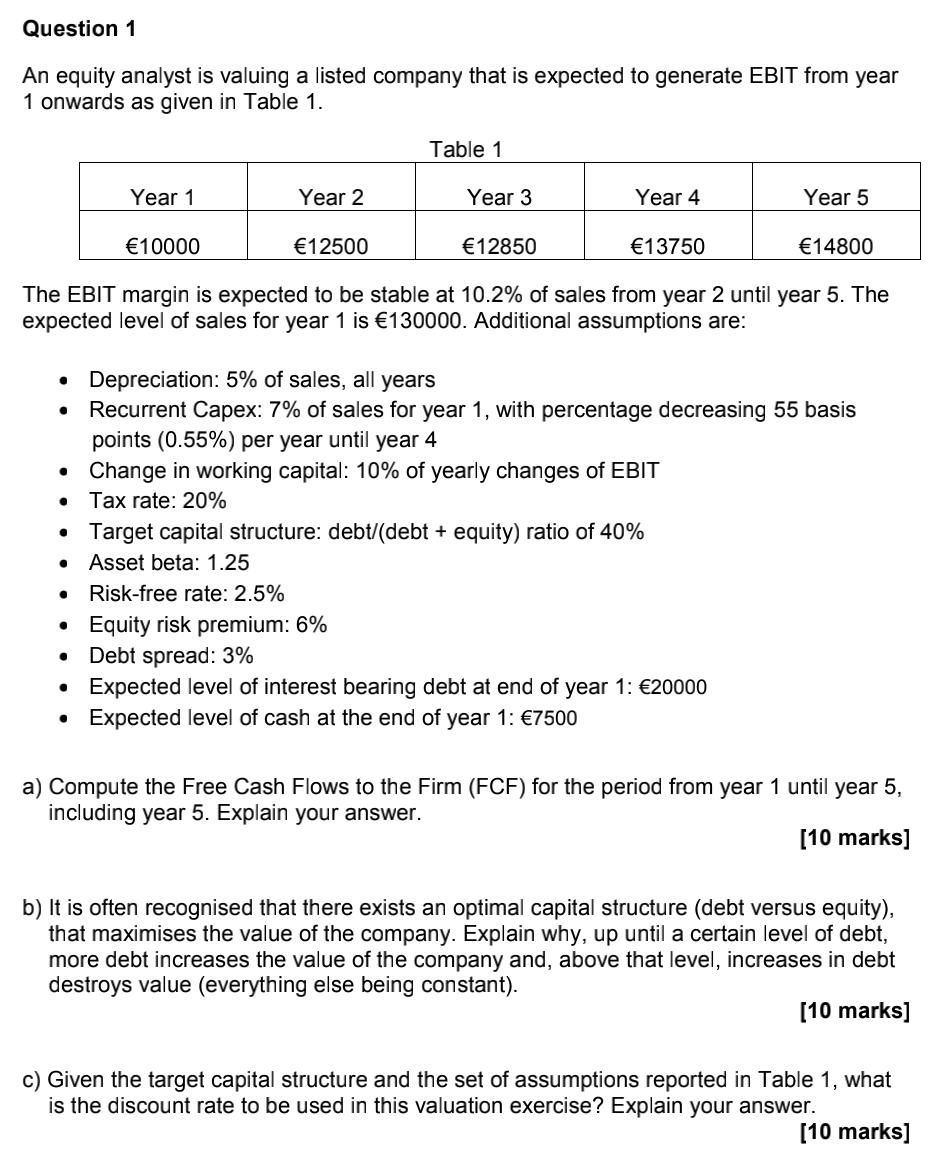
Question 1 An equity analyst is valuing a listed company that is expected to generate EBIT from year 1 onwards as given in Table 1. Table 1 Year 1 Year 2 Year 3 Year 4 Year 5 10000 12500 12850 13750 14800 The EBIT margin is expected to be stable at 10.2% of sales from year 2 until year 5. The expected level of sales for year 1 is 130000. Additional assumptions are: Depreciation: 5% of sales, all years Recurrent Capex: 7% of sales for year 1, with percentage decreasing 55 basis points (0.55%) per year until year 4 Change in working capital: 10% of yearly changes of EBIT Tax rate: 20% Target capital structure: debt/(debt + equity) ratio of 40% Asset beta: 1.25 Risk-free rate: 2.5% Equity risk premium: 6% Debt spread: 3% Expected level of interest bearing debt at end of year 1: 20000 Expected level of cash at the end of year 1: 7500 a) Compute the Free Cash Flows to the Firm (FCF) for the period from year 1 until year 5, including year 5. Explain your answer. [10 marks] b) It is often recognised that there exists an optimal capital structure (debt versus equity), that maximises the value of the company. Explain why, up until a certain level of debt, more debt increases the value of the company and, above that level, increases in debt destroys value (everything else being constant). [10 marks] c) Given the target capital structure and the set of assumptions reported in Table 1, what is the discount rate to be used in this valuation exercise? Explain your answer. [10 marks]
Step by Step Solution
3.47 Rating (150 Votes )
There are 3 Steps involved in it
a To compute the Free Cash Flows to the Firm FCF for the period from year 1 until year 5 including year 5 we need to calculate the following components 1 EBIT Earnings Before Interest and Taxes Year 1 ... View full answer

Get step-by-step solutions from verified subject matter experts