



Question: Question 1 and 2 are referring to the below article. Companies rated A and higher in Malaysia, in theory, have access to the bank market
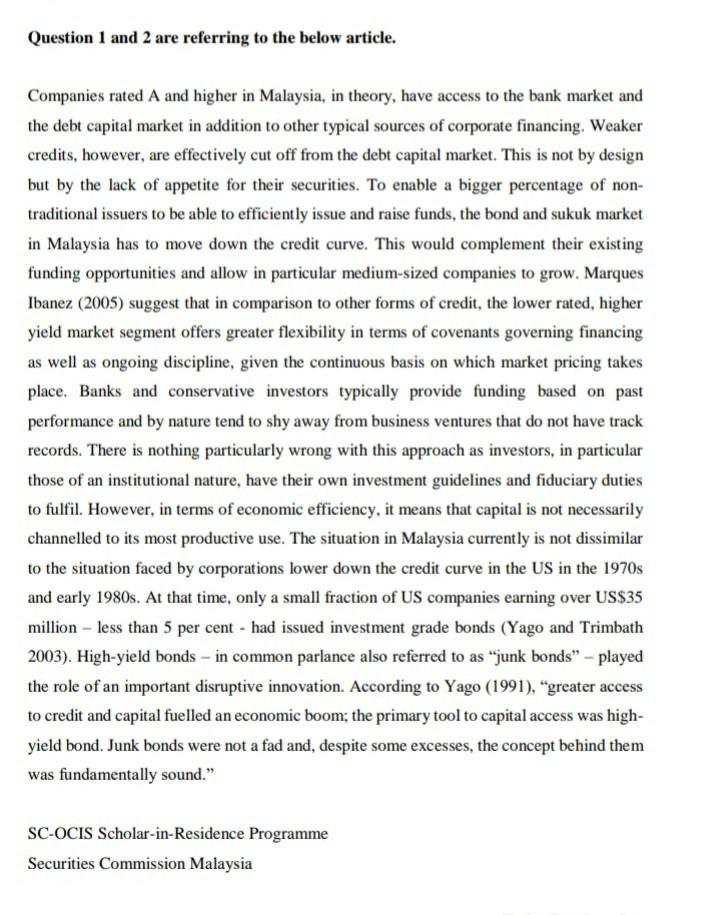

Question 1 and 2 are referring to the below article. Companies rated A and higher in Malaysia, in theory, have access to the bank market and the debt capital market in addition to other typical sources of corporate financing. Weaker credits, however, are effectively cut off from the debt capital market. This is not by design but by the lack of appetite for their securities. To enable a bigger percentage of non- traditional issuers to be able to efficiently issue and raise funds, the bond and sukuk market in Malaysia has to move down the credit curve. This would complement their existing funding opportunities and allow in particular medium-sized companies to grow. Marques Ibanez (2005) suggest that in comparison to other forms of credit, the lower rated, higher yield market segment offers greater flexibility in terms of covenants governing financing as well as ongoing discipline, given the continuous basis on which market pricing takes place. Banks and conservative investors typically provide funding based on past performance and by nature tend to shy away from business ventures that do not have track records. There is nothing particularly wrong with this approach as investors, in particular those of an institutional nature, have their own investment guidelines and fiduciary duties to fulfil. However, in terms of economic efficiency, it means that capital is not necessarily channelled to its most productive use. The situation in Malaysia currently is not dissimilar to the situation faced by corporations lower down the credit curve in the US in the 1970s and early 1980s. At that time, only a small fraction of US companies earning over US$35 million - less than 5 per cent - had issued investment grade bonds (Yago and Trimbath 2003). High-yield bonds - in common parlance also referred to as junk bonds - played the role of an important disruptive innovation. According to Yago (1991), greater access to credit and capital fuelled an economic boom; the primary tool to capital access was high- yield bond. Junk bonds were not a fad and, despite some excesses, the concept behind them was fundamentally sound. SC-OCIS Scholar-in-Residence Programme Securities Commission Malaysia QUESTION 2 (25 MARKS) ""To enable a bigger percentage of non-traditional issuers to be able to efficiently issue and raise funds, the bond and sukuk market in Malaysia has to move down the credit curve." Other than this approach, discuss how the issuers attract the bond investors? Question 1 and 2 are referring to the below article. Companies rated A and higher in Malaysia, in theory, have access to the bank market and the debt capital market in addition to other typical sources of corporate financing. Weaker credits, however, are effectively cut off from the debt capital market. This is not by design but by the lack of appetite for their securities. To enable a bigger percentage of non- traditional issuers to be able to efficiently issue and raise funds, the bond and sukuk market in Malaysia has to move down the credit curve. This would complement their existing funding opportunities and allow in particular medium-sized companies to grow. Marques Ibanez (2005) suggest that in comparison to other forms of credit, the lower rated, higher yield market segment offers greater flexibility in terms of covenants governing financing as well as ongoing discipline, given the continuous basis on which market pricing takes place. Banks and conservative investors typically provide funding based on past performance and by nature tend to shy away from business ventures that do not have track records. There is nothing particularly wrong with this approach as investors, in particular those of an institutional nature, have their own investment guidelines and fiduciary duties to fulfil. However, in terms of economic efficiency, it means that capital is not necessarily channelled to its most productive use. The situation in Malaysia currently is not dissimilar to the situation faced by corporations lower down the credit curve in the US in the 1970s and early 1980s. At that time, only a small fraction of US companies earning over US$35 million - less than 5 per cent - had issued investment grade bonds (Yago and Trimbath 2003). High-yield bonds - in common parlance also referred to as junk bonds - played the role of an important disruptive innovation. According to Yago (1991), greater access to credit and capital fuelled an economic boom; the primary tool to capital access was high- yield bond. Junk bonds were not a fad and, despite some excesses, the concept behind them was fundamentally sound. SC-OCIS Scholar-in-Residence Programme Securities Commission Malaysia QUESTION 2 (25 MARKS) ""To enable a bigger percentage of non-traditional issuers to be able to efficiently issue and raise funds, the bond and sukuk market in Malaysia has to move down the credit curve." Other than this approach, discuss how the issuers attract the bond investors
Step by Step Solution
There are 3 Steps involved in it

Get step-by-step solutions from verified subject matter experts