







Question: Question 1 and 2 talk about the utility function,MRIS,optimal consumption bundle Question 1 (7 Marks) Joan has a utility function given by U(C'1, Cg) =
Question 1 and 2 talk about the utility function,MRIS,optimal consumption bundle
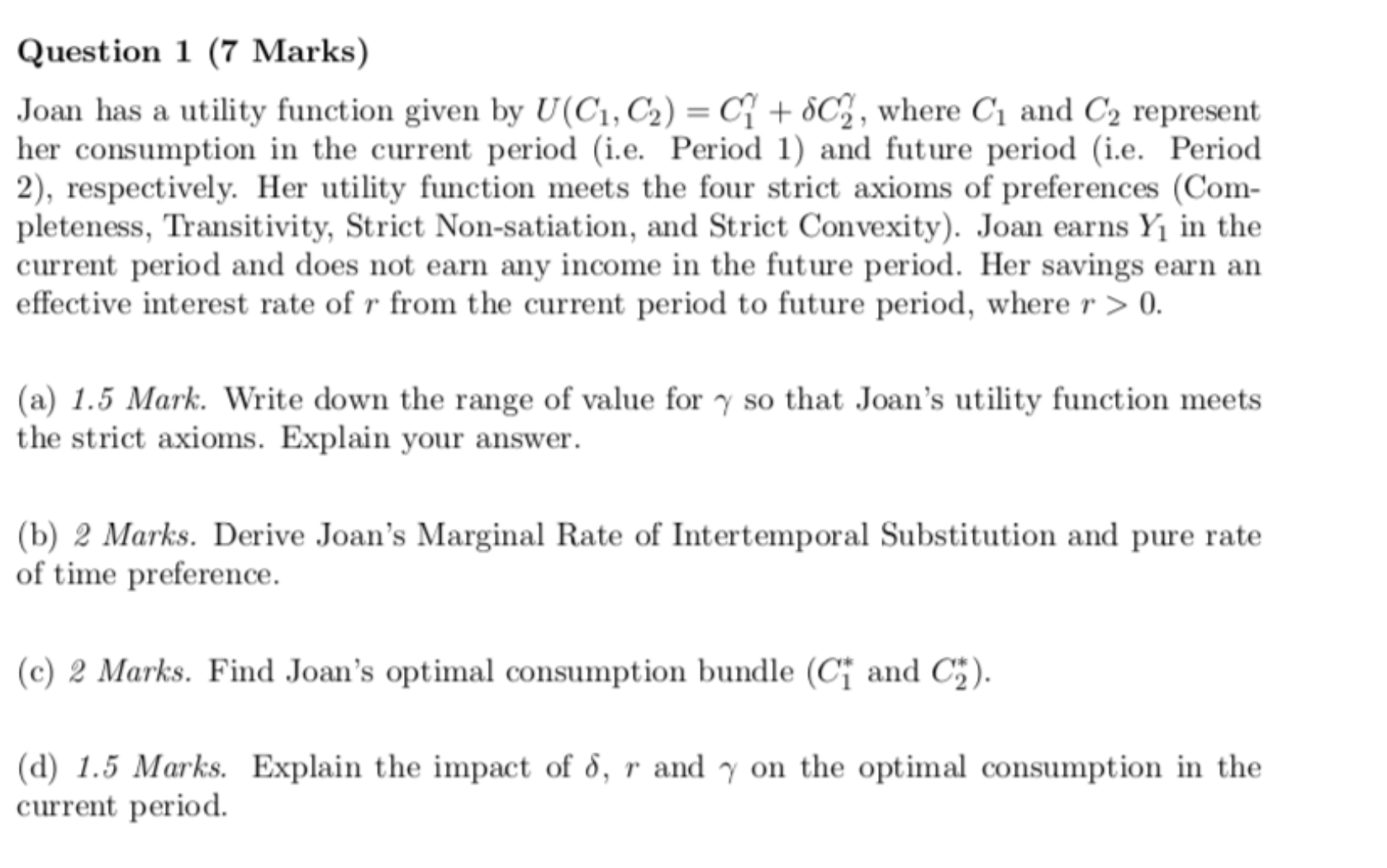
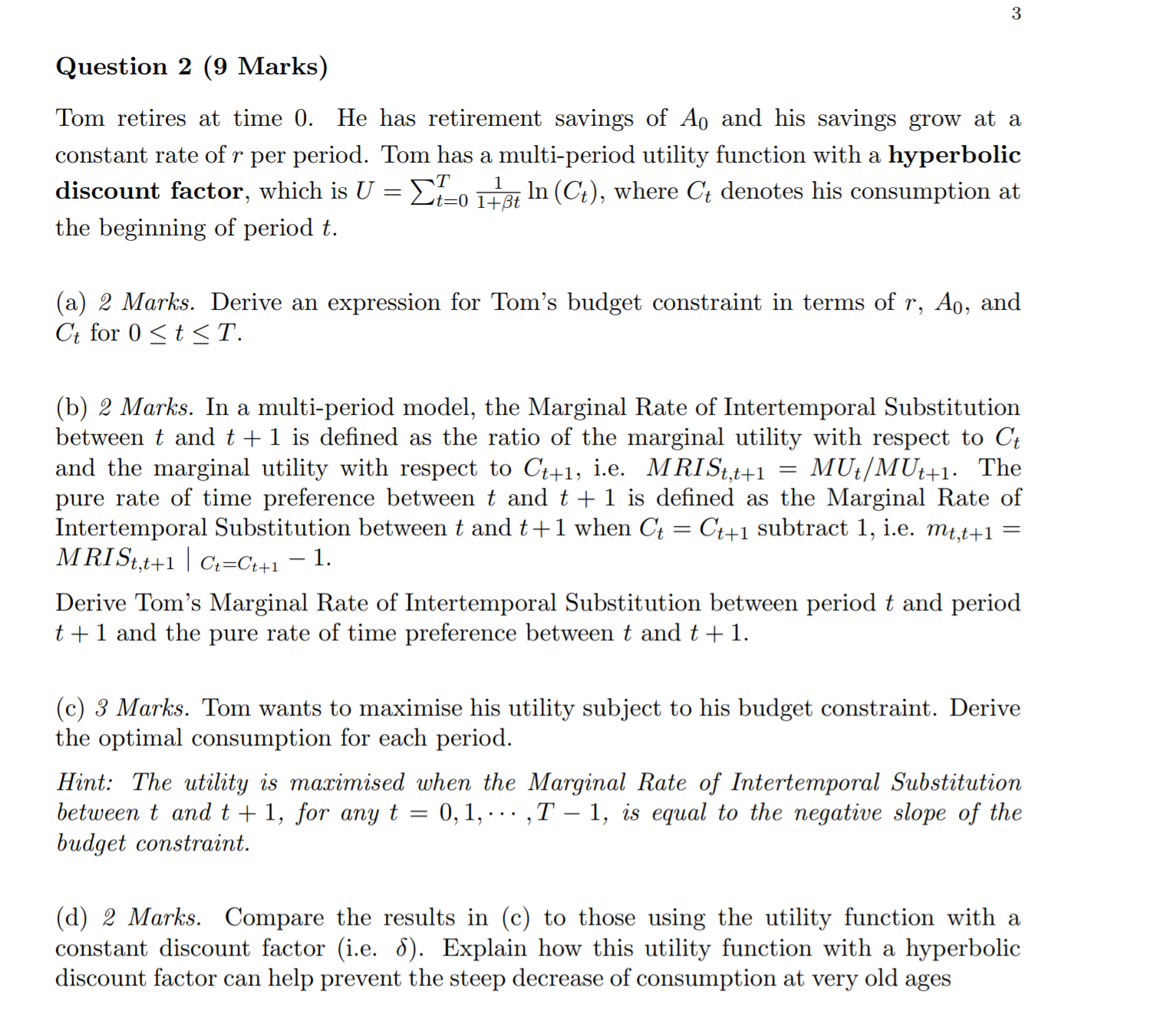
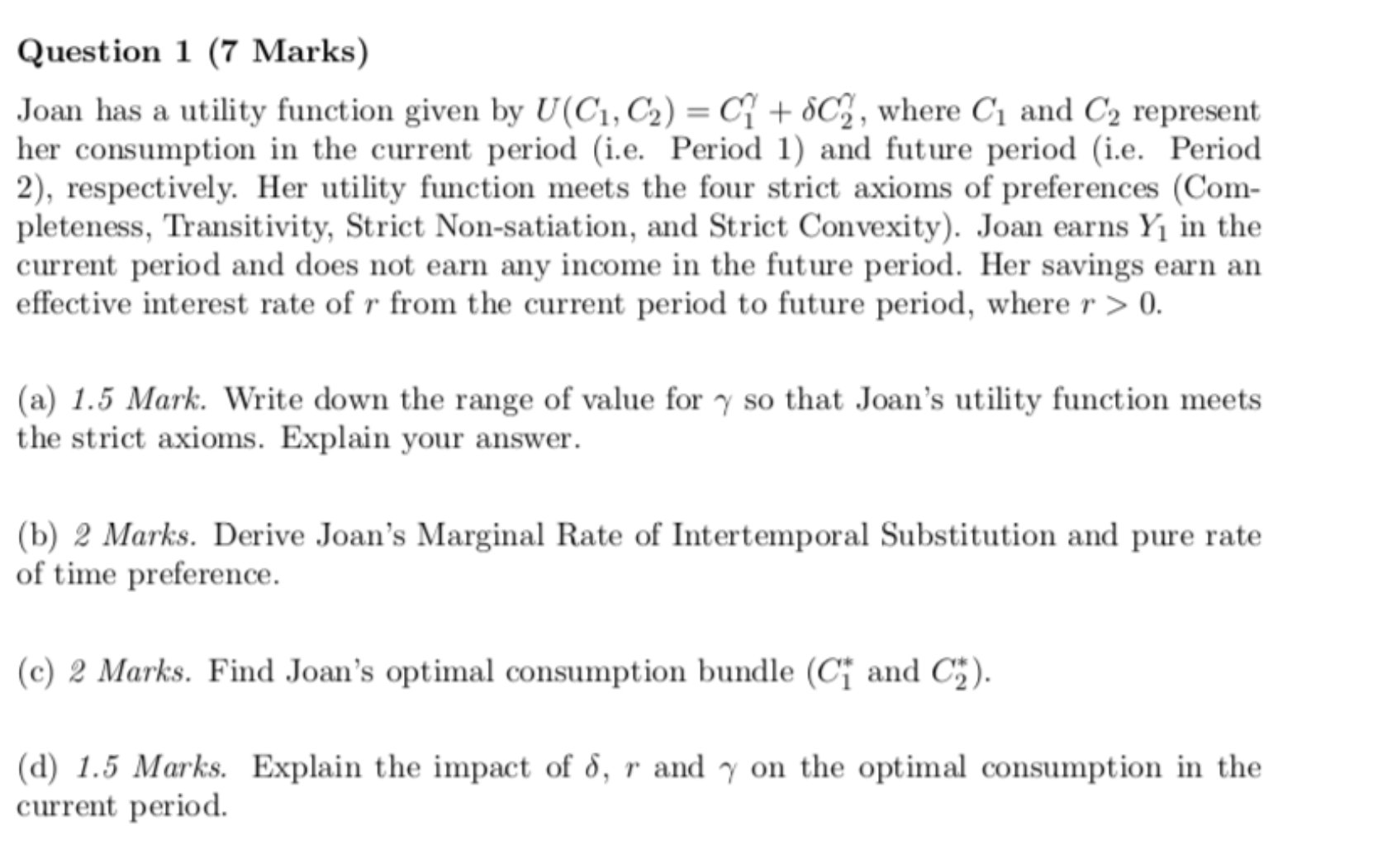
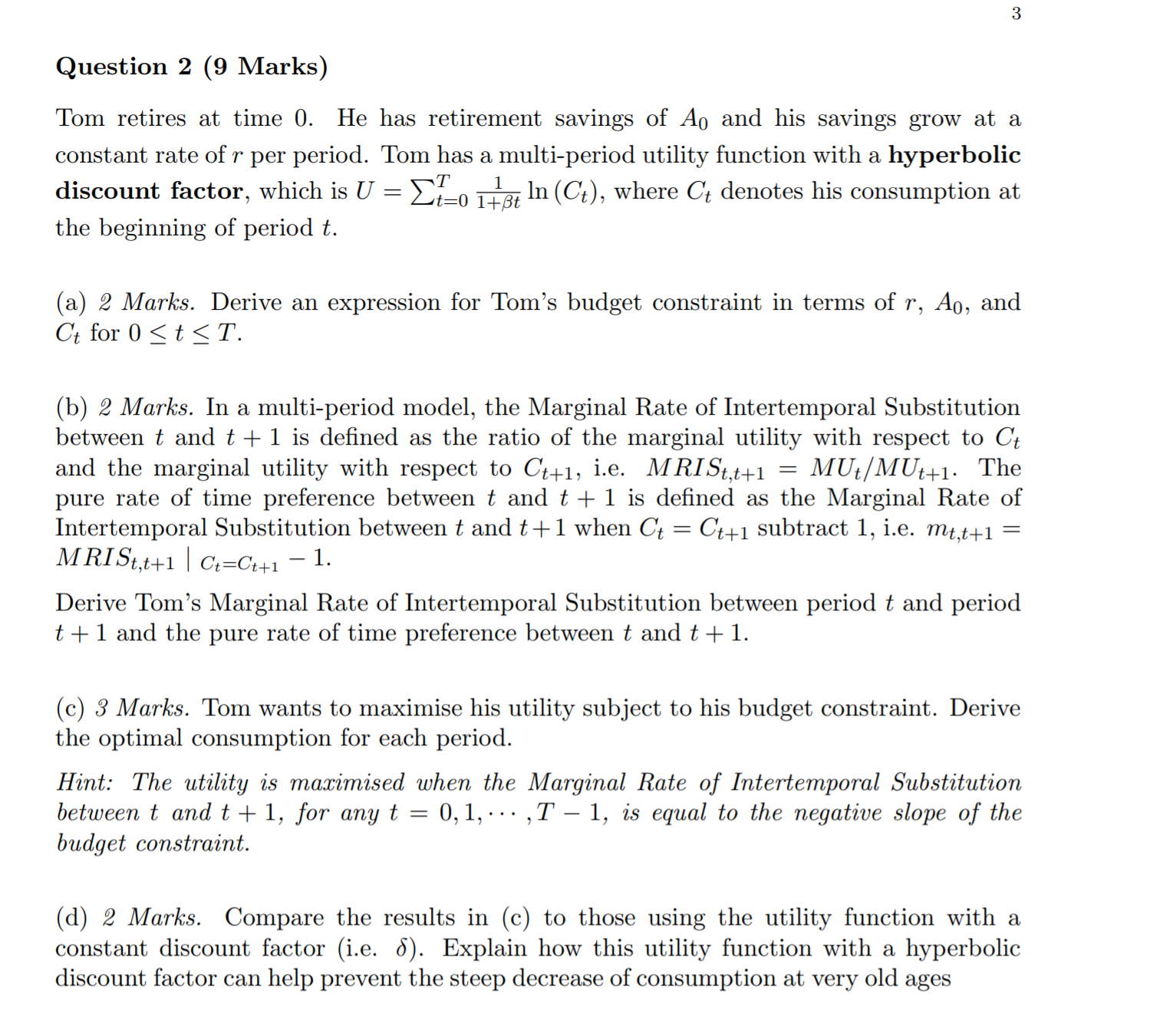
Question 1 (7 Marks) Joan has a utility function given by U(C'1, Cg) = C? + 60;, where C; and 02 represent her consumption in the current period (i.e. Period 1) and future period (i.e. Period 2), respectively. Her utility function meets the four strict axioms of preferences (Com- pleteness, Transitivity, Strict Non-satiation, and Strict Convexity). Joan earns Y1 in the current period and does not earn any income in the future period. Her savings earn an effective interest rate of r from the current period to future period, where r > 0. (a) 1.5 Mark. Write down the range of value for 7 so that Joan's utility function meets the strict axioms. Explain your answer. (b) 2 Marks. Derive Joan's Marginal Rate of Intel-temporal Substitution and pure rate of time preference. (c) 2 Marks. Find Joan's optimal consumption bundle (C; and CE). (d) 1.5 Marks. Explain the impact of 6, r and 7 on the optimal consumption in the current period. Question 2 (9 Marks) Tom retires at time 0. He has retirement savings of A0 and his savings grow at a constant rate of 7' per period. Tom has a multiperiod utility function with a hyperbolic discount factor, which is U 2 23:0 $131: In (Ct), where 0,; denotes his consumption at the beginning of period t. (a) 2 Marks. Derive an expression for Tom's budget constraint in terms of 1", A0, and Ct for (l g t g T. (b) 2 Marks. In a multiperiod model, the Marginal Rate of Intertemporal Substitution between t and t + 1 is dened as the ratio of the marginal utility with respect to 0t and the marginal utility with respect to CH1, i.e. MRISHH = MUt/MUHL The pure rate of time preference between t and t + 1 is dened as the Marginal Rate of Intertemporal Substitution between t and t+ 1 when Gt 2 CH1 subtract 1, i.e. mm" = M RISt,t+1 | Ct=ct+1 1~ Derive Tom's Marginal Rate of Intertemporal Substitution between period t and period t + 1 and the pure rate of time preference between t and t+ 1. (c) 3 Marks. Tom wants to maximise his utility subject to his budget constraint. Derive the optimal consumption for each period. Hint: The utility is maximised when the Marginal Rate of Intertempoml Substitution between t and t + 1, for any t = 0,1,n- ,T 1, is equal to the negative slope of the budget constraint. (d) 2 Marks. Compare the results in (c) to those using the utility function with a constant discount factor (i.e. 6). Explain how this utility function with a hyperbolic discount factor can help prevent the steep decrease of consumption at very old ages
Step by Step Solution
There are 3 Steps involved in it

Get step-by-step solutions from verified subject matter experts
 Study Help