







Question: QUESTION 1: ANSWER ALL THE THREE SUB-QUESTIONS (25 Marks) The Ghana Audit Service has a legal personality under public law and is created by the
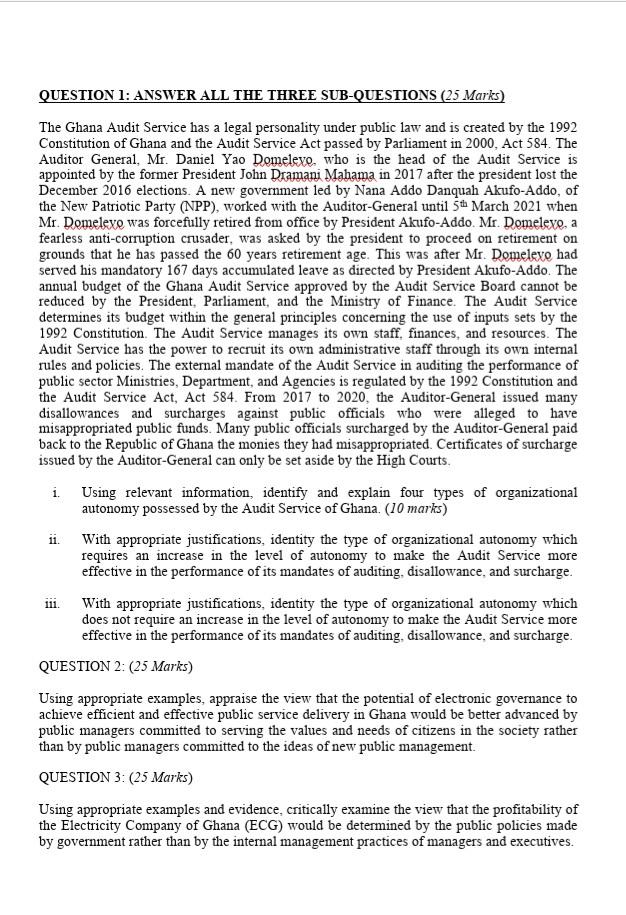
QUESTION 1: ANSWER ALL THE THREE SUB-QUESTIONS (25 Marks) The Ghana Audit Service has a legal personality under public law and is created by the 1992 Constitution of Ghana and the Audit Service Act passed by Parliament in 2000, Act 584. The Auditor General, Mr. Daniel Yao Domelevo. who is the head of the Audit Service is appointed by the former President John Dramani Mahama in 2017 after the president lost the December 2016 elections. A new government led by Nana Addo Danquah Akufo-Addo, of the New Patriotic Party (NPP), worked with the Auditor-General until 56 March 2021 when Mr. Domelexe was forcefully retired from office by President Akufo-Addo. Mr. Domeleve, a fearless anti-corruption crusader, was asked by the president to proceed on retirement on grounds that he has passed the 60 years retirement age. This was after Mr. Domelevo had served his mandatory 167 days accumulated leave as directed by President Akufo-Addo. The annual budget of the Ghana Audit Service approved by the Audit Service Board cannot be reduced by the President, Parliament, and the Ministry of Finance. The Audit Service determines its budget within the general principles concerning the use of inputs sets by the 1992 Constitution. The Audit Service manages its own staff, finances, and resources. The Audit Service has the power to recruit its own administrative staff through its own internal rules and policies. The external mandate of the Audit Service in auditing the performance of public sector Ministries, Department, and Agencies is regulated by the 1992 Constitution and the Audit Service Act, Act 584. From 2017 to 2020, the Auditor-General issued many disallowances and surcharges against public officials who were alleged to have misappropriated public funds. Many public officials surcharged by the Auditor-General paid back to the Republic of Ghana the monies they had misappropriated. Certificates of surcharge issued by the Auditor-General can only be set aside by the High Courts. i Using relevant information, identify and explain four types of organizational autonomy possessed by the Audit Service of Ghana. (10 marks) ii. With appropriate justifications, identity the type of organizational autonomy which requires an increase in the level of autonomy to make the Audit Service more effective in the performance of its mandates of auditing, disallowance, and surcharge. With appropriate justifications, identity the type of organizational autonomy which does not require an increase in the level of autonomy to make the Audit Service more effective in the performance of its mandates of auditing, disallowance, and surcharge. QUESTION 2: (25 Marks) Using appropriate examples, appraise the view that the potential of electronic governance to achieve efficient and effective public service delivery in Ghana would be better advanced by public managers committed to serving the values and needs of citizens in the society rather than by public managers committed to the ideas of new public management. QUESTION 3: (25 Marks) Using appropriate examples and evidence, critically examine the view that the profitability of the Electricity Company of Ghana (ECG) would be determined by the public policies made by government rather than by the internal management practices of managers and executives. QUESTION 1: ANSWER ALL THE THREE SUB-QUESTIONS (25 Marks) The Ghana Audit Service has a legal personality under public law and is created by the 1992 Constitution of Ghana and the Audit Service Act passed by Parliament in 2000, Act 584. The Auditor General, Mr. Daniel Yao Domelevo. who is the head of the Audit Service is appointed by the former President John Dramani Mahama in 2017 after the president lost the December 2016 elections. A new government led by Nana Addo Danquah Akufo-Addo, of the New Patriotic Party (NPP), worked with the Auditor-General until 56 March 2021 when Mr. Domelexe was forcefully retired from office by President Akufo-Addo. Mr. Domeleve, a fearless anti-corruption crusader, was asked by the president to proceed on retirement on grounds that he has passed the 60 years retirement age. This was after Mr. Domelevo had served his mandatory 167 days accumulated leave as directed by President Akufo-Addo. The annual budget of the Ghana Audit Service approved by the Audit Service Board cannot be reduced by the President, Parliament, and the Ministry of Finance. The Audit Service determines its budget within the general principles concerning the use of inputs sets by the 1992 Constitution. The Audit Service manages its own staff, finances, and resources. The Audit Service has the power to recruit its own administrative staff through its own internal rules and policies. The external mandate of the Audit Service in auditing the performance of public sector Ministries, Department, and Agencies is regulated by the 1992 Constitution and the Audit Service Act, Act 584. From 2017 to 2020, the Auditor-General issued many disallowances and surcharges against public officials who were alleged to have misappropriated public funds. Many public officials surcharged by the Auditor-General paid back to the Republic of Ghana the monies they had misappropriated. Certificates of surcharge issued by the Auditor-General can only be set aside by the High Courts. i Using relevant information, identify and explain four types of organizational autonomy possessed by the Audit Service of Ghana. (10 marks) ii. With appropriate justifications, identity the type of organizational autonomy which requires an increase in the level of autonomy to make the Audit Service more effective in the performance of its mandates of auditing, disallowance, and surcharge. With appropriate justifications, identity the type of organizational autonomy which does not require an increase in the level of autonomy to make the Audit Service more effective in the performance of its mandates of auditing, disallowance, and surcharge. QUESTION 2: (25 Marks) Using appropriate examples, appraise the view that the potential of electronic governance to achieve efficient and effective public service delivery in Ghana would be better advanced by public managers committed to serving the values and needs of citizens in the society rather than by public managers committed to the ideas of new public management. QUESTION 3: (25 Marks) Using appropriate examples and evidence, critically examine the view that the profitability of the Electricity Company of Ghana (ECG) would be determined by the public policies made by government rather than by the internal management practices of managers and executives
Step by Step Solution
There are 3 Steps involved in it
1 Expert Approved Answer
Step: 1 Unlock

Question Has Been Solved by an Expert!
Get step-by-step solutions from verified subject matter experts
Step: 2 Unlock
Step: 3 Unlock
 Study Help