







Question: Question 1 : Answer the following short answer or multiple choice questions. Please provide you answer in the provided blank space after the question only
Question 1 : Answer the following short answer or multiple choice questions. Please provide you answer in the provided blank space after the question only (i.e., your short answers should be, well, short J)
1.1. Provide the definitions for resource loading and resource leveling.
Resource loading:
Resource leveling:
1.2. What would the resource allocation problem become if resources were not limited, as is generally not the case?
Project monitoring and control problem
Scope creep problem
Resource selection problem
Profit maximization problem
1.3. List four of the simple priority rules that are used for allocating scarce resources.
1.4. What is the goal of “The Goal” text and how can you define the critical chain?
- Goal:
- Critical chain:
1.5. Which type of project termination is used when the project is successfully completed, and introduced as a new, formal part, of the organization?
Termination-by-integration
Termination-by-extinction
Termination-by-starvation
Termination-by-addition
1.6. At what stages in the project execution, it is the most easy to deal with changes?
Late stages
Planning stages
Early stages
Selection stages
1.7. Who makes the decisions to terminate a project?
A committee of senior managers
The project manager
The client
The functional managers involved in the project
1.8. What are the three critical aspects on which the organizations focus their attention in order to improve their internal processes (i.e., dimensions used in capability maturity models)?
1.9. Two resources (A and B) are needed to complete the project depicted in the network below. The time needed to complete activities A1 and A2, which use resource A, and the time needed to complete activities B1 and B2, which use resource B, are given in parenthesis).
What is the minimum completion time possible for the project?
What is the maximum completion time possible for the project?
1.10. What are the four risk criteria used for preparing a risk management plan? Use the extended model to identify the fourth risk criterion.
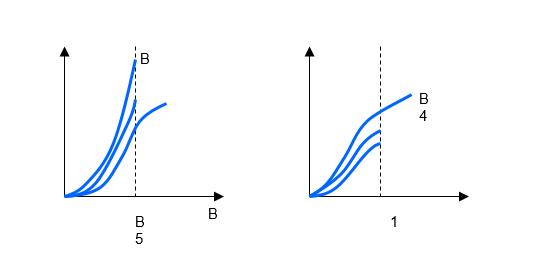
1.11 Two potential design solutions are considered for a new project and their main performance measure is represented in the figure below.
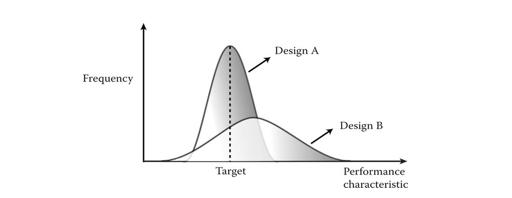
In regard to project quality management considerations, which one of the two designs will be selected? Justify your answer.
1.12 All the activities of the three projects depicted in the figure below have probabilistic duration estimates coming from a normal distribution with a mean of 10 and standard deviation of 3.
By simulation the execution of the projects, the following project completion time were obtained
Project 1 | Project 2 | Project 3 | |
Average | 50.4 | 51.9 | 53.4 |
Std. dev. | 7.1 | 6.3 | 5.3 |
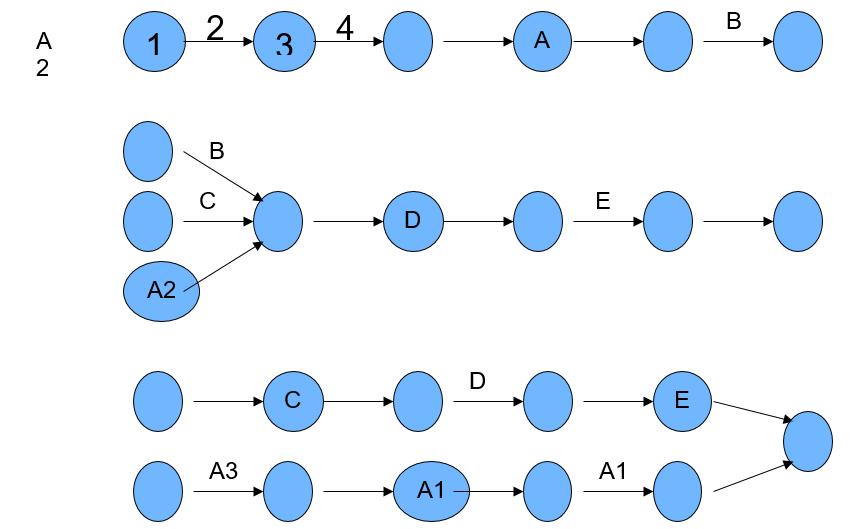
Explain the results in the above table.
1.13 Considering the critical chain resource allocation approach, what is the difference between project buffer and feeding buffer?
1.14 What is one specific characteristic for aviation project management?
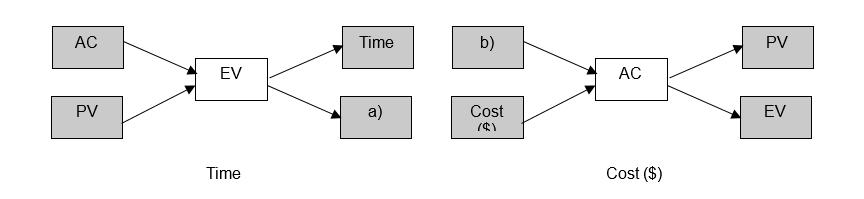
1.15 Which of the following earned value possible scenarios would you prefer as a project manager?
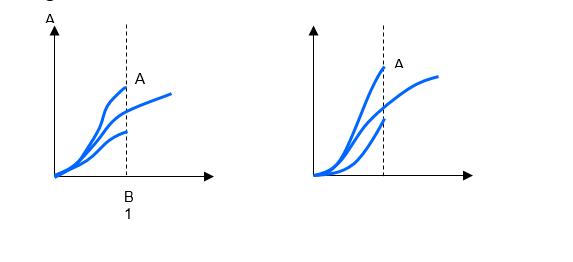
Question 2 Consider the following AON network for an engineering project.
The estimated normal durations for each task are indicated in the table below. Each task in this project can be compressed by a maximum of two weeks. Each week’s decrease in duration will cost an amount that is equal to its estimated normal duration (also indicated in the table below). For example, the duration of task A can be reduced to 7 weeks by spending an additional $8, or it can be reduced to 6 weeks for an additional cost of $16.
Activity | Predecessor | Normal time | Maximum crash time | Crash cost per week |
A | - | 8 | 2 | 8 |
B | - | 11 | 3 | 11 |
C | B | 7 | 2 | 7 |
D | A | 9 | 2 | 9 |
E | A | 17 | 3 | 5 |
F | C, D | 12 | 2 | 12 |
- Which tasks should be compressed if we want to reduce the project by 3 weeks at the smallest possible cost?
- What is the increase in the cost for each week that we decrease the project duration?
- Consider that the normal cost of the project is $X. If the project is completed in more than 26 weeks, a penalty of $15 per week is charged for each week late. However, if the project is completed in less than 26 weeks, there is a $15 bonus paid for each week early. Find the project duration that minimizes the total cost.
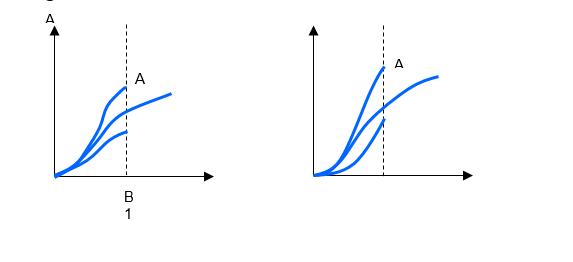
Question 3 : Projects A and B are both nearing completion. You are managing a super important project C that requires an immediate input of a resource being used by both projects A and B, but is otherwise unavailable. Project A has a Type 1 life cycle, while Project B’s life cycle is Type 2, as depicted in the figure below.
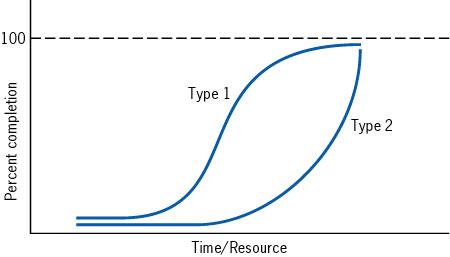
From which (or both, or neither) do you borrow the resource? Why?
Question 4 Two projects A and B, having 5 activities each, need to be scheduled concurrently. To be completed, each of the two projects needs two resources, which are presented in the below figure as white and gray.
All activities of both projects A and B have one time unit duration. Using multitasking, present all possible scenarios for scheduling the two projects, and calculate their resultant total completion times. Which of the scheduling scenarios would you recommend?
Question 5 Consider the information about a project plan presented in the following table.
Task | Immediate predecessor | Duration (days) | Scheduled cost/day |
A | - | 3 | $1,000 |
B | - | 5 | $2,000 |
C | A | 4 | $4,000 |
D | B | 8 | $1,000 |
E | C | 6 | $2,000 |
F | D | 8 | $3,000 |
The following table shows the weekly control reports for the first two weeks (assume 5 working days each week).
Task | End of week 1 | End of week 2 | ||
Actual completed (%) | Actual cost | Actual completed (%) | Actual cost | |
A | 60% | $1,500 | 100% | $2,900 |
B | 30% | $3,000 | 100% | $11,000 |
C | 10% | $2,000 | 100% | $13,500 |
D | 0% | 0 | 90% | $10,000 |
E | 0% | 0 | 50% | $4,000 |
F | 0% | 0 | 0% | 0 |
a) Use the earned value approach to calculate the cost variance, schedule variance, cost performance index, schedule performance index for the whole project at the end of week 1 and at the end of week 2.
b) Use the original estimate approach (budgeted cost) and the revised estimate approach to calculate the projected total cost at completion, respectively at the end of week 1 and at the end of week 2.
Frequency Target Design A Design B Performance characteristic A 2 1 A2 2 B C A3 3 C 4. D A1 D A E A1 E B 1 A 1 A 1 B 4 100 Percent completion Type 1 D Type 2 Time/Resource AC PV EV Time Time a) b) Cost (8) AC Cost ($) PV EV
Step by Step Solution
3.41 Rating (160 Votes )
There are 3 Steps involved in it
resource loadingresource loading is a process which is used in project management a... View full answer

Get step-by-step solutions from verified subject matter experts
 Study Help