







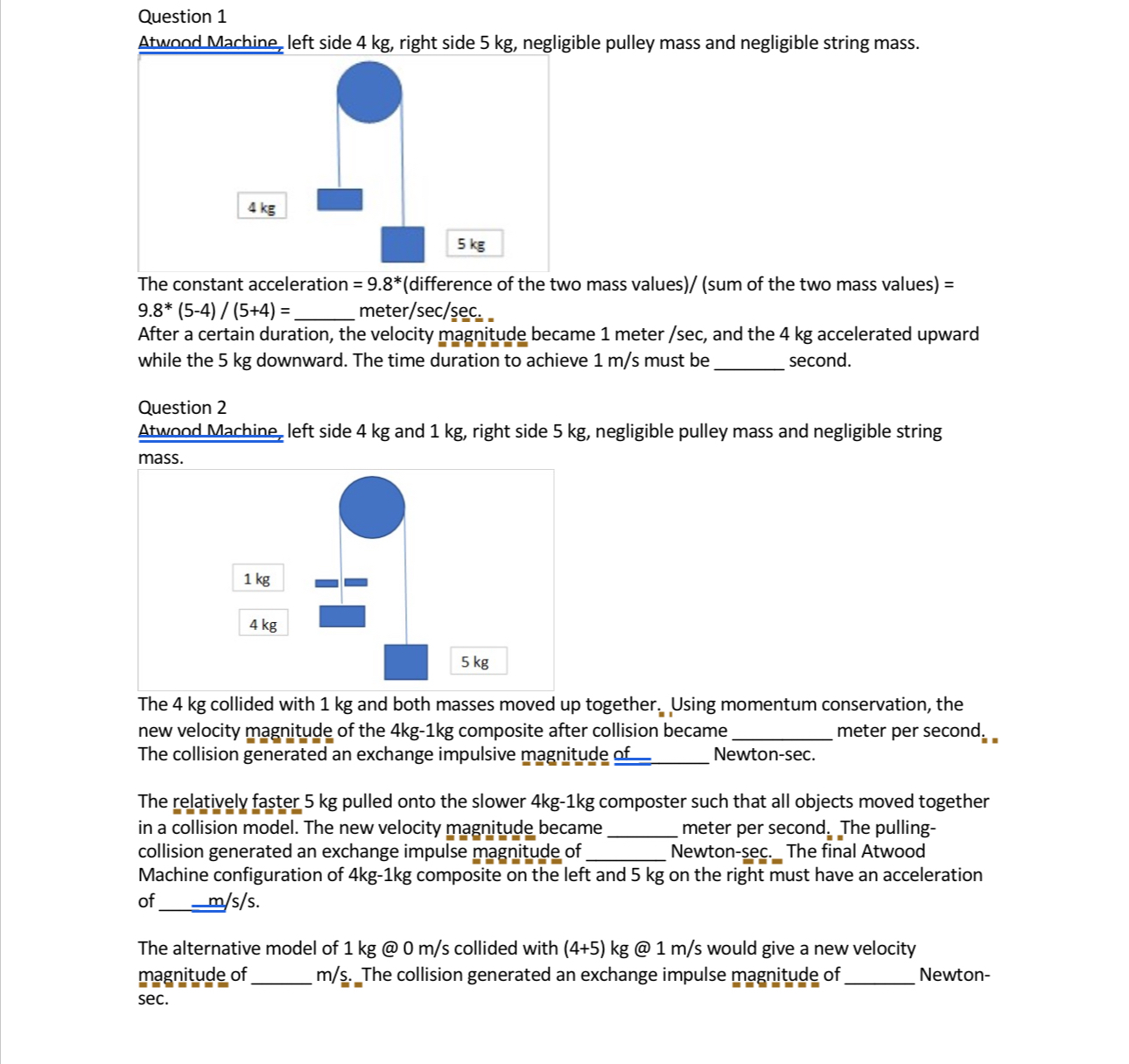
Question: Question 1 Atword Machine, left side 4 kg , right side 5 kg , negligible pulley mass and negligible string mass. The constant acceleration =
Question
Atword Machine, left side kg right side kg negligible pulley mass and negligible string mass.
The constant acceleration difference of the two mass valuessum of the two mass values meter
After a certain duration, the velocity magnitude became mete and the kg accelerated upward while the kg downward. The time duration to achieve must be second.
Question
Atwood Marchine left side kg and kg right side kg negligible pulley mass and negligible string mase
The kg collided with kg and both masses moved up together. Using momentum conservation, the new velocity magnitude of the kg kg composite after collision became meter per second. The collision generated an exchange impulsive magnitude of Newtonsec
The relatively faster kg pulled onto the slower kg kg composter such that all objects moved together in a collision model. The new velocity magnitude became meter per second. The pullingcollision generated an exchange impulse magnitude of Newtonsec The final Atwood Machine configuration of composite on the left and kg on the right must have an acceleration of ss
The alternative model of kg @ collided with kg @ would give a new velocity magnitude of The collision generated an exchange impulse magnitude of Newtonsec.
Step by Step Solution
There are 3 Steps involved in it
1 Expert Approved Answer
Step: 1 Unlock

Question Has Been Solved by an Expert!
Get step-by-step solutions from verified subject matter experts
Step: 2 Unlock
Step: 3 Unlock
 Study Help