







Question: Question 1 (Based on problem 3.4 from textbook Margulis, 2017) For this question, you have to use some empirical equations from the textbook. In order
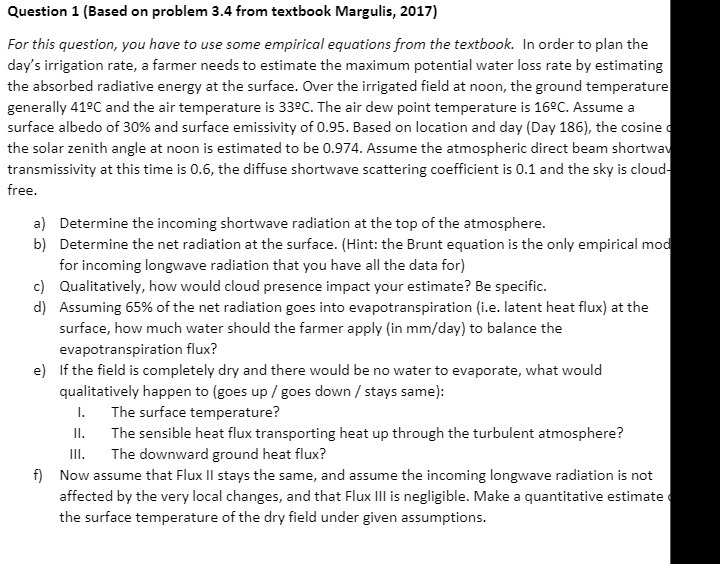
Question 1 (Based on problem 3.4 from textbook Margulis, 2017) For this question, you have to use some empirical equations from the textbook. In order to plan the day's irrigation rate, a farmer needs to estimate the maximum potential water loss rate by estimating the absorbed radiative energy at the surface. Over the irrigated field at noon, the ground temperature generally 412C and the air temperature is 339C. The air dew point temperature is 169C. Assume a surface albedo of 30% and surface emissivity of 0.95. Based on location and day (Day 186), the cosine the solar zenith angle at noon is estimated to be 0.974. Assume the atmospheric direct beam shortway transmissivity at this time is 0.6, the diffuse shortwave scattering coefficient is 0.1 and the sky is cloud- free. a) Determine the incoming shortwave radiation at the top of the atmosphere. b) Determine the net radiation at the surface. (Hint: the Brunt equation is the only empirical mod for incoming longwave radiation that you have all the data for) c) Qualitatively, how would cloud presence impact your estimate? Be specific. d) Assuming 65% of the net radiation goes into evapotranspiration (i.e. latent heat flux) at the surface, how much water should the farmer apply (in mm/day) to balance the evapotranspiration flux? 2) If the field is completely dry and there would be no water to evaporate, what would qualitatively happen to (goes up / goes down / stays same): I. The surface temperature? 11. The sensible heat flux transporting heat up through the turbulent atmosphere? III. The downward ground heat flux? f) Now assume that Flux II stays the same, and assume the incoming longwave radiation is not affected by the very local changes, and that Flux Ill is negligible. Make a quantitative estimate the surface temperature of the dry field under given assumptions
Step by Step Solution
There are 3 Steps involved in it

Get step-by-step solutions from verified subject matter experts
 Study Help