







Question: Question 1: Based on the above case study, discuss with examples , how is digital logistics different from traditional logistics. (10 marks) Question 2: Defence
Question 1: Based on the above case study, discuss with examples, how is digital logistics different from traditional logistics. (10 marks)
Question 2: Defence with facts from the above case study, THREE (3) solutions to how the KN Control Tower became the major source of solution provider to KN to mitigate all sorts of its supply chain disruption. (15 marks)
Question 3: Evaluate with the relevant examples, your THREE (3) judgements on how the KNs logistics control tower adds value to the performance of the KNs global logistics operations from the point of production, transportation and consumption. (15 marks)
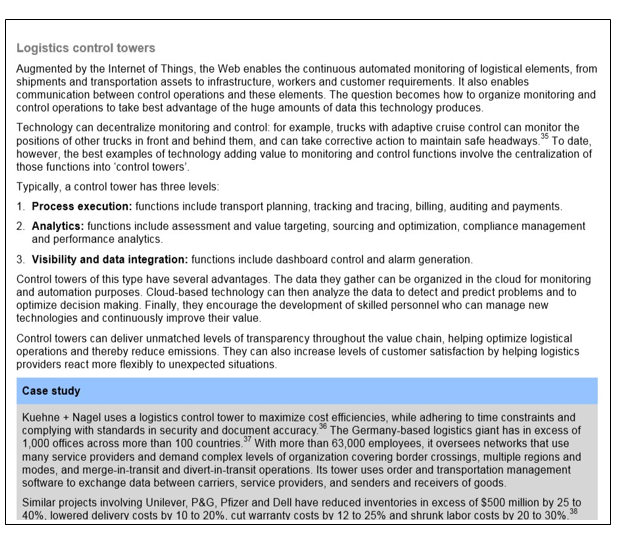
Logistics control towers Augmented by the Internet of Things, the Web enables the continuous automated monitoring of logistical elements, from shipments and transportation assets to infrastructure, workers and customer requirements. It also enables communication between control operations and these elements. The question becomes how to organize monitoring and control operations to take best advantage of the huge amounts of data this technology produces. Technology can decentralize monitoring and control: for example, trucks with adaptive cruise control can monitor the positions of other trucks in front and behind them, and can take corrective action to maintain safe headways. 35 To date, however, the best examples of technology adding value to monitoring and control functions involve the centralization of those functions into 'control towers'. Typically, a control tower has three levels: 1. Process execution: functions include transport planning, tracking and tracing, billing, auditing and payments. 2. Analytics: functions include assessment and value targeting, sourcing and optimization, compliance management and performance analytics. 3. Visibility and data integration: functions include dashboard control and alarm generation. Control towers of this type have several advantages. The data they gather can be organized in the cloud for monitoring and automation purposes. Cloud-based technology can then analyze the data to detect and predict problems and to optimize decision making. Finally, they encourage the development of skilled personnel who can manage new technologies and continuously improve their value. Control towers can deliver unmatched levels of transparency throughout the value chain, helping optimize logistical operations and thereby reduce emissions. They can also increase levels of customer satisfaction by helping logistics providers react more flexibly to unexpected situations. Case study Kuehne + Nagel uses a logistics control tower to maximize cost efficiencies, while adhering to time constraints and complying with standards in security and document accuracy 36 The Germany-based logistics giant has in excess of 1,000 offices across more than 100 countries 37 With more than 63,000 employees, it oversees networks that use many service providers and demand complex levels of organization covering border crossings, multiple regions and modes, and merge-in-transit and divert-in-transit operations. Its tower uses order and transportation management software to exchange data between carriers, service providers, and senders and receivers of goods. Similar projects involving Unilever, P\&G, Pfizer and Dell have reduced inventories in excess of $500 million by 25 to 40%. lowered deliverv costs bv 10 to 20%. cut warranty costs bv 12 to 25% and shrunk labor costs bv 20 to 30%. 38
Step by Step Solution
There are 3 Steps involved in it

Get step-by-step solutions from verified subject matter experts
 Study Help