







Question: Question 1: Based on the data collected from 23 flights, what is the probability of at least one O-ring failing, regardless of temperature? (Note: This
Question 1: Based on the data collected from 23 flights, what is the probability of at least one O-ring failing, regardless of temperature? (Note: This probability is called an experimental probability because it's based on only 23 flights, which is a fairly small number of events. To get a better approximation of the actual probability, we would need data from many more flights. Note also that even though there was O-ring failure on seven flights, all of those shuttles returned safely.)
Question 2: Determine the conditional probability P(O-ring failure|temperature of 65F or lower).
Question 3: Determine P(O-ring failure | temperature is greater than 65F).
Question 4: Determine whether O-ring failure is independent of the temperature being 65F or lower. Question: Analysis showed that the lower the temperature, the longer the O-rings would be separated from the joint, allowing dangerous gases to escape. The temperature at the launch of the Challenger shuttle was approximately 31F, about 20F colder than during any previous shuttle launch. Would you have recommended the Challenger be launched on that ill-fated day? Give reasons for your answer.
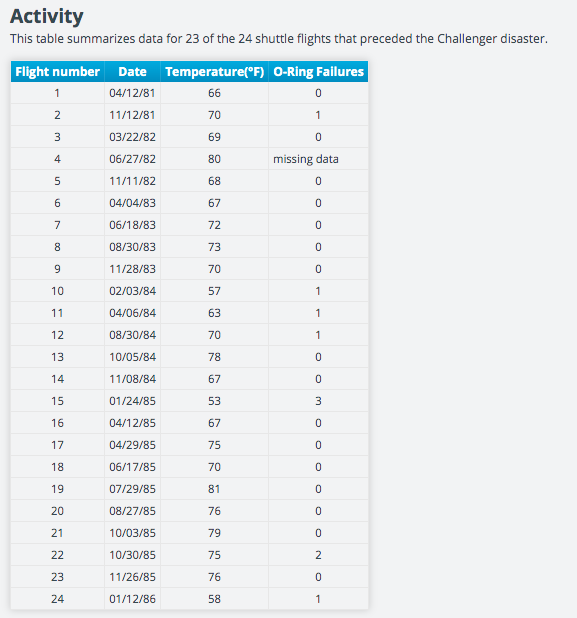
Activity This table summarizes data for 23 of the 24 shuttle flights that preceded the Challenger disaster. Flight number Date Temperature('F) O-Ring Failures 1 04/12/81 66 11/12/81 70 WU 03/22/82 69 O 06/27/82 80 missing data un 11/11/82 68 04/04/83 67 0 06/18/83 72 CO 08/30/83 73 11/28/83 70 10 02/03/84 57 11 04/06/84 63 12 08/30/84 70 13 10/05/84 78 14 11/08/84 67 15 01/24/85 53 16 04/12/85 67 17 04/29/85 75 18 06/17/85 70 19 07/29/85 81 20 08/27/85 76 21 10/03/85 79 22 10/30/85 75 23 11/26/85 76 O N O O O O O O WO O 24 01/12/86 58
Step by Step Solution
There are 3 Steps involved in it

Get step-by-step solutions from verified subject matter experts
 Study Help