







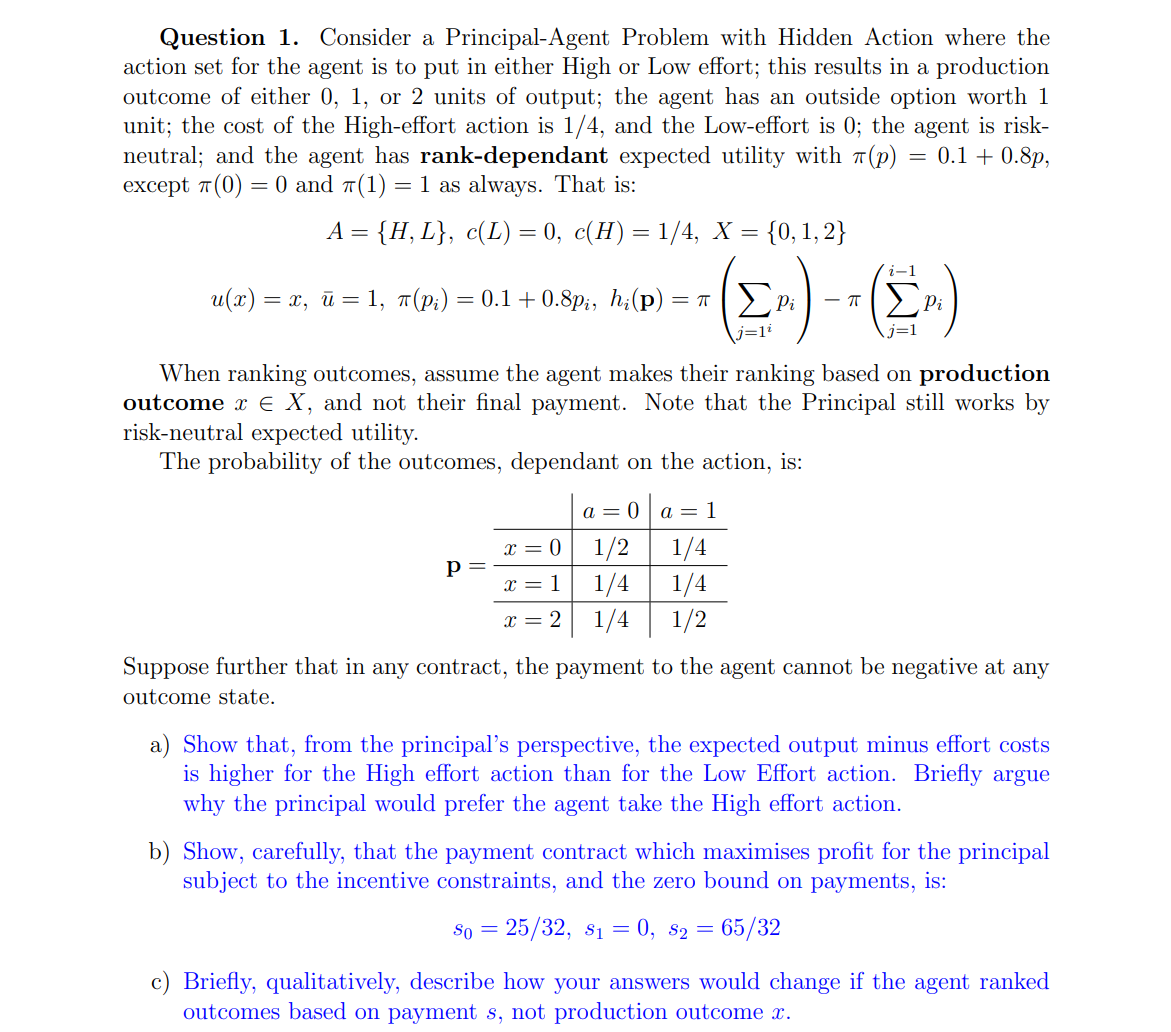
Question: . Question 1. Consider a Principal-Agent Problem with Hidden Action where the action set for the agent is to put in either High or Low
.
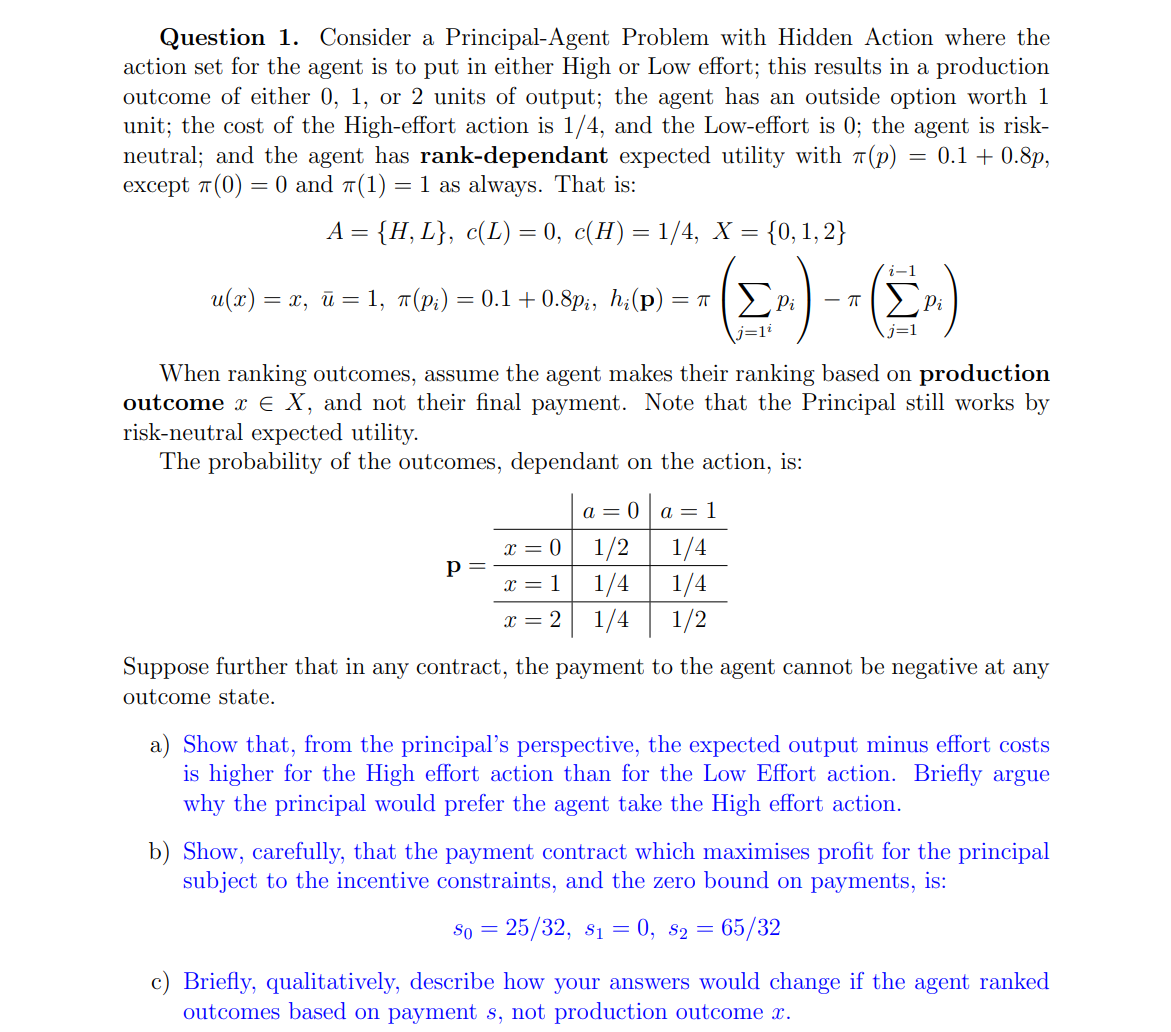
Question 1. Consider a Principal-Agent Problem with Hidden Action where the action set for the agent is to put in either High or Low effort; this results in a production outcome of either 0, 1, or 2 units of output; the agent has an outside option worth 1 unit; the cost of the High-effort action is 1/4, and the Low-effort is 0; the agent is risk- neutral; and the agent has rank-dependant expected utility with 7r(p) = 0.1 + 0.810, except 7r(0) = 0 and :rr{1) = 1 as always. That is: A: {Ha-L}! C(L):O, C(H) : 1/4: X: {03132} 215(33) = 9:, = 1, 7r(p,-) = 0.1 +0.8p,-, h,(p) = at 2,1),- 7r (1:10,) 3:21: j=1 When ranking outcomes, assume the agent makes their ranking based on production outcome 3: E X, and not their nal payment. Note that the Principal still works by risk-neutral expected utility. The probability of the outcomes, dependant on the action, is: Suppose further that in any contract, the payment to the agent cannot be negative at any outcome state. a) Show that, from the principal's perspective, the expected output minus effort costs is higher for the High effort action than for the Low Effort action Briey argue why the principal would prefer the agent take the High effort action. b) Show, carefully, that the payment contract which maximises prot for the principal subject to the incentive constraints, and the zero bound on payments, is: so = 25/32, 51 = U, 52 = 55/32 c) Briey, qualitatively, describe how your answers would change if the agent ranked outcomes based on payment 3, not production outcome as
Step by Step Solution
There are 3 Steps involved in it

Get step-by-step solutions from verified subject matter experts
 Study Help