







Question: Question 1: Consider a random complex-valued signal x, where the real and imaginary parts are independently drawn from a uniform distribution over the range [0,1].
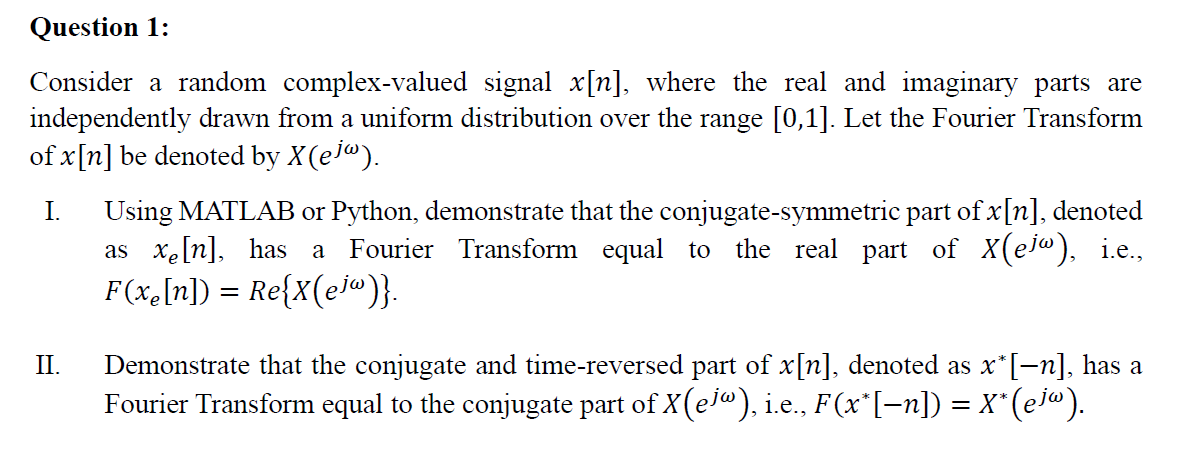
Question 1: Consider a random complex-valued signal x, where the real and imaginary parts are independently drawn from a uniform distribution over the range [0,1]. Let the Fourier Transform of x [n] be denoted by X(eiw). I. Using MATLAB or Python, demonstrate that the conjugate-symmetric part of x [n], denoted as Xen], has a Fourier Transform equal to the real part of X(ew), i.e., F(Xe[n]) = Re{x(eiw)} II. Demonstrate that the conjugate and time-reversed part of x [n], denoted as x*[-n], has a Fourier Transform equal to the conjugate part of X(el@ ), i.e., F(x*[-n]) = x*(eiw)
Step by Step Solution
There are 3 Steps involved in it
1 Expert Approved Answer
Step: 1 Unlock

Question Has Been Solved by an Expert!
Get step-by-step solutions from verified subject matter experts
Step: 2 Unlock
Step: 3 Unlock
 Study Help