







Question: Question 1 Consider a simultaneous move game where two identical firms with constant marginal costs set quantities of a homogeneous product. In this question, firms
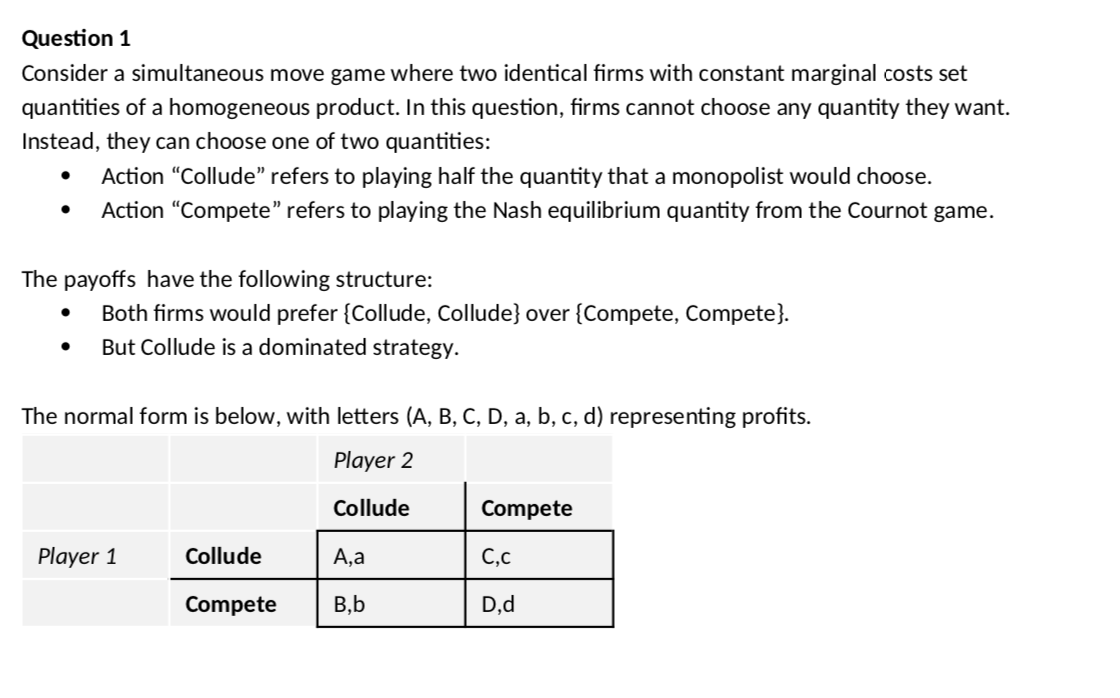
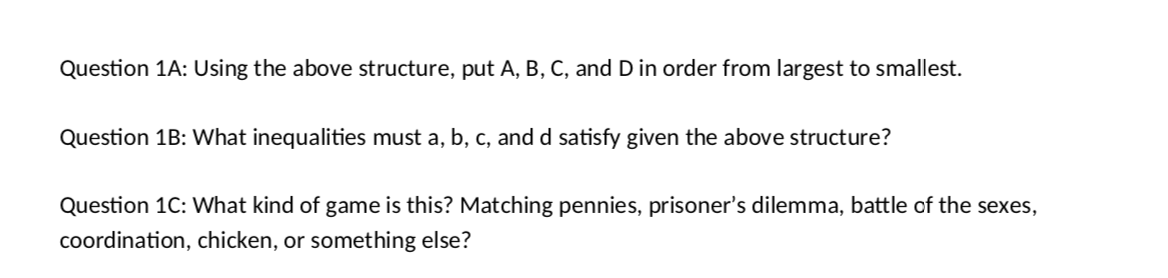
Question 1 Consider a simultaneous move game where two identical firms with constant marginal costs set quantities of a homogeneous product. In this question, firms cannot choose any quantity they want. Instead, they can choose one of two quantities: Action "Collude" refers to playing half the quantity that a monopolist would choose Action "Compete" refers to playing the Nash equilibrium quantity from the Cournot game. The payoffs have the following structure: Both firms would prefer {Collude, Collude} over {Compete, Compete But Collude is a dominated strategy The normal form is below, with letters (A, B, C, D, a, b, c, d) representing profits. Player 2 Collude Compete Collude Player 1 , , Compete ,b D,d Question 1A: Using the above structure, put A, B, C, and Din order from largest to smallest. Question 1B: What inequalities must a, b, c, and d satisfy given the above structure? Question 1C: What kind of game is this? Matching pennies, prisoner's dilemma, battle of the sexes, coordination, chicken, or something else? Question 1 Consider a simultaneous move game where two identical firms with constant marginal costs set quantities of a homogeneous product. In this question, firms cannot choose any quantity they want. Instead, they can choose one of two quantities: Action "Collude" refers to playing half the quantity that a monopolist would choose Action "Compete" refers to playing the Nash equilibrium quantity from the Cournot game. The payoffs have the following structure: Both firms would prefer {Collude, Collude} over {Compete, Compete But Collude is a dominated strategy The normal form is below, with letters (A, B, C, D, a, b, c, d) representing profits. Player 2 Collude Compete Collude Player 1 , , Compete ,b D,d Question 1A: Using the above structure, put A, B, C, and Din order from largest to smallest. Question 1B: What inequalities must a, b, c, and d satisfy given the above structure? Question 1C: What kind of game is this? Matching pennies, prisoner's dilemma, battle of the sexes, coordination, chicken, or something else
Step by Step Solution
There are 3 Steps involved in it

Get step-by-step solutions from verified subject matter experts
 Study Help