







Question: Question 1: Consider four wireless nodes (A, B, C, D). The radio coverage is shown in the attached figure. When A transmits, it can only
Question 1:
Consider four wireless nodes (A, B, C, D). The radio coverage is shown in the attached figure. When A transmits, it can only be heard/received by B; when B transmits, it is heard/received by C; when C transmits, it is heard/received by B and D; when D transmits, only C can hear/receive it.
Suppose each node has an infinite supply of messages it can send to other nodes, and that all share the same frequency. If a message's destination is not an immediate neighbor, then the message must be relayed (e.g., A can communicate with D by having its messages relayed through B and C).
Time is slotted, with a message transmission between neighboring nodes taking exactly one slot. During a slot, a node can do one of three things: (i) send a message; (ii) receive a message; (iii) remain silent. If a node hears two or more simultaneous transmissions, a collision occurs and none of the transmissions is correctly received. Ignore all other potential sources of message errors (such as bit errors caused by fading).
Suppose, further, that there is an omniscient controller that has perfect information of network conditions and can schedule transmissions between nodes in an optimal way.
Finally, suppose a data message is to be transferred from C to A. What is the maximum rate at which this transfer can occur, given that there are no other messages between othsource/destination pairs, expressed as messages/slot.
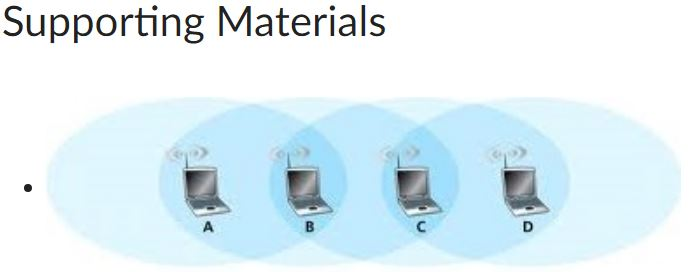
Qeustion 2:
Consider the same scenario as in Question 1 in this Part, but with a different traffic pattern. Now, A wants to send messages to B and D wants to send messages to C. There is no other traffic in the network. The maximum combined (aggregate) rate at which messages can flow is ______ messages/slot.
Qeustion 3:
Consider the same scenario as in Question 1 in this Part, but with a different traffic pattern. Now, A wants to send messages to B and C wants to send messages to D. There is no other traffic in the network. The maximum combined (aggregate) rate at which messages can flow is ________ messages/slot.
Qeustion 4
Consider the same scenario as in Question 1 in this Part, but now for every data message sent from source to destination, the destination will send an ACK back to the source (as in TCP). Also suppose that each ACK takes one time slot. Suppose that C wants to send to A, and there is no other traffic in the network. The maximum rate at which the transfer of data messages between these two nodes can occur is ________ messages/slot.
Supporting Materials Supporting Materials
Step by Step Solution
There are 3 Steps involved in it

Get step-by-step solutions from verified subject matter experts
 Study Help