







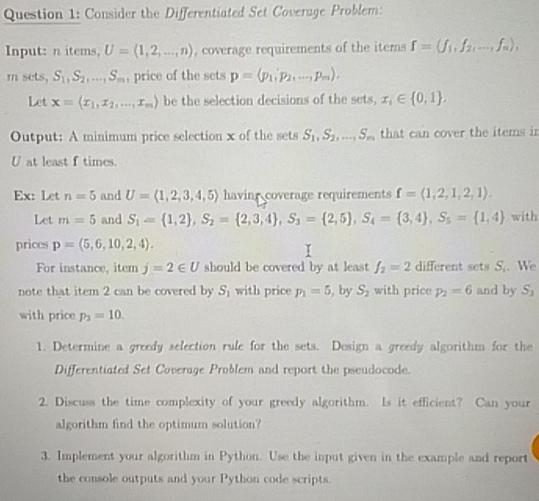
Question: Question 1 : Consider the Differentiated Set Coveruge Problem: Input: n items, U = ( 1 , 2 , dots, n ) , coverage requirements
Question : Consider the Differentiated Set Coveruge Problem:
Input: items, dots, coverage requirements of the itema dots, sets, dots, price of the sets dots,
Let dots, be the selection decisions of the sets,
Output: A minimum price selection of the sets dots, that can cover the items is at least f times.
Ex: Let and luving coverage requirements
Let and with prices
For instance, item inU should be covered by at least different sets We note that item can be concred by with price by with price and by with price
Determine a grody selection rule for the sets. Design a greedy algorithen for the Differentiated Set Coverage Problem and report the poeudocode.
Discus the time comploxity of your srecdy atgorithm. Is it efficient? Can your algorithm find the optimum solution?
Implement your algotitim in Python. Uke the inpat given in the example ad report the console outputs and your Python code scripts.
Step by Step Solution
There are 3 Steps involved in it
1 Expert Approved Answer
Step: 1 Unlock

Question Has Been Solved by an Expert!
Get step-by-step solutions from verified subject matter experts
Step: 2 Unlock
Step: 3 Unlock
 Study Help