


Question: Question 1) Consider the following problem. Maximize Z=2x, +7x, +4x3, Subject to x + 2x, +x, S6 3x, +3x, +2x, so And x 20, x,
Question 1) Consider the following problem.

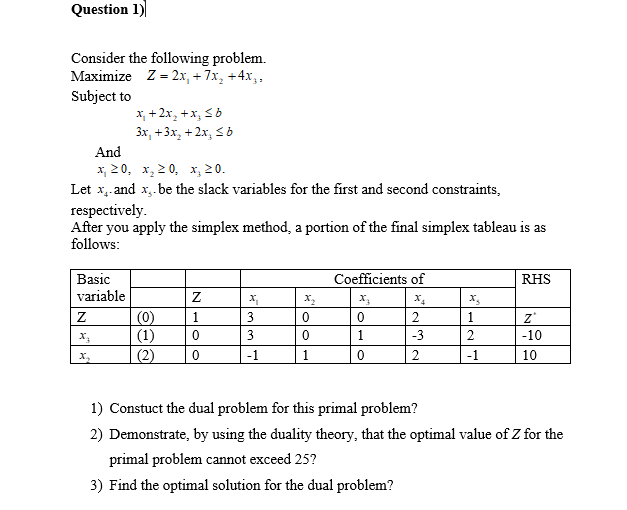
Question 1) Consider the following problem. Maximize Z=2x, +7x, +4x3, Subject to x + 2x, +x, S6 3x, +3x, +2x, so And x 20, x, 20, X, 20. Let x, and x, be the slack variables for the first and second constraints, respectively. After you apply the simplex method, a portion of the final simplex tableau is as follows: Coefficients of RHS Basic variable z Z 0 (0) (1) (2) 1 0 3 3 -1 0 1 2 -3 2 0 1 2 -1 Z -10 X 0 1 0 10 1) Constuct the dual problem for this primal problem? 2) Demonstrate, by using the duality theory, that the optimal value of Z for the primal problem cannot exceed 25? 3) Find the optimal solution for the dual problem? Question 1) Consider the following problem. Maximize Z=2x, +7x, +4x3, Subject to x + 2x, +x, S6 3x, +3x, +2x, so And x 20, x, 20, X, 20. Let x, and x, be the slack variables for the first and second constraints, respectively. After you apply the simplex method, a portion of the final simplex tableau is as follows: Coefficients of RHS Basic variable z Z 0 (0) (1) (2) 1 0 3 3 -1 0 1 2 -3 2 0 1 2 -1 Z -10 X 0 1 0 10 1) Constuct the dual problem for this primal problem? 2) Demonstrate, by using the duality theory, that the optimal value of Z for the primal problem cannot exceed 25? 3) Find the optimal solution for the dual

Step by Step Solution

There are 3 Steps involved in it

1 Expert Approved Answer
Step: 1 Unlock blur-text-image

Question Has Been Solved by an Expert!

Get step-by-step solutions from verified subject matter experts

Step: 2 Unlock
Step: 3 Unlock

Students Have Also Explored These Related General Management Questions!