



Question: Question 1 Consider the language L_() over the alphabet consisting of the set of proposition symbols ={P_(1),cdots,P_(i),cdots} , and punctuation symbols (and), and connective symbols
Question 1\ Consider the language
L_()over the alphabet consisting of the set of proposition symbols\
={P_(1),cdots,P_(i),cdots}, and punctuation symbols (and), and connective symbols\
not,vv,^(^()),=>.\ Which of the following expressions is a well-formed formula?\ a).
(P_(1)^(^())not(P_(2)vvP_(3)))\ b).
(not(P_(2)=>P_(1))^(^())(P_(3)vvP_(4)))\ c).
(P_(4)vv(P_(3)^(^())P_(1)=>P_(2)))\ d).
((P_(5)=>((notP_(4))vvP_(3)))^(^())(notP_(1)))\ e)
(P_(7)vv(notP_(7)))=>P_(3)\ f)
(P_(1)^(^())(P_(2)vvP_(3))=>P_(4))\ g).
((P_(7)vvP_(3))=>(notP_(1)^(^())P_(2))) 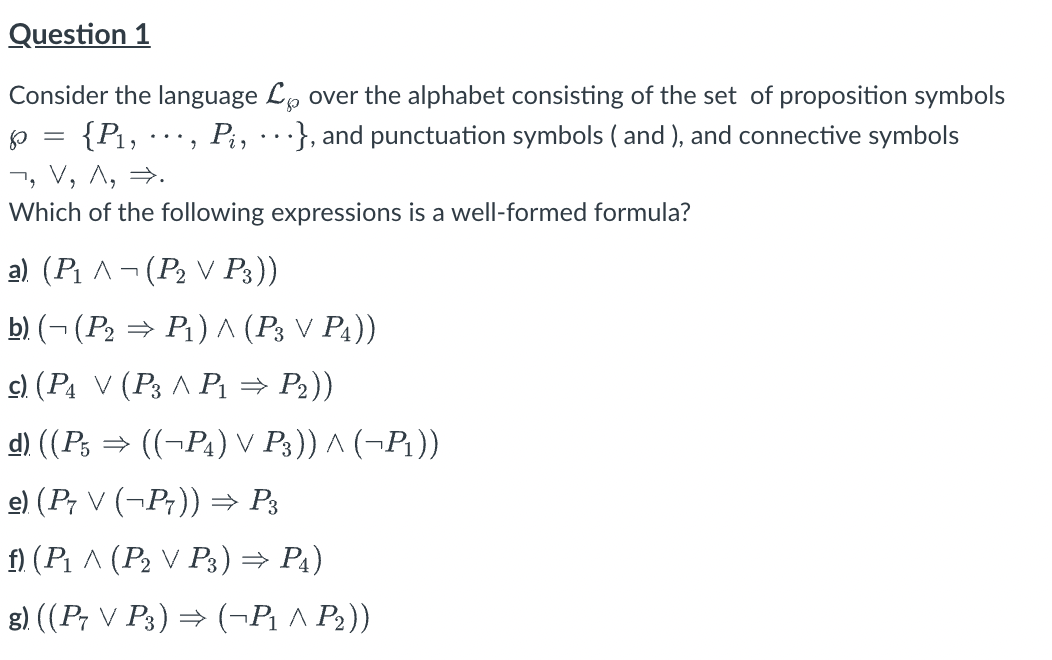
Consider the language L over the alphabet consisting of the set of proposition symbols ={P1,,Pi,}, and punctuation symbols ( and ), and connective symbols ,,,. Which of the following expressions is a well-formed formula? a). (P1(P2P3)) b). ((P2P1)(P3P4)) c). (P4(P3P1P2)) d). ((P5((P4)P3))(P1)) e) (P7(P7))P3 f) (P1(P2P3)P4) g). ((P7P3)(P1P2))
Step by Step Solution
There are 3 Steps involved in it
1 Expert Approved Answer
Step: 1 Unlock

Question Has Been Solved by an Expert!
Get step-by-step solutions from verified subject matter experts
Step: 2 Unlock
Step: 3 Unlock