







Question: QUESTION 1 Course Learning Outcome (CLO) 1: Critically evaluate contemporary issues, theories and empirical research evidence in financial and management accounting, including strengths and limitations.
QUESTION 1 Course Learning Outcome (CLO) 1: Critically evaluate contemporary issues, theories and empirical research evidence in financial and management accounting, including strengths and limitations. International Financial Reporting Standards (IFRS) and General Accepted Accounting Principles (GAAP) have disagreement in the treatments to some of accounts in financial statements. Based on the above statement, discuss the disagreement in the accounting treatment or standards utilized by Exxon Mobil and Royal Dutch Shell (Shell). [Total: 25 marks] QUESTION 2 Course Learning Outcome (CLO) 2: Explain the implications and relevance of the current knowledge boundaries in accounting theory. Discuss FOUR (4) areas where Accounting and Auditing Organization for Islamic Financial Institutions (AAOIFI) standards differ with Malaysian Accounting Standard Boards (MASB) standards. [Total: 25 marks] . BAA3733 ACCOUNTING THEORY & PRACTICE Page 2 of 6 QUESTION 3 Course Learning Outcome (CLO) 3: Critically evaluate some alternative technical approaches and extensions to accounting theory and practice. Relevance and reliability are two cores principles that have to be met by accountants in order to assist and guide users to make decisions. However, some regards these two principles as two competing attributes in a piece of information, and others said these two are complementary. Based on the statement above, justify your understanding regarding this accounting matter by referring to relevant scholars' reasoning, sources or examples. [Total: 25 marks] QUESTION 4 Course Learning Outcome (CLO) 4: Recognize some of the implications of alternative national and cultural contexts in which accounting can be seen as operating and how accounting theory may be applied to complex multinational businesses. Social accounting involves the identifications and recording of the social responsibility activities conducted by an entity. This aspect is shown in the company's annual report. The following are a few of large companies that prepare the non-financial report. i. Adidas ii. Microsoft iii. Dutch Lady. Based on the above information, choose ONE (1) of the companies listed, discuss on how the social accounting information is delivered and to what extent the social accounting beneficial to the users.
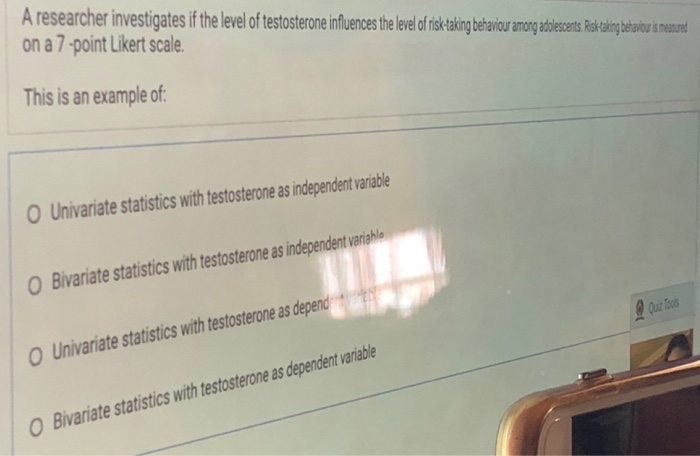
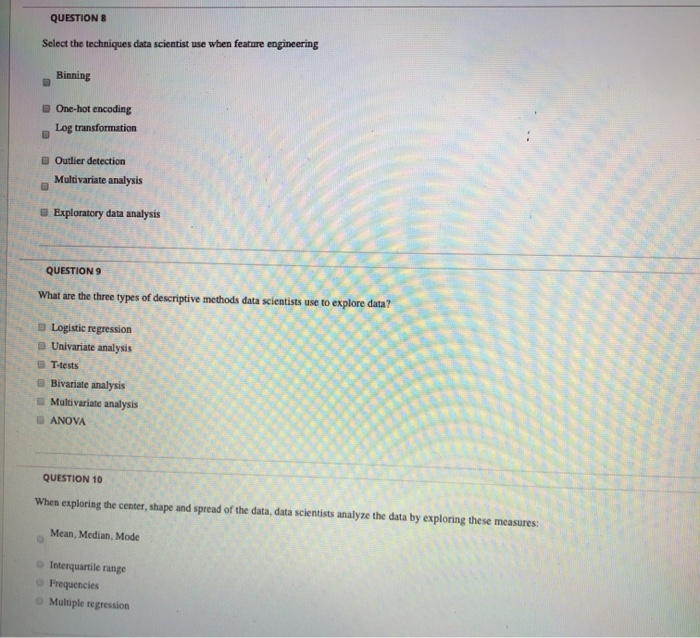
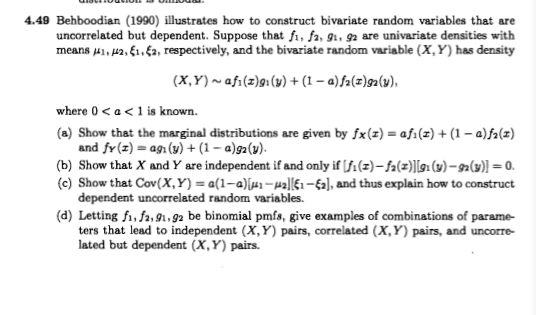
on a 7 -point Likert scale. A researcher investigates if the level of testosterone influences the level of risk-taking behaviour among adolescents. Risk taking behaviour is measured This is an example of: O Univariate statistics with testosterone as independent variable O Bivariate statistics with testosterone as independent variable O Univariate statistics with testosterone as dependent Quiz Took O Bivariate statistics with testosterone as dependent variableQUESTION B Select the techniques data scientist use when feature engineering Binning One-hot encoding Log transformation Outlier detection Multivariate analysis Exploratory data analysis QUESTION 9 What are the three types of descriptive methods data scientists use to explore data? Logistic regression Univariate analysis T-tests Bivariate analysis Multivariate analysis ANOVA QUESTION 10 When exploring the center, shape and spread of the data, data scientists analyze the data by exploring these measures: Mean, Median, Mode Interquartile range O Frequencies Multiple regression4.49 Behboodian (1990) illustrates how to construct bivariate random variables that are uncorrelated but dependent. Suppose that f1, fa, 91, 92 are univariate densities with means /41, un, 1, Ca, respectively, and the bivariate random variable (X, Y) has density (X, Y) ~ afi(z)gi(y) + (1 - a)/=(x)ga(y). where 0
Step by Step Solution
There are 3 Steps involved in it

Get step-by-step solutions from verified subject matter experts
 Study Help