





Question: Question 1 Define the following terms: 1. Risk 2. Probability distribution 3. Standard deviation 4. Required rate of return 5. Coefficient of variation 6. Efficient
Question 1 Define the following terms: 1. Risk 2.Question 1 Define the following terms: 1. Risk 2.Question 1 Define the following terms: 1. Risk 2.
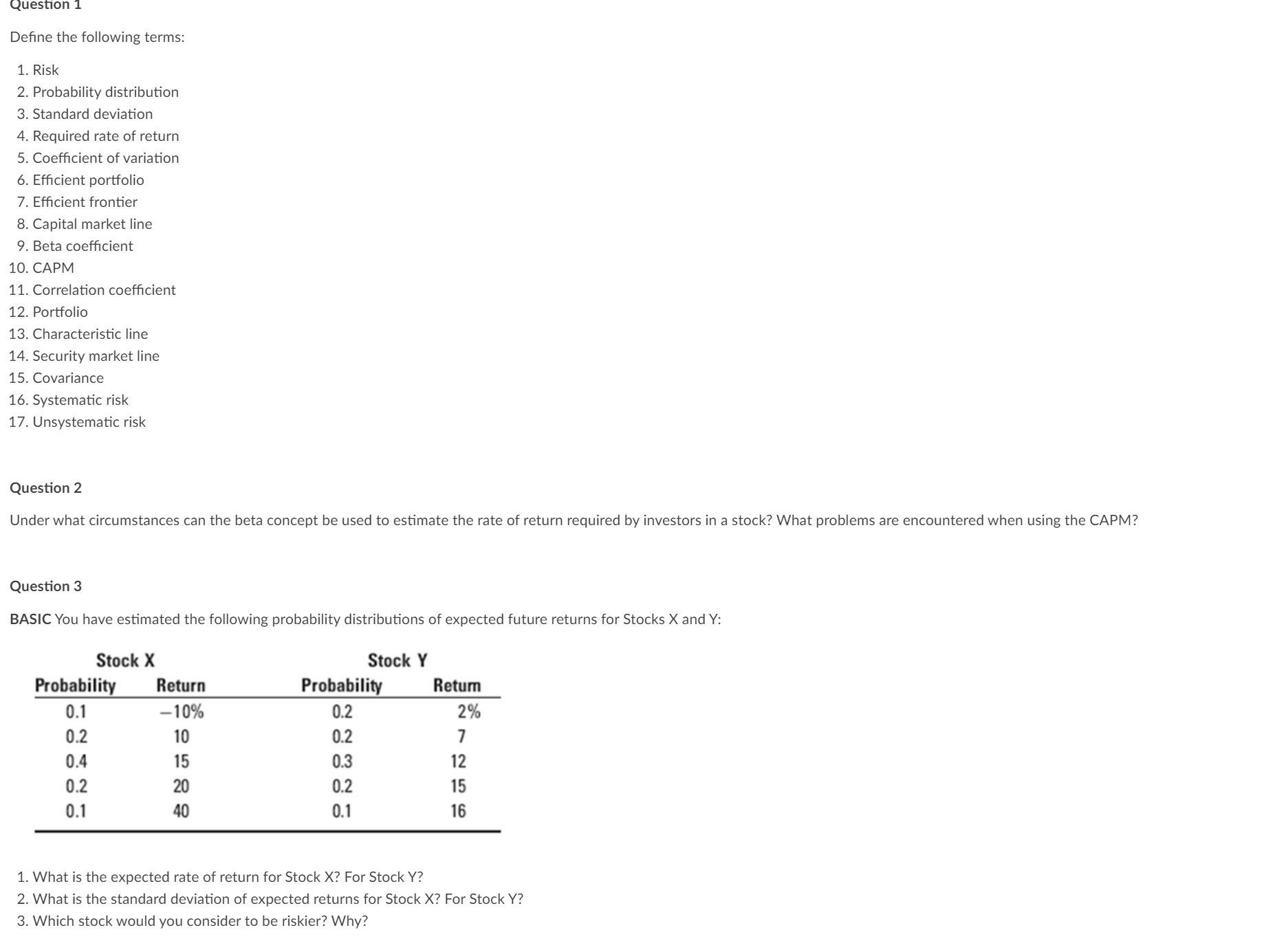
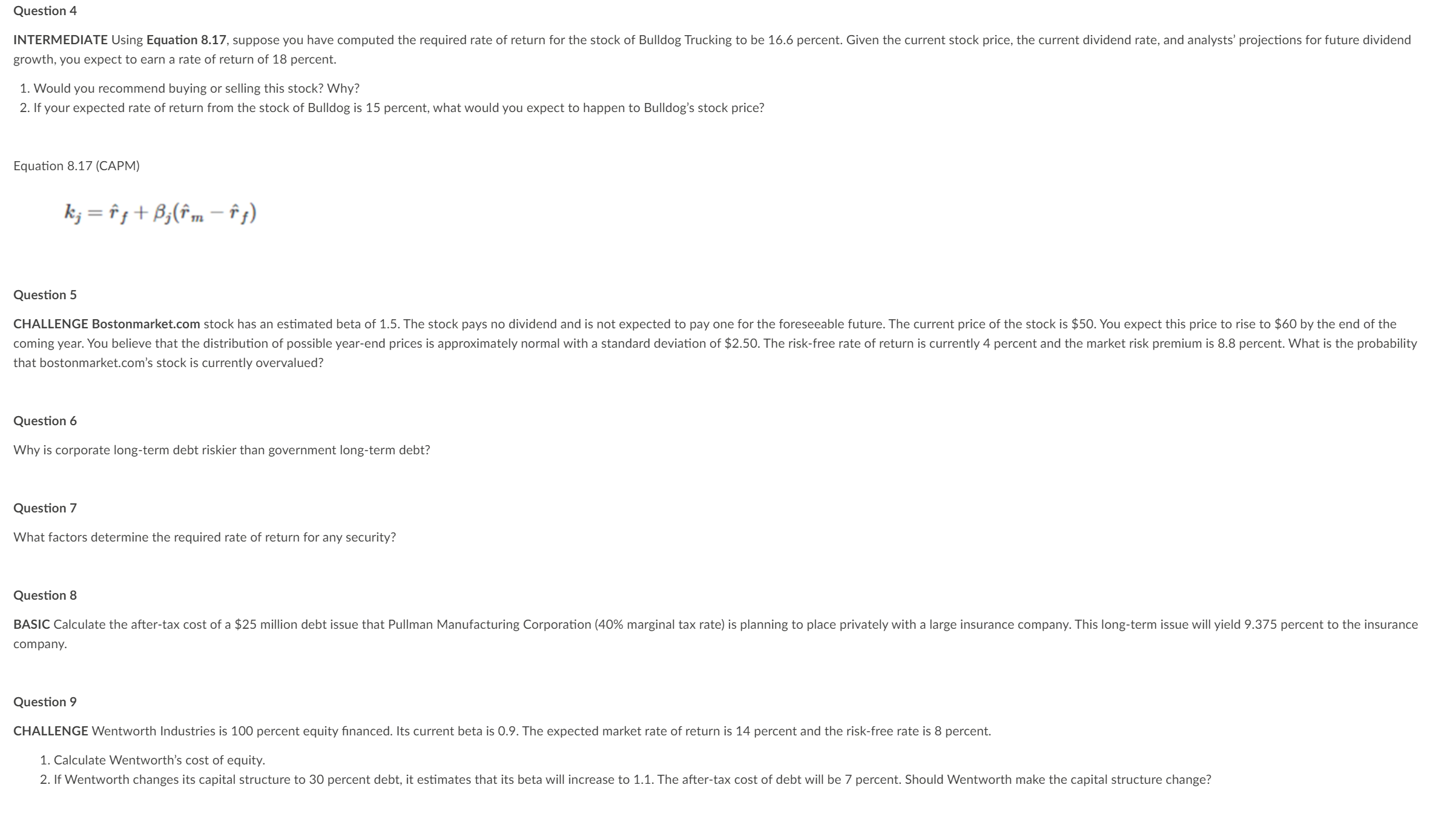
Question 1 Define the following terms: 1. Risk 2. Probability distribution 3. Standard deviation 4. Required rate of return 5. Coefficient of variation 6. Efficient portfolio 7. Efficient frontier 8. Capital market line 9. Beta coefficient 10. CAPM 11. Correlation coefficient 12. Portfolio 13. Characteristic line 14. Security market line 15. Covariance 16. Systematic risk 17. Unsystematic risk Question 2 Under what circumstances can the beta concept be used to estimate the rate of return required by investors in a stock? What problems are encountered when using the CAPM? Question 3 BASIC You have estimated the following probability distributions of expected future returns for Stocks X and Y: Stock X Stock Y Probability Return Probability Retum 0.1 -10% 0.2 2% 0.2 10 0.2 7 04 15 0.3 12 0.2 20 0.2 15 0.1 40 0.1 16 1. What is the expected rate of return for Stock X? For Stock Y? 2. What is the standard deviation of expected returns for Stock X? For Stock Y? 3. Which stock would you consider to be riskier? Why? Question 4 INTERMEDIATE Using Equation 8.17, suppose you have computed the required rate of return for the stock of Bulldog Trucking to be 16.6 percent. Given the current stock price, the current dividend rate, and analysts' projections for future dividend growth, you expect to earn a rate of return of 18 percent. 1. Would you recommend buying or selling this stock? Why? 2. If your expected rate of return from the stock of Bulldog is 15 percent, what would you expect to happen to Bulldog's stock price? Equation 8.17 (CAPM) kj =77+ Bi(Fm 75) Question 5 CHALLENGE Bostonmarket.com stock has an estimated beta of 1.5. The stock pays no dividend and is not expected to pay one for the foreseeable future. The current price of the stock is $50. You expect this price to rise to $60 by the end of the coming year. You believe that the distribution of possible year-end prices is approximately normal with a standard deviation of $2.50. The risk-free rate of return is currently 4 percent and the market risk premium is 8.8 percent. What is the probability that bostonmarket.com's stock is currently overvalued? Question 6 Why is corporate long-term debt riskier than government long-term debt? Question 7 What factors determine the required rate of return for any security? Question 8 BASIC Calculate the after-tax cost of a $25 million debt issue that Pullman Manufacturing Corporation (40% marginal tax rate) is planning to place privately with a large insurance company. This long-term issue will yield 9.375 percent to the insurance company. Question 9 CHALLENGE Wentworth Industries is 100 percent equity financed. Its current beta is 0.9. The expected market rate of return is 14 percent and the risk-free rate is 8 percent. 1. Calculate Wentworth''s cost of equity. 2. If Wentworth changes its capital structure to 30 percent debt, it estimates that its beta will increase to 1.1. The after-tax cost of debt will be 7 percent. Should Wentworth make the capital structure change? Question 10 INTERMEDIATE The Folske Fan Corporation has four divisions: Proportion of Division Firm's Assets Consumer products 50% Consulting 10 Industrial products 30 Financial services 10 The (leveraged) beta for Folske has been estimated to be 1.25. The company believes that the (leveraged) beta for consumer products is 1.2; for consulting, 1.3; and for financial services, 1.5. The appropriate capital structure for the industrial products division is 70 percent equity and 30 percent debt (and all projects in that division are currently financed in those proportions). The firm's consolidated capital structure consists of 60 percent equity and 40 percent debt. The risk-free rate is 9 percent, and the market risk premium is 8.6 percent. Folske's marginal tax rate is 40 percent. What is the minimum rate of return that Folske should demand on the equity-financed portion of investments in its industrial products division, assuming these investments continue to be financed with 70 percent equity and 30 percent debt
Step by Step Solution

There are 3 Steps involved in it

1 Expert Approved Answer
Step: 1 Unlock blur-text-image
Question Has Been Solved by an Expert!

Get step-by-step solutions from verified subject matter experts

Step: 2 Unlock
Step: 3 Unlock

Students Have Also Explored These Related Finance Questions!