







Question: Question 1 ( Deflection - based pavement design using Burmister two - laver theory ) An early - day pavement design method relies on limiting
Question Deflectionbased pavement design using Burmister twolaver theory
An earlyday pavement design method relies on limiting the maximum pavement surface deflection to within mm under a selected wheel load. It also involves performing a plate bearing test to determine subgrade soil properties.
A plate bearing test at a construction site performed directly on the subgrade produces a deflection of The applied load is kN and the loading plate has a diameter of mm The same test performed on a trial section with mm thick pavement placed on the subgrade gives a deflection of
Given that the selected design wheel load weighs ton with a tyre pressure of determine the required pavement thickness using Burmister twolayer theory. Assume for all materials.
Hints: three steps analyses are required as follows:
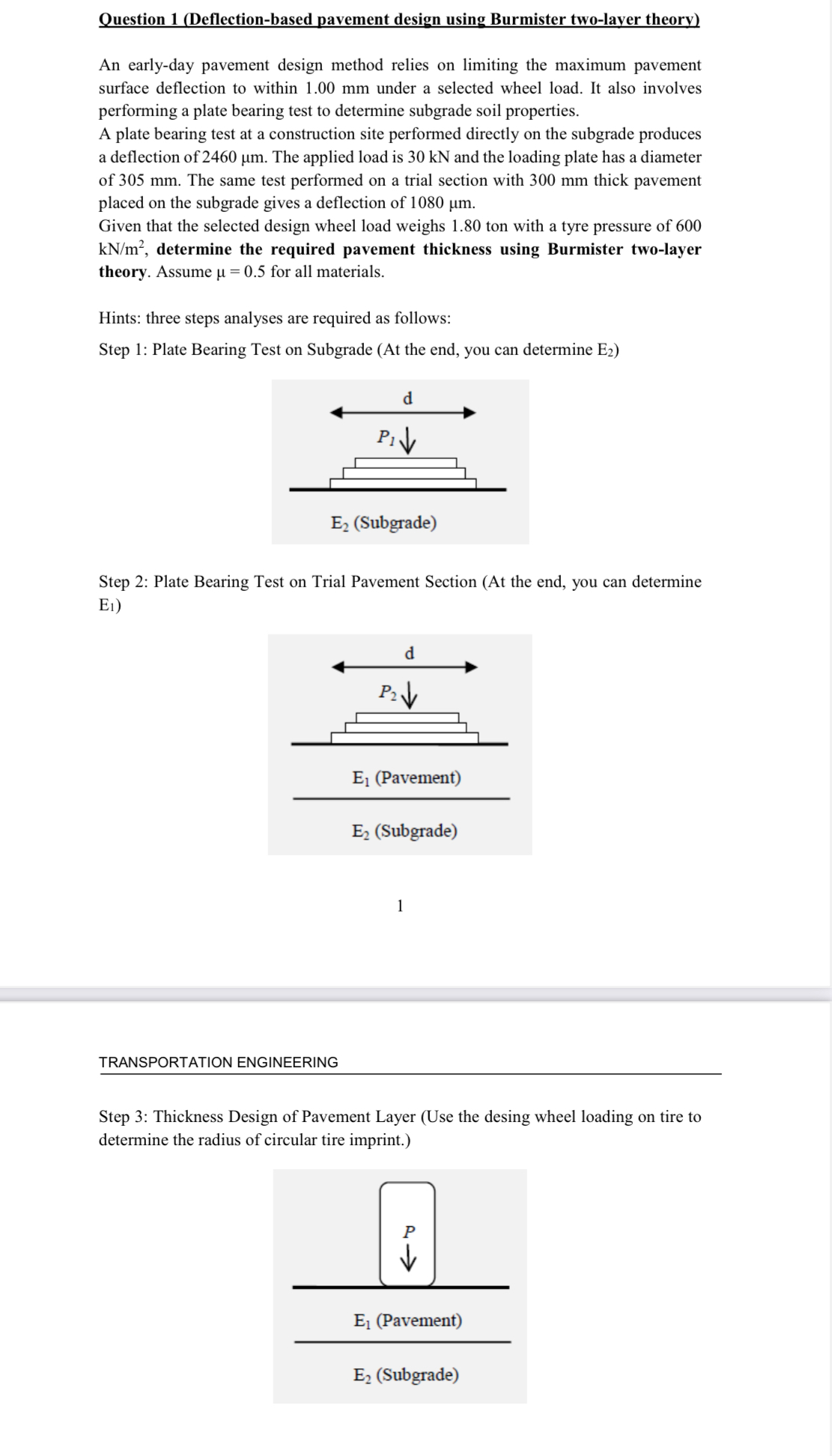
Step : Plate Bearing Test on Subgrade At the end, you can determine
Step : Plate Bearing Test on Trial Pavement Section At the end, you can determine
TRANSPORTATION ENGINEERING
Step : Thickness Design of Pavement Layer Use the desing wheel loading on tire to determine the radius of circular tire imprint.P
Step by Step Solution
There are 3 Steps involved in it
1 Expert Approved Answer
Step: 1 Unlock

Question Has Been Solved by an Expert!
Get step-by-step solutions from verified subject matter experts
Step: 2 Unlock
Step: 3 Unlock
 Study Help