







Question: Question 1 Entity - Relationship ( ER ) and Enhanced ER ( EER ) Modeling ( 4 0 Marks ) Task 1 : Complex ER
Question
EntityRelationship ER and Enhanced ER EER Modeling Marks
Task : Complex ER Diagram
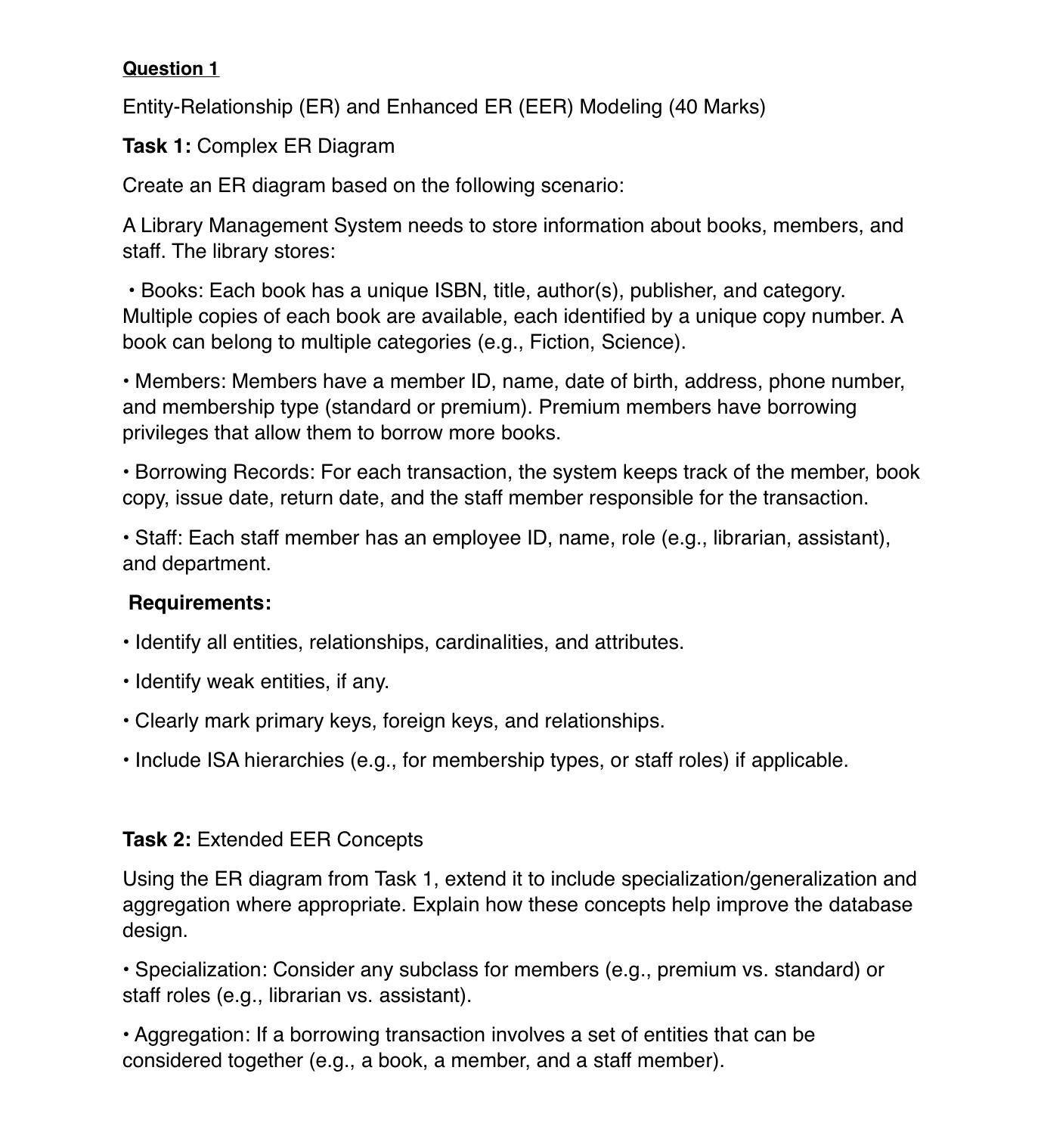
Create an ER diagram based on the following scenario:
A Library Management System needs to store information about books, members, and staff. The library stores:
Books: Each book has a unique ISBN, title, authors publisher, and category. Multiple copies of each book are available, each identified by a unique copy number. A book can belong to multiple categories eg Fiction, Science
Members: Members have a member ID name, date of birth, address, phone number, and membership type standard or premium Premium members have borrowing privileges that allow them to borrow more books.
Borrowing Records: For each transaction, the system keeps track of the member, book copy, issue date, return date, and the staff member responsible for the transaction.
Staff: Each staff member has an employee ID name, role eg librarian, assistant and department.
Requirements:
Identify all entities, relationships, cardinalities, and attributes.
Identify weak entities, if any.
Clearly mark primary keys, foreign keys, and relationships.
Include ISA hierarchies eg for membership types, or staff roles if applicable.
Task : Extended EER Concepts
Using the ER diagram from Task extend it to include specializationgeneralization and aggregation where appropriate. Explain how these concepts help improve the database design.
Specialization: Consider any subclass for members eg premium vs standard or staff roles eg librarian vs assistant
Aggregation: If a borrowing transaction involves a set of entities that can be considered together eg a book, a member, and a staff member
Step by Step Solution
There are 3 Steps involved in it
1 Expert Approved Answer
Step: 1 Unlock

Question Has Been Solved by an Expert!
Get step-by-step solutions from verified subject matter experts
Step: 2 Unlock
Step: 3 Unlock
 Study Help