







Question: Question 1 : Explain the operations management transformation process demonstrated by FamilyMart Co. Tips: Answer try to related above study material - Explain the transformation
 Question 1 : Explain the operations management transformation process demonstrated by FamilyMart Co.
Tips:
Answer try to related above study material
- Explain the transformation process ( input-process-output) in operation management
-Identify and explain what's the Input components in Family Mart : For example, employees, store, materials, equipment, layout, facilities, building, certification. Explain the importance of input in the process.
-Identify and explain what is the process in FamilyMart : activities related to Transforming process that make sure input to convert to output. For example, may explain 2 important process - inventory planning , restocking and another one the billings.
--Identify and explain what is the process in FamilyMart : what are the one important output ( example billing, customer order fulfilled) and explain how do you measure example customer experience.
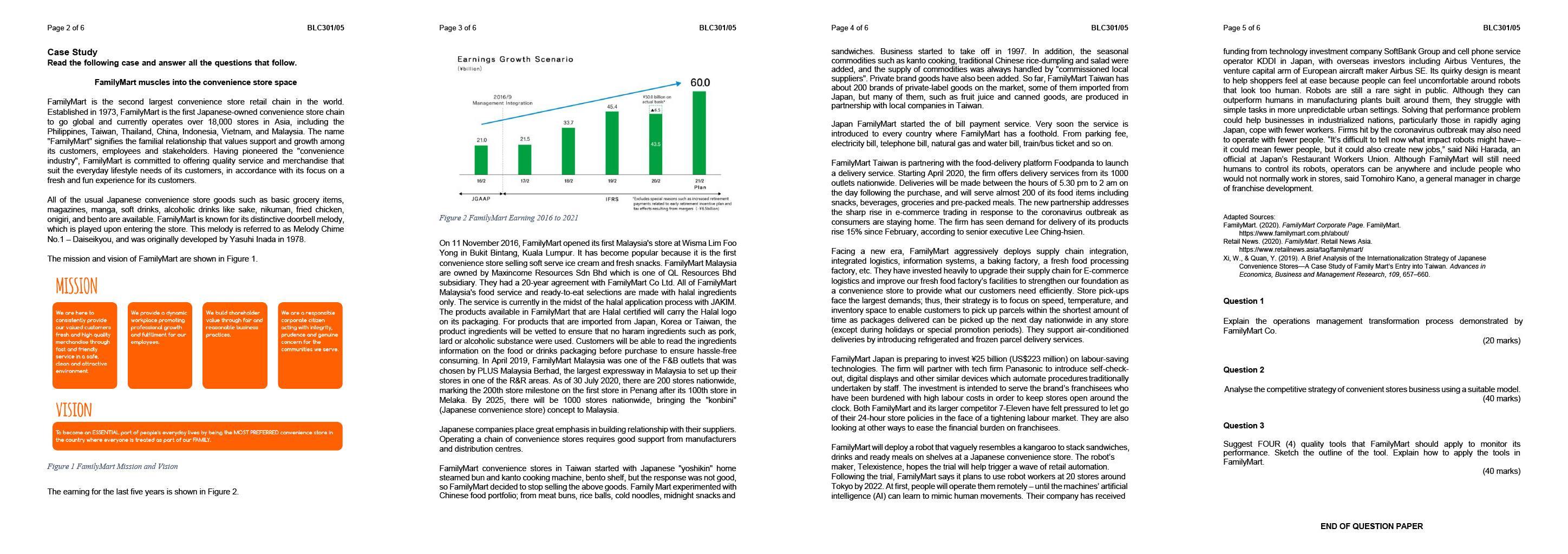
Page 4 of 6 BLC301/05 Page 5 of 6 BLC301/05 sandwiches. Business started to take off in 1997. In addition, the seasonal commodities such as kanto cooking, traditional Chinese rice-dumpling and salad were added, and the supply of commodities was always handled by "commissioned local suppliers". Private brand goods have also been added. So far, Family Mart Taiwan has about 200 brands of private-label goods on the market, some of them imported from Japan, but many of them, such as fruit juice and canned goods, are produced in partnership with local companies in Taiwan. 50,0 billion on actual basis A6.S 33.7 Japan Family Mart started the of bill payment service. Very soon the service is introduced to every country where Family Mart has a foothold. From parking fee, electricity bill, telephone bill, natural gas and water bill, train/bus ticket and so on. funding from technology investment company SoftBank Group and cell phone service operator KDDI in Japan, with overseas investors including Airbus Ventures, the venture capital arm of European aircraft maker Airbus SE. Its quirky design is meant to help shoppers feel at ease because people can feel uncomfortable around robots that look too human. Robots are still a rare sight in public. Although they can outperform humans in manufacturing plants built around them, they struggle with simple tasks in more unpredictable urban settings. Solving that performance problem could help businesses in industrialized nations, particularly those in rapidly aging Japan, cope with fewer workers. Firms hit by the coronavirus outbreak may also need to operate with fewer people. "It's difficult to tell now what impact robots might have- it could mean fewer people, but it could also create new jobs," said Niki Harada, an official at Japan's Restaurant Workers Union. Although Family Mart will still need humans to control its robots, operators can be anywhere and include people who would not normally work in stores, said Tomohiro Kano, a general manager in charge of franchise development. 43.5 16/2 17/2 19/2 20/2 IFRS tax effects resulting from mergerstiepler and Page 2 of 6 BLC301/05 Page 3 of 6 BLC301/05 Case Study Read the following case and answer all the questions that follow. Earnings Growth Scenario (billion) FamilyMart muscles into the convenience store space 60.0 2016/9 FamilyMart is the second largest convenience store retail chain in the world. Management Integration 45.4 Established in 1973, Family Mart is the first Japanese-owned convenience store chain to go global and currently operates over 18,000 stores in Asia, including the Philippines, Taiwan, Thailand, China, Indonesia, Vietnam, and Malaysia. The name "Family Mart" signifies the familial relationship that values support and growth among 21.0 21.5 its customers, employees and stakeholders. Having pioneered the "convenience industry", Family Mart is committed to offering quality service and merchandise that suit the everyday lifestyle needs of its customers, in accordance with its focus on a fresh and fun experience for its customers. 2112 Plan All of the usual Japanese convenience store goods such as basic grocery items, JGAAP Excludes special reasons such as increased retirement payments related to early retirement magazines, manga, soft drinks, alcoholic drinks like sake, nikuman, fried chicken, onigiri, and bento are available. Family Mart is known for its distinctive doorbell melody, Figure 2 Family Mart Earning 2016 to 2021 which is played upon entering the store. This melody is referred to as Melody Chime No. 1 - Daiseikyou, and was originally developed by Yasuhi Inada in 1978. On 11 November 2016, Family Mart opened its first Malaysia's store at Wisma Lim Foo The mission and vision of Family Mart are shown in Figure 1. Yong in Bukit Bintang, Kuala Lumpur. It has become popular because it is the first convenience store selling soft serve ice cream and fresh snacks. Family Mart Malaysia are owned by Maxincome Resources Sdn Bhd which is one of QL Resources Bhd subsidiary. They had a 20-year agreement with Family Mart Co Ltd. All of FamilyMart Malaysia's food service and ready-to-eat selections are made with halal ingredients only. The service is currently in the midst of the halal application process with JAKIM. We are here to We provide a dynamic We build shoreholder We are a responsible The products available in Family Mart that are Halal certified will carry the Halal logo consistently provide workplace promoting value through fair and corporate citizen on its packaging. For products that are imported from Japan, Korea or Taiwan, the our valued customers professional growth reasonable business acting with integrity. fresh and high quality and fulfillment for our practices prudence and genuine product ingredients will be vetted to ensure that no haram ingredients such as pork, merchandise through employees concern for the lard or alcoholic substance were used. Customers will be able to read the ingredients fost and friendly communities we serve information on the food or drinks packaging before purchase to ensure hassle-free service in a safe clean and attractive consuming. In April 2019, Family Mart Malaysia was one of the F&B outlets that was environment chosen by PLUS Malaysia Berhad, the largest expressway in Malaysia to set up their stores in one of the R&R areas. As of 30 July 2020, there are 200 stores nationwide, marking the 200th store milestone on the first store in Penang after its 100th store in Melaka. By 2025, there will be 1000 stores nationwide, bringing the "konbini" (Japanese convenience store) concept to Malaysia. Family Mart Taiwan is partnering with the food delivery platform Foodpanda to launch a delivery service. Starting April 2020, the firm offers delivery services from its 1000 outlets nationwide. Deliveries will be made between the hours of 5.30 pm to 2 am on the day following the purchase, and will serve almost 200 of its food items including snacks, beverages, groceries and pre-packed meals. The new partnership addresses the sharp rise in e-commerce trading in response to the coronavirus outbreak as consumers are staying home. The firm has seen demand for delivery of its products rise 15% since February, according to senior executive Lee Ching-hsien. Adapted Sources: Family Mart. (2020). Family Mart Corporate Page. FamilyMart. https://www.familymart.com.ph/about/ Retail News. (2020). Family Mart. Retail News Asia. https://www.retailnews.asia/tag/familymart Xi, W., & Quan, Y. (2019). A Brief Analysis of the Internationalization Strategy of Japanese Convenience Stores-A Case Study of Family Mart's Entry into Taiwan. Advances in Economics, Business and Management Research, 109, 657-660. MISSION Facing a new era, Family Mart aggressively deploys supply chain integration, integrated logistics, information systems, a baking factory, a fresh food processing factory, etc. They have invested heavily to upgrade their supply chain for E-commerce logistics and improve our fresh food factory's facilities to strengthen our foundation as a convenience store to provide what our customers need efficiently. Store pick-ups face the largest demands; thus, their strategy is to focus on speed, temperature, and inventory space to enable customers to pick up parcels within the shortest amount of time as packages delivered can be picked up the next day nationwide in any store (except during holidays or special promotion periods). They support air-conditioned deliveries by introducing refrigerated and frozen parcel delivery services. Question 1 Explain the operations management transformation process demonstrated by Family Mart Co. (20 marks) Question 2 Family Mart Japan is preparing to invest 25 billion (US$223 million) on labour-saving technologies. The firm will partner with tech firm Panasonic to introduce self-check- out, digital displays and other similar devices which automate procedures traditionally undertaken by staff. The investment is intended to serve the brand's franchisees who have been burdened with high labour costs in order to keep stores open around the clock. Both Family Mart and its larger competitor 7-Eleven have felt pressured to let go of their 24-hour store policies in the face of a tightening labour market. They are also looking at other ways to ease the financial burden on franchisees. Analyse the competitive strategy of convenient stores business using a suitable model. (40 marks) VISION Question 3 To become an ESSENTIAL port of people's everyday lives by being the MOST PREFERRED convenience store in the country where everyone is treated as part of our FAMILY. Japanese companies place great emphasis in building relationship with their suppliers. Operating a chain of convenience stores requires good support from manufacturers and distribution centres. Suggest FOUR (4) quality tools that Family Mart should apply to monitor its performance. Sketch the outline of the tool. Explain how to apply the tools in Family Mart (40 marks) Figure 1 Family Mart Mission and Vision Family Mart will deploy a robot that vaguely resembles a kangaroo to stack sandwiches, drinks and ready meals on shelves at a Japanese convenience store. The robot's maker, Telexistence, hopes the trial will help trigger a wave of retail automation. Following the trial, Family Mart says it plans to use robot workers at 20 stores around Tokyo by 2022. At first, people will operate them remotely-until the machines' artificial intelligence (AI) can learn to mimic human movements. Their company has received Family Mart convenience stores in Taiwan started with Japanese "yoshikin" home steamed bun and kanto cooking machine, bento shelf, but the response was not good, so Family Mart decided to stop selling the above goods. Family Mart experimented with Chinese food portfolio, from meat buns, rice balls, cold noodles, midnight snacks and The earning for the last five years is shown in Figure 2. END OF QUESTION PAPER Page 4 of 6 BLC301/05 Page 5 of 6 BLC301/05 sandwiches. Business started to take off in 1997. In addition, the seasonal commodities such as kanto cooking, traditional Chinese rice-dumpling and salad were added, and the supply of commodities was always handled by "commissioned local suppliers". Private brand goods have also been added. So far, Family Mart Taiwan has about 200 brands of private-label goods on the market, some of them imported from Japan, but many of them, such as fruit juice and canned goods, are produced in partnership with local companies in Taiwan. 50,0 billion on actual basis A6.S 33.7 Japan Family Mart started the of bill payment service. Very soon the service is introduced to every country where Family Mart has a foothold. From parking fee, electricity bill, telephone bill, natural gas and water bill, train/bus ticket and so on. funding from technology investment company SoftBank Group and cell phone service operator KDDI in Japan, with overseas investors including Airbus Ventures, the venture capital arm of European aircraft maker Airbus SE. Its quirky design is meant to help shoppers feel at ease because people can feel uncomfortable around robots that look too human. Robots are still a rare sight in public. Although they can outperform humans in manufacturing plants built around them, they struggle with simple tasks in more unpredictable urban settings. Solving that performance problem could help businesses in industrialized nations, particularly those in rapidly aging Japan, cope with fewer workers. Firms hit by the coronavirus outbreak may also need to operate with fewer people. "It's difficult to tell now what impact robots might have- it could mean fewer people, but it could also create new jobs," said Niki Harada, an official at Japan's Restaurant Workers Union. Although Family Mart will still need humans to control its robots, operators can be anywhere and include people who would not normally work in stores, said Tomohiro Kano, a general manager in charge of franchise development. 43.5 16/2 17/2 19/2 20/2 IFRS tax effects resulting from mergerstiepler and Page 2 of 6 BLC301/05 Page 3 of 6 BLC301/05 Case Study Read the following case and answer all the questions that follow. Earnings Growth Scenario (billion) FamilyMart muscles into the convenience store space 60.0 2016/9 FamilyMart is the second largest convenience store retail chain in the world. Management Integration 45.4 Established in 1973, Family Mart is the first Japanese-owned convenience store chain to go global and currently operates over 18,000 stores in Asia, including the Philippines, Taiwan, Thailand, China, Indonesia, Vietnam, and Malaysia. The name "Family Mart" signifies the familial relationship that values support and growth among 21.0 21.5 its customers, employees and stakeholders. Having pioneered the "convenience industry", Family Mart is committed to offering quality service and merchandise that suit the everyday lifestyle needs of its customers, in accordance with its focus on a fresh and fun experience for its customers. 2112 Plan All of the usual Japanese convenience store goods such as basic grocery items, JGAAP Excludes special reasons such as increased retirement payments related to early retirement magazines, manga, soft drinks, alcoholic drinks like sake, nikuman, fried chicken, onigiri, and bento are available. Family Mart is known for its distinctive doorbell melody, Figure 2 Family Mart Earning 2016 to 2021 which is played upon entering the store. This melody is referred to as Melody Chime No. 1 - Daiseikyou, and was originally developed by Yasuhi Inada in 1978. On 11 November 2016, Family Mart opened its first Malaysia's store at Wisma Lim Foo The mission and vision of Family Mart are shown in Figure 1. Yong in Bukit Bintang, Kuala Lumpur. It has become popular because it is the first convenience store selling soft serve ice cream and fresh snacks. Family Mart Malaysia are owned by Maxincome Resources Sdn Bhd which is one of QL Resources Bhd subsidiary. They had a 20-year agreement with Family Mart Co Ltd. All of FamilyMart Malaysia's food service and ready-to-eat selections are made with halal ingredients only. The service is currently in the midst of the halal application process with JAKIM. We are here to We provide a dynamic We build shoreholder We are a responsible The products available in Family Mart that are Halal certified will carry the Halal logo consistently provide workplace promoting value through fair and corporate citizen on its packaging. For products that are imported from Japan, Korea or Taiwan, the our valued customers professional growth reasonable business acting with integrity. fresh and high quality and fulfillment for our practices prudence and genuine product ingredients will be vetted to ensure that no haram ingredients such as pork, merchandise through employees concern for the lard or alcoholic substance were used. Customers will be able to read the ingredients fost and friendly communities we serve information on the food or drinks packaging before purchase to ensure hassle-free service in a safe clean and attractive consuming. In April 2019, Family Mart Malaysia was one of the F&B outlets that was environment chosen by PLUS Malaysia Berhad, the largest expressway in Malaysia to set up their stores in one of the R&R areas. As of 30 July 2020, there are 200 stores nationwide, marking the 200th store milestone on the first store in Penang after its 100th store in Melaka. By 2025, there will be 1000 stores nationwide, bringing the "konbini" (Japanese convenience store) concept to Malaysia. Family Mart Taiwan is partnering with the food delivery platform Foodpanda to launch a delivery service. Starting April 2020, the firm offers delivery services from its 1000 outlets nationwide. Deliveries will be made between the hours of 5.30 pm to 2 am on the day following the purchase, and will serve almost 200 of its food items including snacks, beverages, groceries and pre-packed meals. The new partnership addresses the sharp rise in e-commerce trading in response to the coronavirus outbreak as consumers are staying home. The firm has seen demand for delivery of its products rise 15% since February, according to senior executive Lee Ching-hsien. Adapted Sources: Family Mart. (2020). Family Mart Corporate Page. FamilyMart. https://www.familymart.com.ph/about/ Retail News. (2020). Family Mart. Retail News Asia. https://www.retailnews.asia/tag/familymart Xi, W., & Quan, Y. (2019). A Brief Analysis of the Internationalization Strategy of Japanese Convenience Stores-A Case Study of Family Mart's Entry into Taiwan. Advances in Economics, Business and Management Research, 109, 657-660. MISSION Facing a new era, Family Mart aggressively deploys supply chain integration, integrated logistics, information systems, a baking factory, a fresh food processing factory, etc. They have invested heavily to upgrade their supply chain for E-commerce logistics and improve our fresh food factory's facilities to strengthen our foundation as a convenience store to provide what our customers need efficiently. Store pick-ups face the largest demands; thus, their strategy is to focus on speed, temperature, and inventory space to enable customers to pick up parcels within the shortest amount of time as packages delivered can be picked up the next day nationwide in any store (except during holidays or special promotion periods). They support air-conditioned deliveries by introducing refrigerated and frozen parcel delivery services. Question 1 Explain the operations management transformation process demonstrated by Family Mart Co. (20 marks) Question 2 Family Mart Japan is preparing to invest 25 billion (US$223 million) on labour-saving technologies. The firm will partner with tech firm Panasonic to introduce self-check- out, digital displays and other similar devices which automate procedures traditionally undertaken by staff. The investment is intended to serve the brand's franchisees who have been burdened with high labour costs in order to keep stores open around the clock. Both Family Mart and its larger competitor 7-Eleven have felt pressured to let go of their 24-hour store policies in the face of a tightening labour market. They are also looking at other ways to ease the financial burden on franchisees. Analyse the competitive strategy of convenient stores business using a suitable model. (40 marks) VISION Question 3 To become an ESSENTIAL port of people's everyday lives by being the MOST PREFERRED convenience store in the country where everyone is treated as part of our FAMILY. Japanese companies place great emphasis in building relationship with their suppliers. Operating a chain of convenience stores requires good support from manufacturers and distribution centres. Suggest FOUR (4) quality tools that Family Mart should apply to monitor its performance. Sketch the outline of the tool. Explain how to apply the tools in Family Mart (40 marks) Figure 1 Family Mart Mission and Vision Family Mart will deploy a robot that vaguely resembles a kangaroo to stack sandwiches, drinks and ready meals on shelves at a Japanese convenience store. The robot's maker, Telexistence, hopes the trial will help trigger a wave of retail automation. Following the trial, Family Mart says it plans to use robot workers at 20 stores around Tokyo by 2022. At first, people will operate them remotely-until the machines' artificial intelligence (AI) can learn to mimic human movements. Their company has received Family Mart convenience stores in Taiwan started with Japanese "yoshikin" home steamed bun and kanto cooking machine, bento shelf, but the response was not good, so Family Mart decided to stop selling the above goods. Family Mart experimented with Chinese food portfolio, from meat buns, rice balls, cold noodles, midnight snacks and The earning for the last five years is shown in Figure 2. END OF QUESTION PAPER
Step by Step Solution
There are 3 Steps involved in it

Get step-by-step solutions from verified subject matter experts
 Study Help