Question: Question 1: For an office building project, the design documents are 60% complete. The architectural design firm has requested the owner to bring another firm
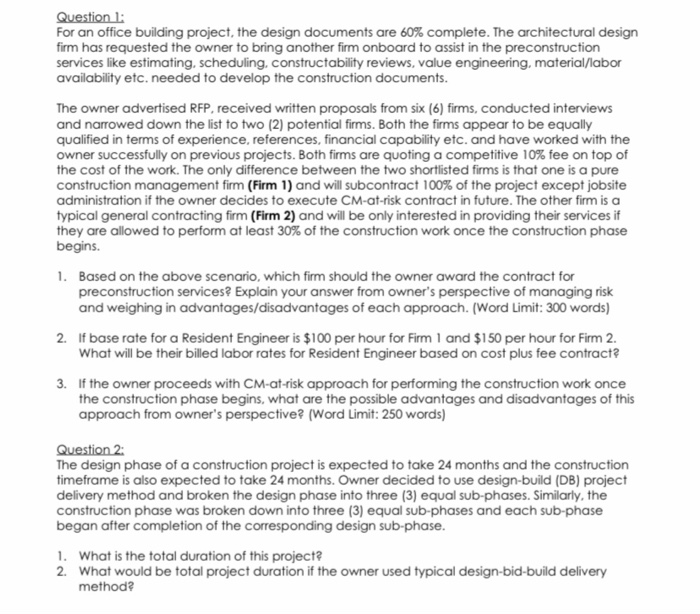
Question 1: For an office building project, the design documents are 60% complete. The architectural design firm has requested the owner to bring another firm onboard to assist in the preconstruction services like estimating, scheduling, constructability reviews, value engineering, material/labor availability etc. needed to develop the construction documents. The owner advertised RFP, received written proposals from six (6) firms, conducted interviews and narrowed down the list to two (2) potential firms. Both the firms appear to be equally qualified in terms of experience, references, financial capability etc. and have worked with the owner successfully on previous projects. Both firms are quoting a competitive 10% fee on top of the cost of the work. The only difference between the two shortlisted firms is that one is a pure construction management firm (Firm 1) and will subcontract 100% of the project except jobsite administration if the owner decides to execute CM-at-risk contract in future. The other firm is a typical general contracting firm (Firm 2) and will be only interested in providing their services if they are allowed to perform at least 30% of the construction work once the construction phase begins. 1. Based on the above scenario, which firm should the owner award the contract for preconstruction services? Explain your answer from owner's perspective of managing risk and weighing in advantages/disadvantages of each approach. (Word Limit: 300 words) 2. If base rate for a Resident Engineer is $100 per hour for Firm 1 and $150 per hour for Firm 2. What will be their billed labor rates for Resident Engineer based on cost plus fee contract? 3. If the owner proceeds with CM-at-risk approach for performing the construction work once the construction phase begins, what are the possible advantages and disadvantages of this approach from owner's perspective? (Word Limit: 250 words) Question 2: The design phase of a construction project is expected to take 24 months and the construction timeframe is also expected to take 24 months. Owner decided to use design-build (DB) project delivery method and broken the design phase into three (3) equal sub-phases. Similarly, the construction phase was broken down into three (3) equal sub-phases and each sub-phase began after completion of the corresponding design sub-phase. 1. What is the total duration of this project? 2. What would be total project duration if the owner used typical design-bid-build delivery method? Question 1: For an office building project, the design documents are 60% complete. The architectural design firm has requested the owner to bring another firm onboard to assist in the preconstruction services like estimating, scheduling, constructability reviews, value engineering, material/labor availability etc. needed to develop the construction documents. The owner advertised RFP, received written proposals from six (6) firms, conducted interviews and narrowed down the list to two (2) potential firms. Both the firms appear to be equally qualified in terms of experience, references, financial capability etc. and have worked with the owner successfully on previous projects. Both firms are quoting a competitive 10% fee on top of the cost of the work. The only difference between the two shortlisted firms is that one is a pure construction management firm (Firm 1) and will subcontract 100% of the project except jobsite administration if the owner decides to execute CM-at-risk contract in future. The other firm is a typical general contracting firm (Firm 2) and will be only interested in providing their services if they are allowed to perform at least 30% of the construction work once the construction phase begins. 1. Based on the above scenario, which firm should the owner award the contract for preconstruction services? Explain your answer from owner's perspective of managing risk and weighing in advantages/disadvantages of each approach. (Word Limit: 300 words) 2. If base rate for a Resident Engineer is $100 per hour for Firm 1 and $150 per hour for Firm 2. What will be their billed labor rates for Resident Engineer based on cost plus fee contract 3. If the owner proceeds with CM-at-risk approach for performing the construction work once the construction phase begins, what are the possible advantages and disadvantages of this approach from owner's perspective? (Word Limit: 250 words) Question 1: For an office building project, the design documents are 60% complete. The architectural design firm has requested the owner to bring another firm onboard to assist in the preconstruction services like estimating, scheduling, constructability reviews, value engineering, material/labor availability etc. needed to develop the construction documents. The owner advertised RFP, received written proposals from six (6) firms, conducted interviews and narrowed down the list to two (2) potential firms. Both the firms appear to be equally qualified in terms of experience, references, financial capability etc. and have worked with the owner successfully on previous projects. Both firms are quoting a competitive 10% fee on top of the cost of the work. The only difference between the two shortlisted firms is that one is a pure construction management firm (Firm 1) and will subcontract 100% of the project except jobsite administration if the owner decides to execute CM-at-risk contract in future. The other firm is a typical general contracting firm (Firm 2) and will be only interested in providing their services if they are allowed to perform at least 30% of the construction work once the construction phase begins. 1. Based on the above scenario, which firm should the owner award the contract for preconstruction services? Explain your answer from owner's perspective of managing risk and weighing in advantages/disadvantages of each approach. (Word Limit: 300 words) 2. If base rate for a Resident Engineer is $100 per hour for Firm 1 and $150 per hour for Firm 2. What will be their billed labor rates for Resident Engineer based on cost plus fee contract? 3. If the owner proceeds with CM-at-risk approach for performing the construction work once the construction phase begins, what are the possible advantages and disadvantages of this approach from owner's perspective? (Word Limit: 250 words) Question 2: The design phase of a construction project is expected to take 24 months and the construction timeframe is also expected to take 24 months. Owner decided to use design-build (DB) project delivery method and broken the design phase into three (3) equal sub-phases. Similarly, the construction phase was broken down into three (3) equal sub-phases and each sub-phase began after completion of the corresponding design sub-phase. 1. What is the total duration of this project? 2. What would be total project duration if the owner used typical design-bid-build delivery method? Question 1: For an office building project, the design documents are 60% complete. The architectural design firm has requested the owner to bring another firm onboard to assist in the preconstruction services like estimating, scheduling, constructability reviews, value engineering, material/labor availability etc. needed to develop the construction documents. The owner advertised RFP, received written proposals from six (6) firms, conducted interviews and narrowed down the list to two (2) potential firms. Both the firms appear to be equally qualified in terms of experience, references, financial capability etc. and have worked with the owner successfully on previous projects. Both firms are quoting a competitive 10% fee on top of the cost of the work. The only difference between the two shortlisted firms is that one is a pure construction management firm (Firm 1) and will subcontract 100% of the project except jobsite administration if the owner decides to execute CM-at-risk contract in future. The other firm is a typical general contracting firm (Firm 2) and will be only interested in providing their services if they are allowed to perform at least 30% of the construction work once the construction phase begins. 1. Based on the above scenario, which firm should the owner award the contract for preconstruction services? Explain your answer from owner's perspective of managing risk and weighing in advantages/disadvantages of each approach. (Word Limit: 300 words) 2. If base rate for a Resident Engineer is $100 per hour for Firm 1 and $150 per hour for Firm 2. What will be their billed labor rates for Resident Engineer based on cost plus fee contract 3. If the owner proceeds with CM-at-risk approach for performing the construction work once the construction phase begins, what are the possible advantages and disadvantages of this approach from owner's perspective? (Word Limit: 250 words)









 Study Help