







Question: Question # 1 Formulate the following problem: a. A farmer wishes to build tobacco-drying barns to receive tobacco from his four fields. He can build
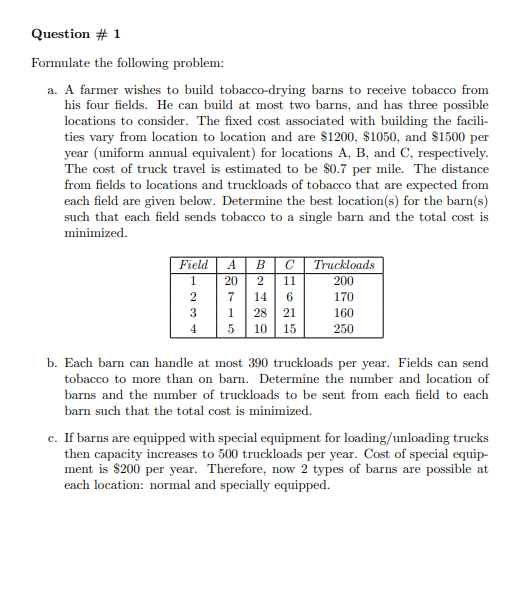
Question \# 1 Formulate the following problem: a. A farmer wishes to build tobacco-drying barns to receive tobacco from his four fields. He can build at most two barns, and has three possible locations to consider. The fixed cost associated with building the facilities vary from location to location and are $1200,$1050, and $1500 per year (uniform annual equivalent) for locations A,B, and C, respectively. The cost of truck travel is estimated to be $0.7 per mile. The distance from fields to locations and truckloads of tobacco that are expected from each field are given below. Determine the best location(s) for the barn(s) such that each field sends tobacco to a single barn and the total cost is minimized. b. Each barn can handle at most 390 truckloads per year. Fields can send tobacco to more than on barn. Determine the number and location of barns and the number of truckloads to be sent from each field to each barn such that the total cost is minimized. c. If barns are equipped with special equipment for loading/unloading trucks then capacity increases to 500 truckloads per year. Cost of special equipment is $200 per year. Therefore, now 2 types of barns are possible at each location: normal and specially equipped. Question \# 1 Formulate the following problem: a. A farmer wishes to build tobacco-drying barns to receive tobacco from his four fields. He can build at most two barns, and has three possible locations to consider. The fixed cost associated with building the facilities vary from location to location and are $1200,$1050, and $1500 per year (uniform annual equivalent) for locations A,B, and C, respectively. The cost of truck travel is estimated to be $0.7 per mile. The distance from fields to locations and truckloads of tobacco that are expected from each field are given below. Determine the best location(s) for the barn(s) such that each field sends tobacco to a single barn and the total cost is minimized. b. Each barn can handle at most 390 truckloads per year. Fields can send tobacco to more than on barn. Determine the number and location of barns and the number of truckloads to be sent from each field to each barn such that the total cost is minimized. c. If barns are equipped with special equipment for loading/unloading trucks then capacity increases to 500 truckloads per year. Cost of special equipment is $200 per year. Therefore, now 2 types of barns are possible at each location: normal and specially equipped
Step by Step Solution
There are 3 Steps involved in it

Get step-by-step solutions from verified subject matter experts
 Study Help