







Question: Question 1 ( i ) A power electronics converter is required for a smartphone charger application to charge the battery from the rectified AC mains
Question
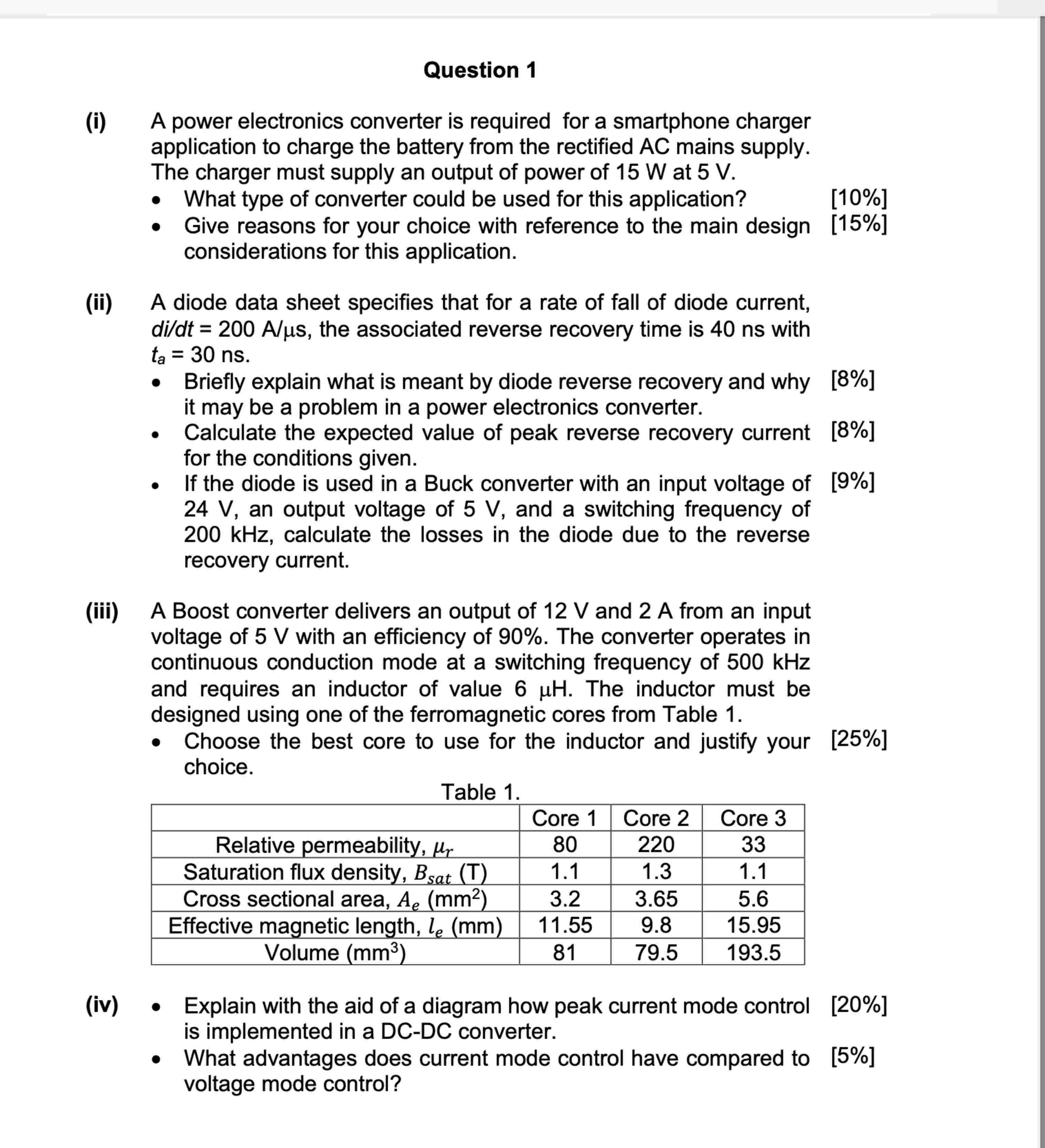
i A power electronics converter is required for a smartphone charger application to charge the battery from the rectified AC mains supply. The charger must supply an output of power of W at V
What type of converter could be used for this application?
Give reasons for your choice with reference to the main design considerations for this application.
ii A diode data sheet specifies that for a rate of fall of diode current, d i d tmathrm~Amu mathrms the associated reverse recovery time is ns with tamathrm~ns
Briefly explain what is meant by diode reverse recovery and why it may be a problem in a power electronics converter.
Calculate the expected value of peak reverse recovery current for the conditions given.
If the diode is used in a Buck converter with an input voltage of V an output voltage of V and a switching frequency of kHz calculate the losses in the diode due to the reverse recovery current.
iii A Boost converter delivers an output of V and A from an input voltage of V with an efficiency of The converter operates in continuous conduction mode at a switching frequency of kHz and requires an inductor of value mu mathrmH The inductor must be designed using one of the ferromagnetic cores from Table
Choose the best core to use for the inductor and justify your
choice.
Table
iv Explain with the aid of a diagram how peak current mode control is implemented in a DCDC converter.
What advantages does current mode control have compared to voltage mode control?
Step by Step Solution
There are 3 Steps involved in it
1 Expert Approved Answer
Step: 1 Unlock

Question Has Been Solved by an Expert!
Get step-by-step solutions from verified subject matter experts
Step: 2 Unlock
Step: 3 Unlock
 Study Help