







Question: Question 1 : Ignore any current plans. Using last year s actual data and sales mix, how many total cases ( units ) would David
Question : Ignore any current plans. Using last years actual data and sales mix, how many total cases units would David need to sell in order to earn $ after tax? What would be the number of cases units sold for each product?
Question : Ignore the desire to earn $ after tax and refer to the original data. David has a few options regarding Sedona Stout pricing noted on pages and : a keep the sales price the same no changeb increase the sales price, or c decrease the sales price. Calculate the total contribution margin of Sedona Stout in total dollars for going with each option remember variable costs may change with the options
Question :Based on the case facts and your calculations, provide a qualitative analysis and specific recommendations to the owner. In you writeup, discuss the assumptions that you made when utilizing the CVP analysis. Provide specific recommendations based on the owners plans.
Objectives:
To understand how to use cost volume profit CVP analysis during management control decision making.
Allied Microbrewery, Inc
THE CASE
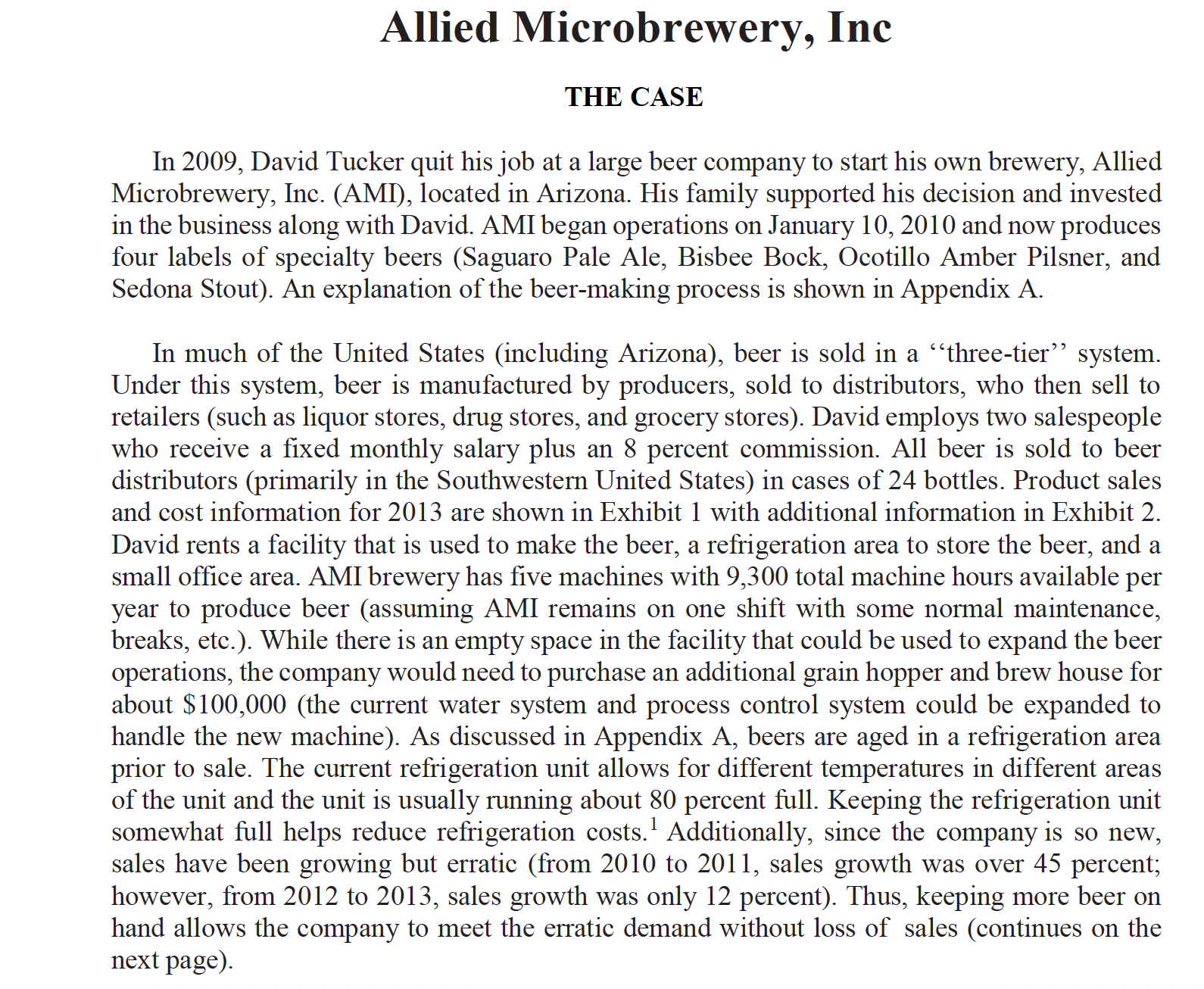
In David Tucker quit his job at a large beer company to start his own brewery, Allied
Microbrewery, Inc. AMI located in Arizona. His family supported his decision and invested
in the business along with David. AMI began operations on January and now produces
four labels of specialty beers Saguaro Pale Ale, Bisbee Bock, Ocotillo Amber Pilsner, and
Sedona Stout An explanation of the beermaking process is shown in Appendix A
In much of the United States including Arizona beer is sold in a "threetier" system.
Under this system, beer is manufactured by producers, sold to distributors, who then sell to
retailers such as liquor stores, drug stores, and grocery stores David employs two salespeople
who receive a fixed monthly salary plus an percent commission. All beer is sold to beer
distributors primarily in the Southwestern United States in cases of bottles. Product sales
and cost information for are shown in Exhibit with additional information in Exhibit
David rents a facility that is used to make the beer, a refrigeration area to store the beer, and a
small office area. AMI brewery has five machines with total machine hours available per
year to produce beer assuming AMI remains on one shift with some normal maintenance,
breaks, etc. While there is an empty space in the facility that could be used to expand the beer
operations, the company would need to purchase an additional grain hopper and brew house for
about $the current water system and process control system could be expanded to
handle the new machine As discussed in Appendix A beers are aged in a refrigeration area
prior to sale. The current refrigeration unit allows for different temperatures in different areas
of the unit and the unit is usually running about percent full. Keeping the refrigeration unit
somewhat full helps reduce refrigeration costs. Additionally, since the company is so new,
sales have been growing but erratic from to sales growth was over percent;
however, from to sales growth was only percent Thus, keeping more beer on
hand allows the company to meet the erratic demand without loss of sales continues on the
next page EXHIBIT
Cost and Sales Information
Panel A: Per Case Information
Panel B: Contribution Margin Income Statement
David has not taken a salary since the business started. While the business has been generating a
small profit, David has been reinvesting the earnings in the business. He wants to grow the
business to generate more profit for his family and himself. David has been considering
increasing the price on Sedona Stout from $ per case to $ per case. He thinks that,
with this price increase, unit sales will decrease from cases to cases per year. Finally, David and his family love root beer. Root beer follows a somewhat similar process to beer in that the ingredients are mixed together to form a "culture" that then goes through fermenting, filtering, and filling. Root beer would not need to be aged or stored in the refrigerator. There is an empty area in the current microbrewery facility that could be dedicated to making root beer. As a result, David has been talking with his family about producing and selling a line of specialty root beer. Root beer would be produced using different machinery rather than the existing five beer machines. David's sister knows someone who is getting out of the soda business and would be willing to sell the used machinery needed to make the root beer for $ Based on market research he has done, David thinks that he could charge $ per case of root beer. Based on the same market research, there is a lot of uncertainty in how many cases of root beer the company could sell. David is less familiar with the root beer market and there is a wide range in sales of specialty root beer in the l APPENDIX A
Be
Step by Step Solution
There are 3 Steps involved in it
1 Expert Approved Answer
Step: 1 Unlock

Question Has Been Solved by an Expert!
Get step-by-step solutions from verified subject matter experts
Step: 2 Unlock
Step: 3 Unlock
 Study Help