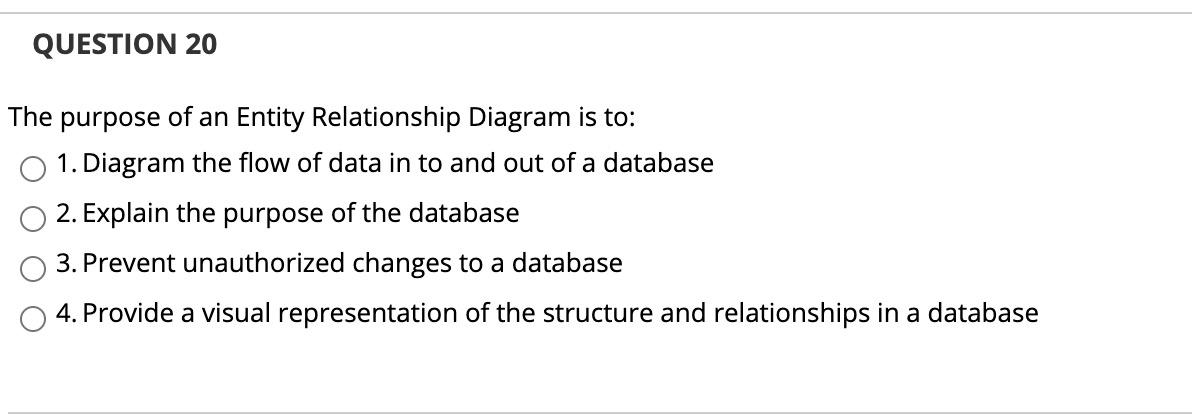
Question: QUESTION 1 In a table containing data about people, the property First Name would be an example of: 1. A Row 2. A Table 3.
QUESTION 1 In a table containing data aboutQUESTION 1 In a table containing data aboutQUESTION 1 In a table containing data aboutQUESTION 1 In a table containing data aboutQUESTION 1 In a table containing data aboutQUESTION 1 In a table containing data aboutQUESTION 1 In a table containing data aboutQUESTION 1 In a table containing data aboutQUESTION 1 In a table containing data aboutQUESTION 1 In a table containing data aboutQUESTION 1 In a table containing data aboutQUESTION 1 In a table containing data about

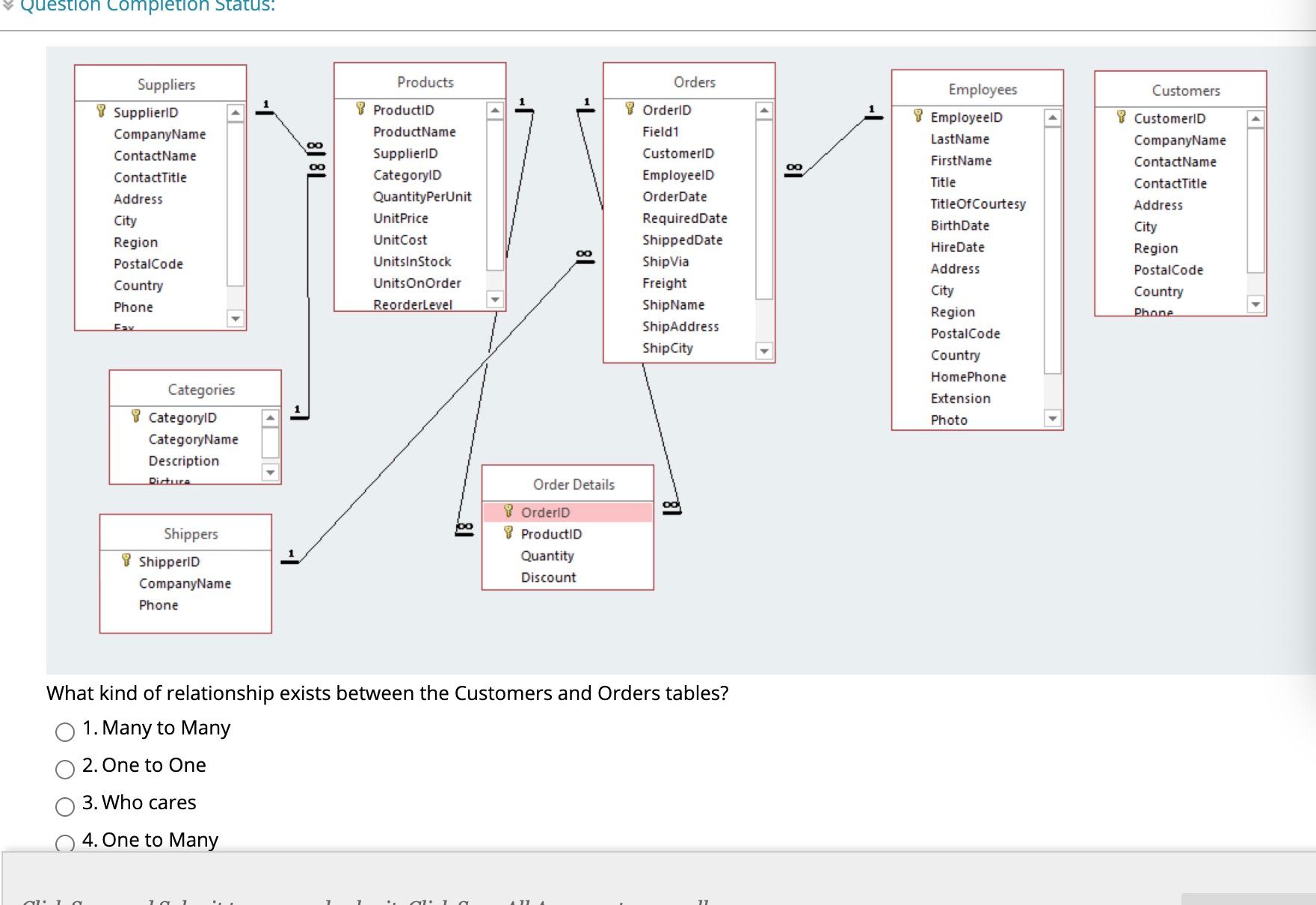
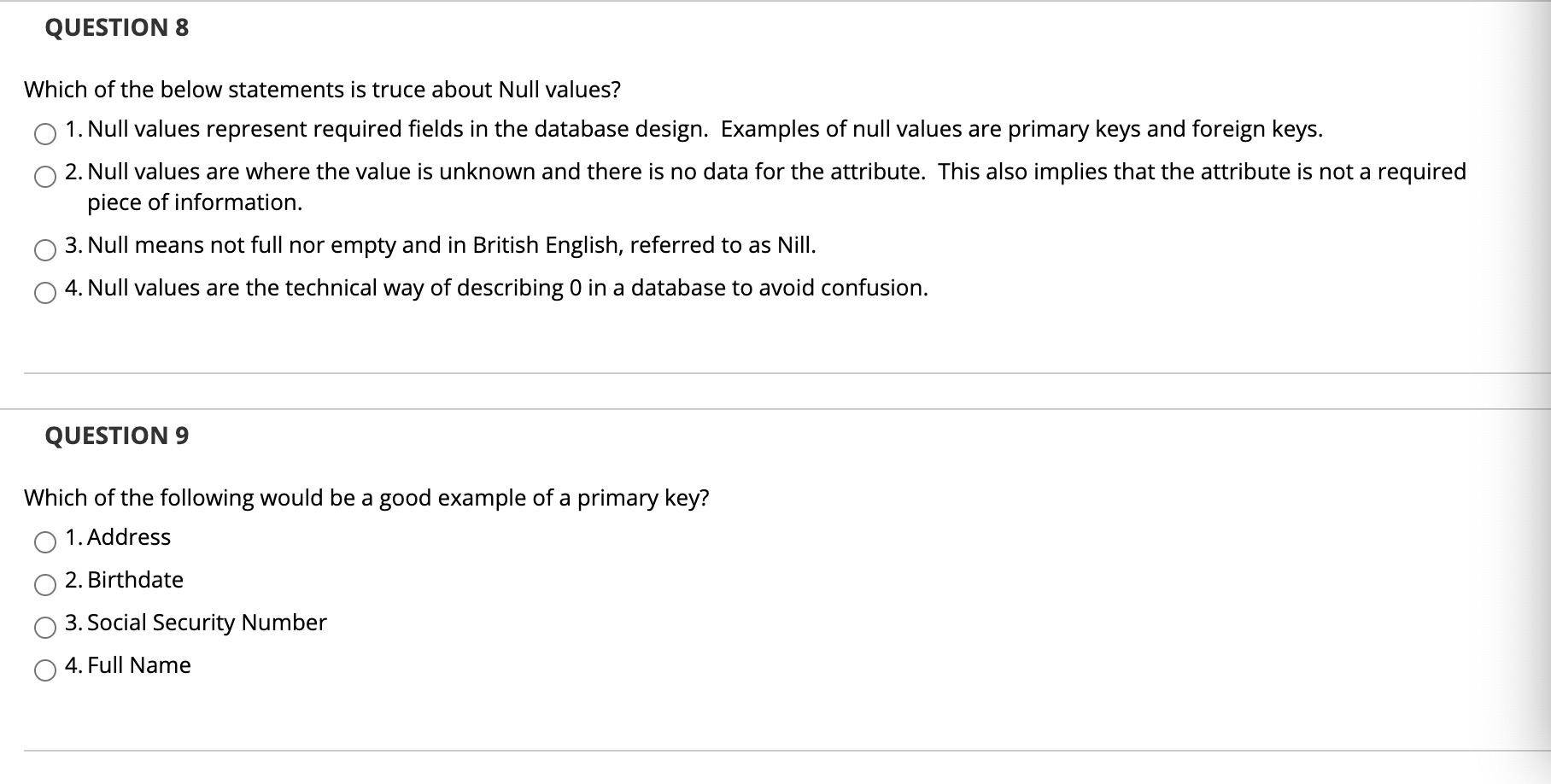
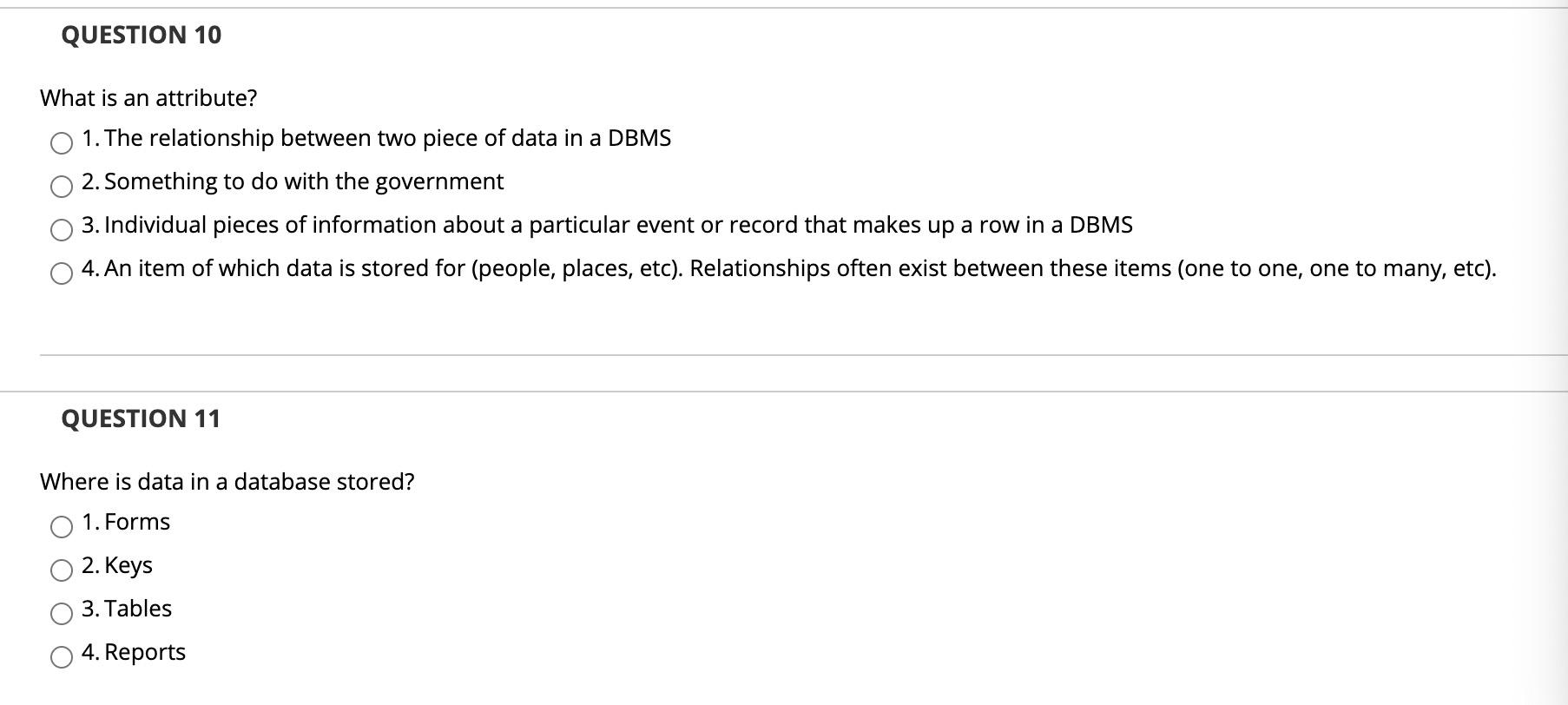
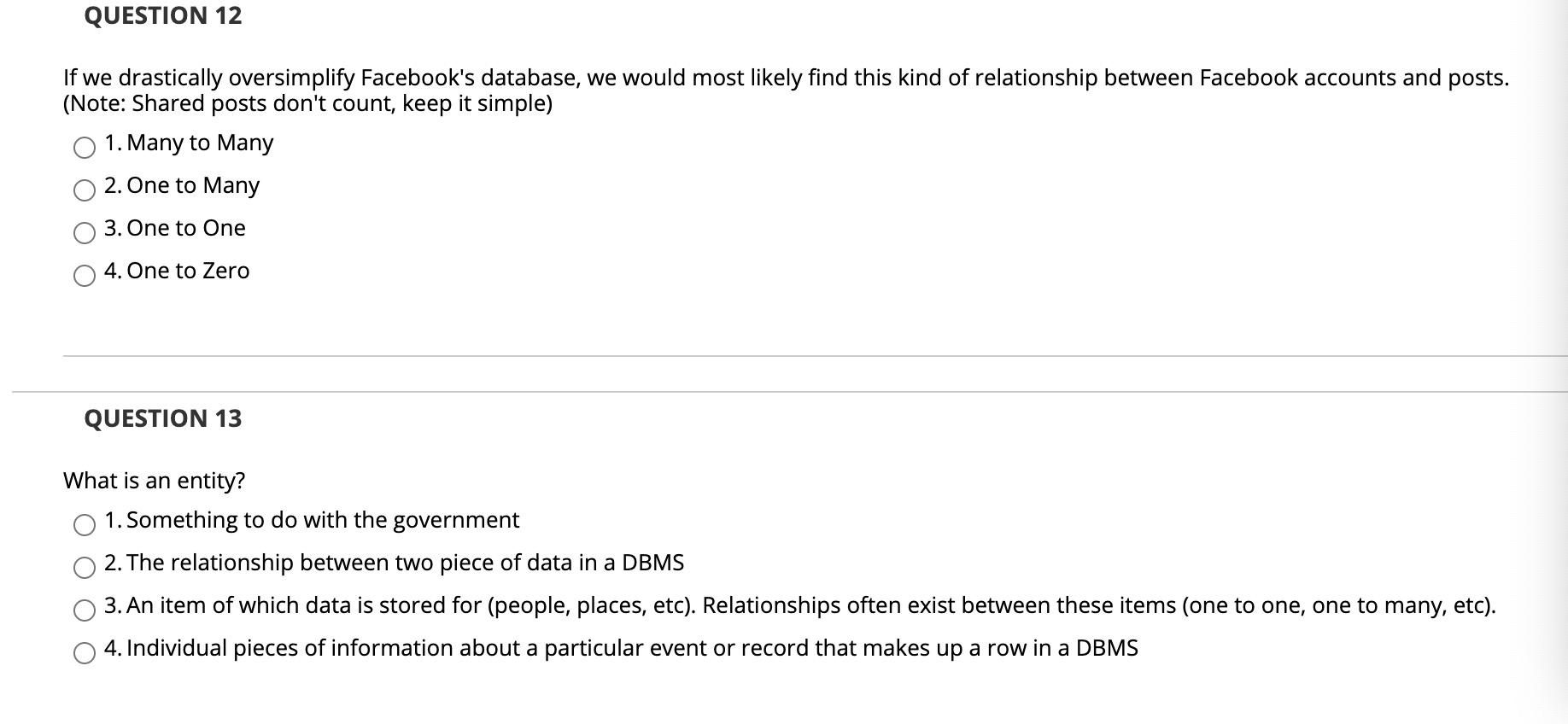
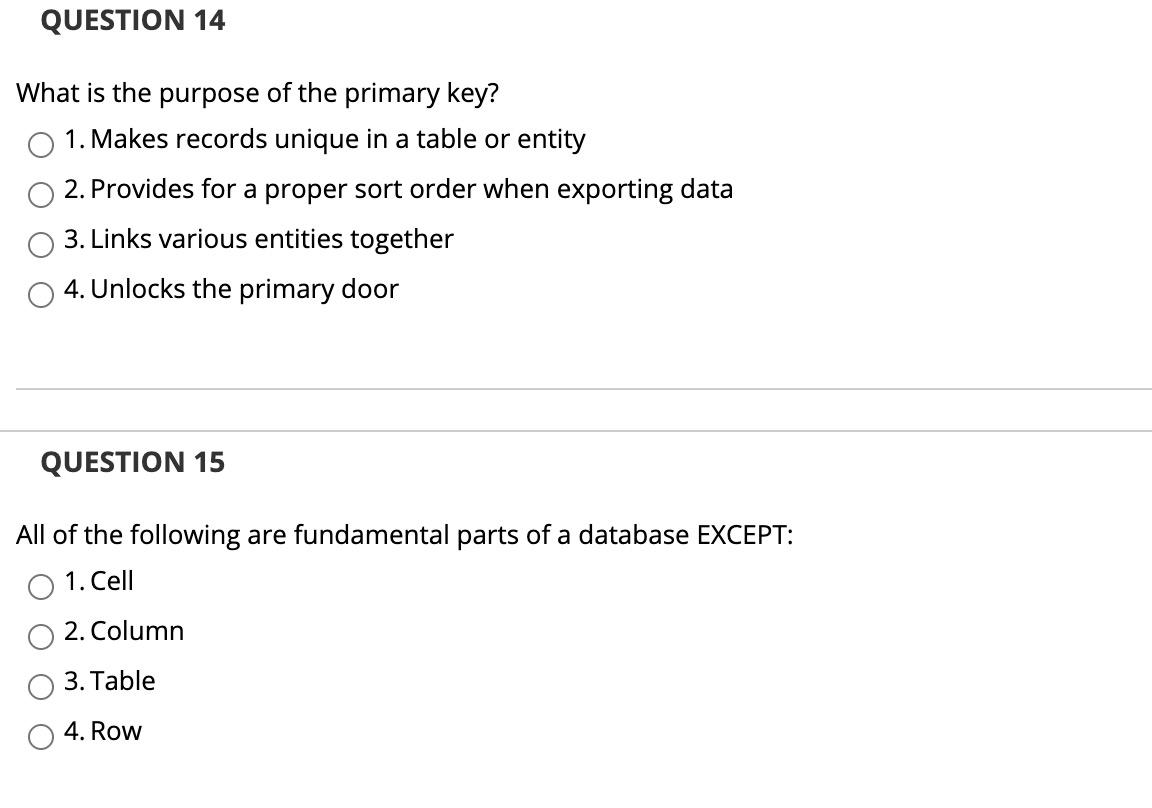
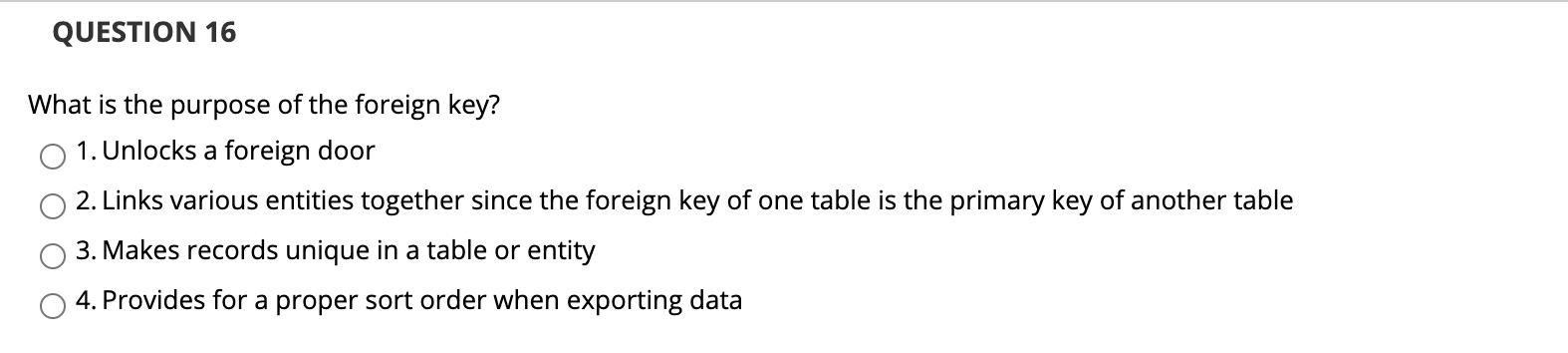
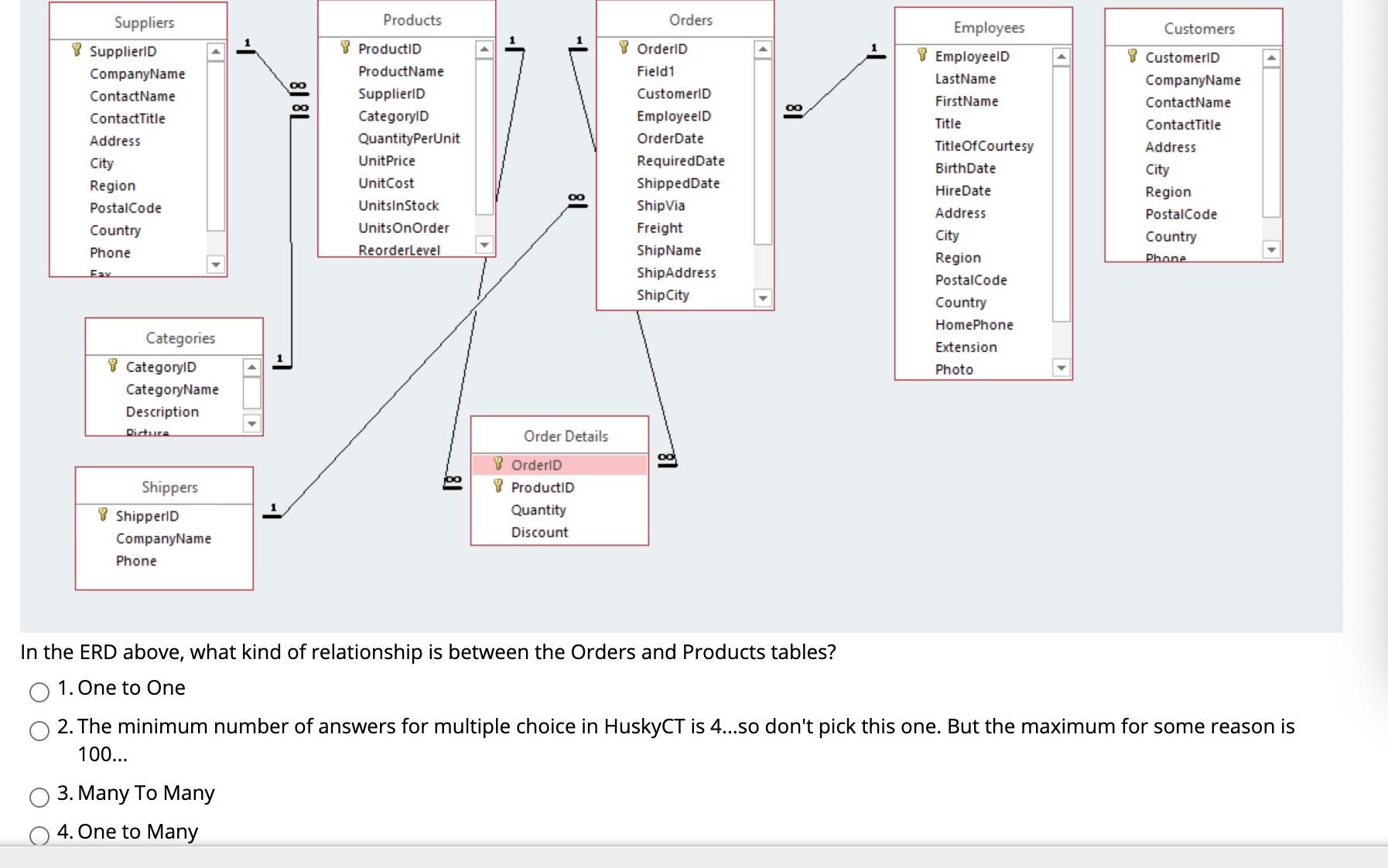
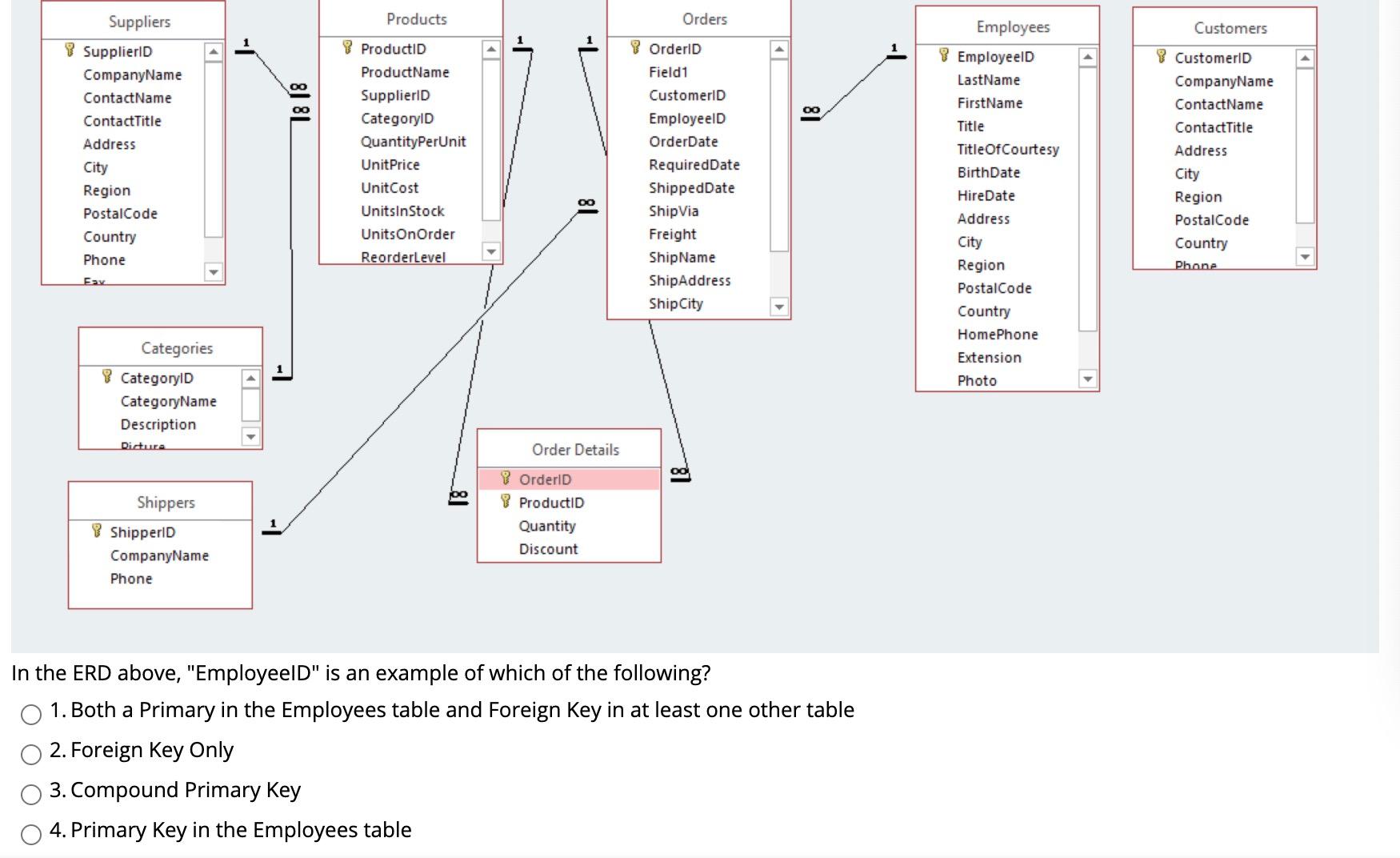
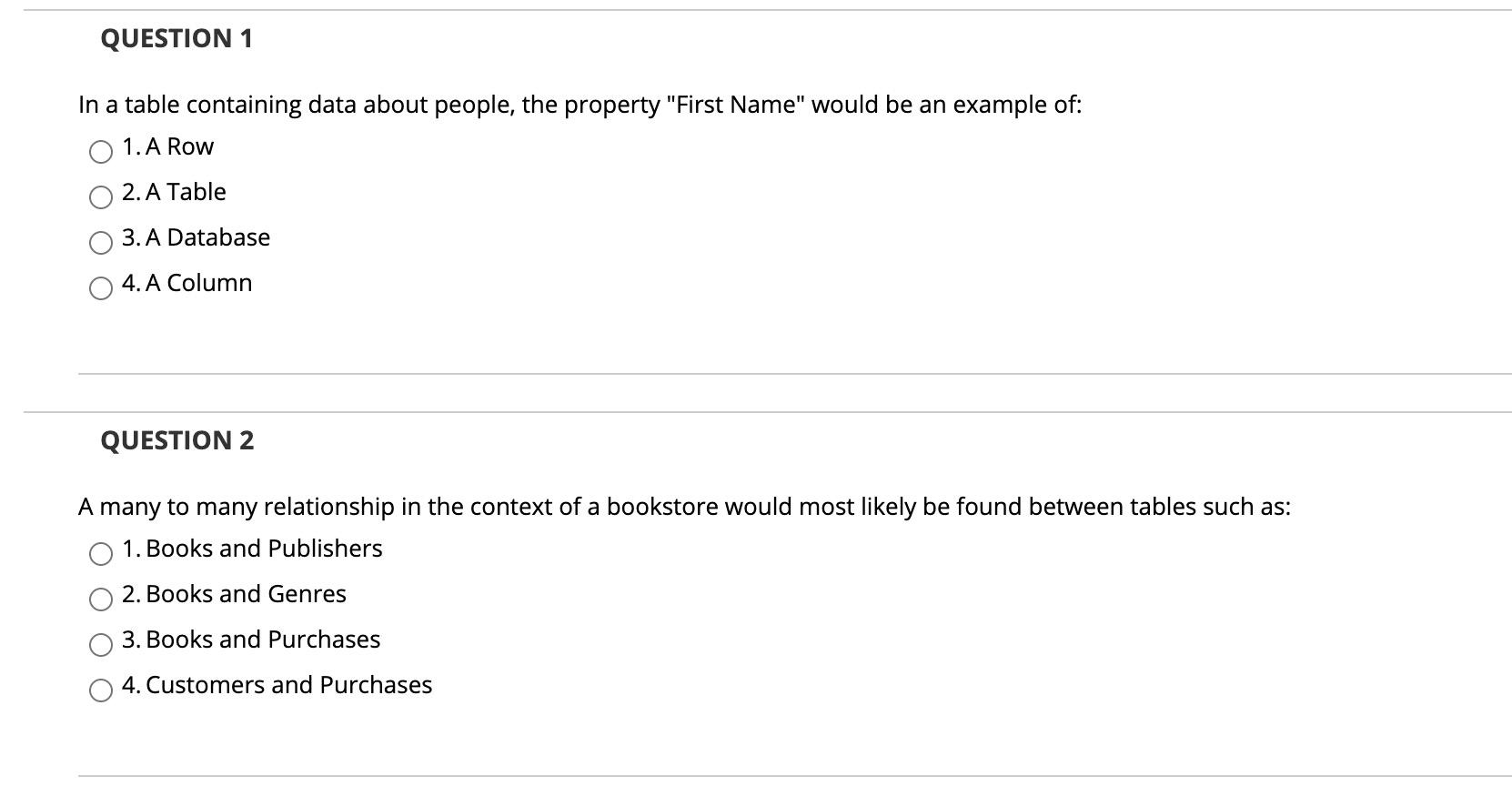
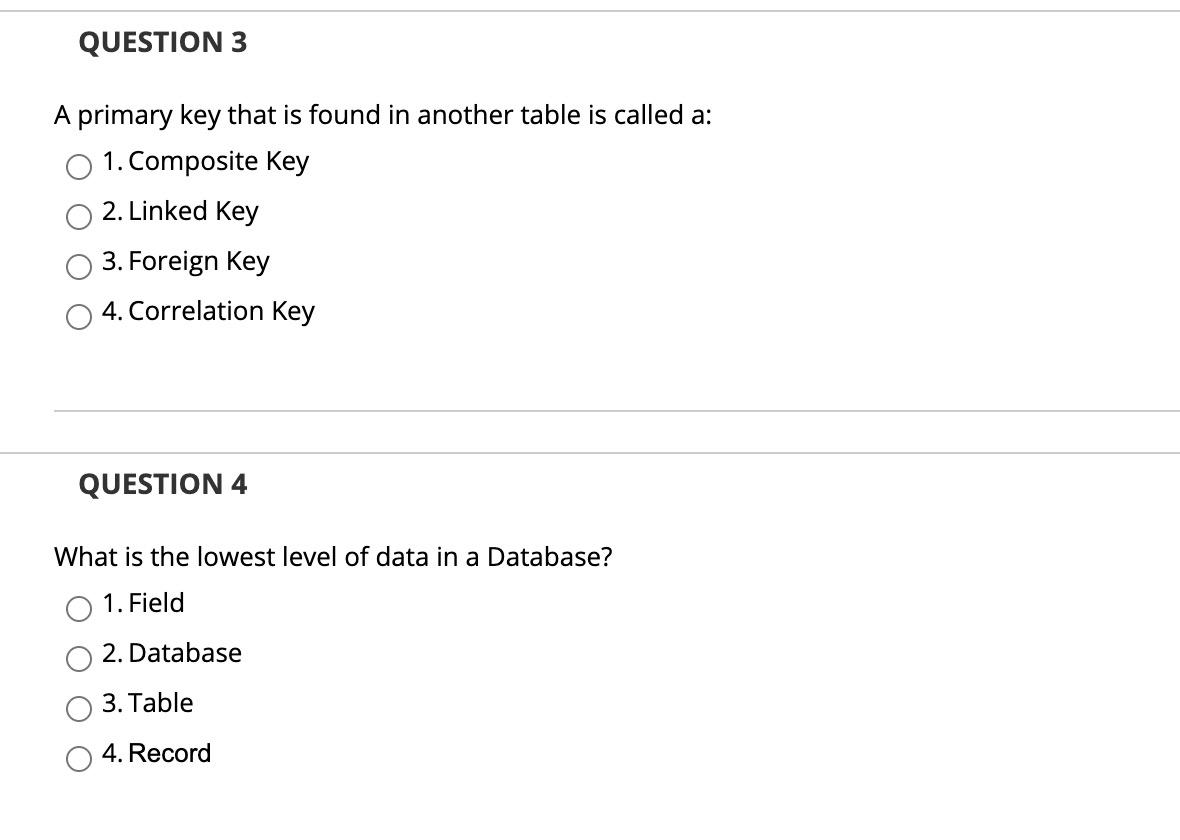
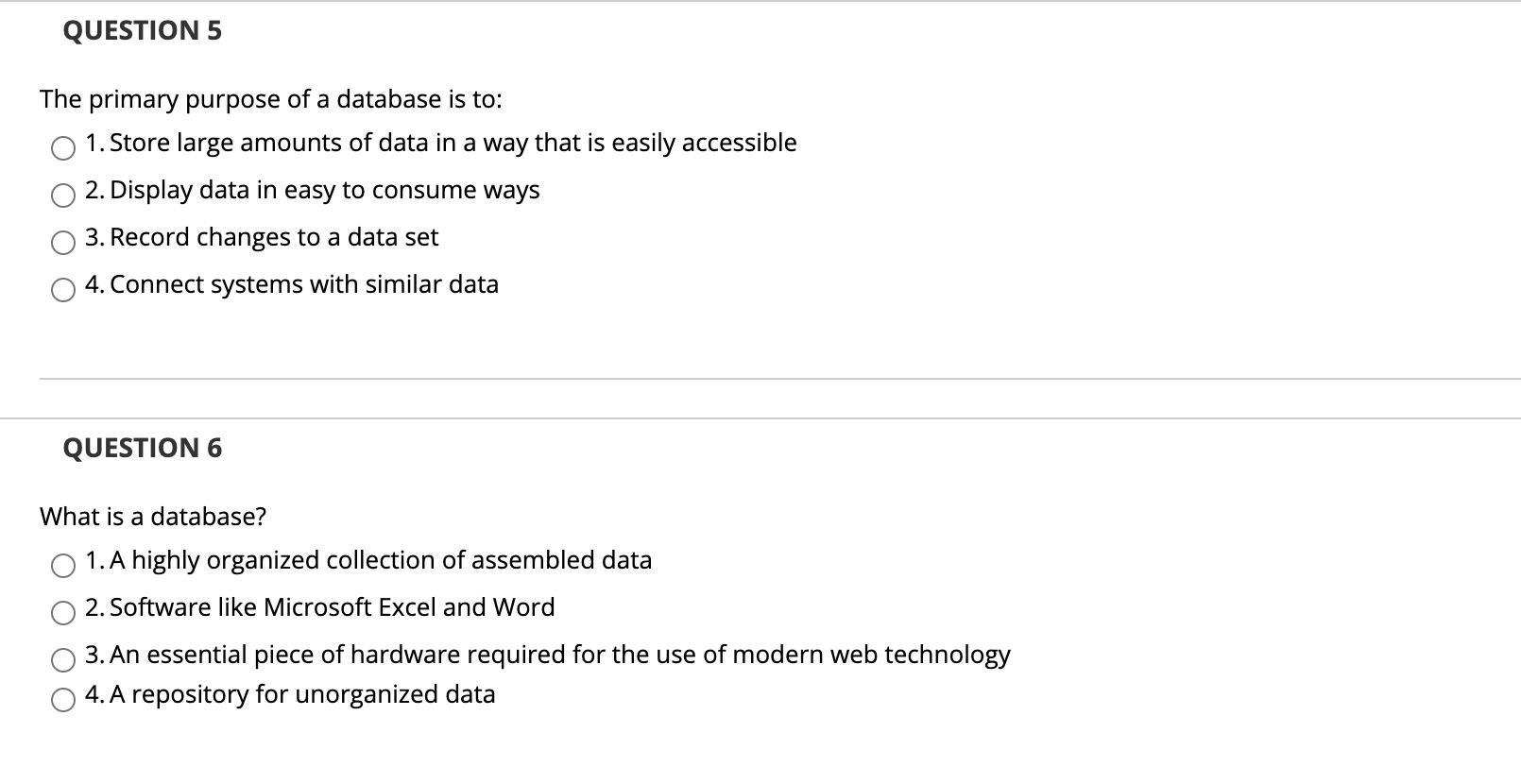
QUESTION 1 In a table containing data about people, the property "First Name" would be an example of: 1. A Row 2. A Table 3. A Database 4. A Column QUESTION 2 A many to many relationship in the context of a bookstore would most likely be found between tables such as: 1. Books and Publishers 2. Books and Genres 3. Books and Purchases 4. Customers and Purchases QUESTION 3 A primary key that is found in another table is called a: O 1. Composite Key 2. Linked Key 3. Foreign Key 4. Correlation Key QUESTION 4 What is the lowest level of data in a Database? 1. Field 2. Database 3. Table 4. Record QUESTION 5 The primary purpose of a database is to: 1. Store large amounts of data in a way that is easily accessible 2. Display data in easy to consume ways 3. Record changes to a data set 4. Connect systems with similar data QUESTION 6 What is a database? 1. A highly organized collection of assembled data 2. Software like Microsoft Excel and Word 3. An essential piece of hardware required for the use of modern web technology 4. A repository for unorganized data Question Completion Status: Products Orders Customers -1 18 18 Suppliers * Supplier CompanyName Contact Name ContactTitle Address City Region PostalCode Country Phone 9 ProductID ProductName Suppliers CategoryID QuantityPerUnit Unit Price Unit Cost UnitsInStock Units OnOrder ReorderLevel * OrderID Field1 CustomerlD Employeeld Order Date RequiredDate ShippedDate ShipVia Freight ShipName ShipAddress Ship City Employees * Employeeld LastName FirstName Title TitleOfCourtesy BirthDate HireDate Address City Region PostalCode Country Home Phone Extension Photo CustomerID CompanyName ContactName Contact Title Address City Region PostalCode Country Phone 81 Fax Categories CategoryID CategoryName Description Dictura Shippers * ShipperiD CompanyName Phone Order Details 7 Ordered 7 ProductID Quantity Discount What kind of relationship exists between the Customers and Orders tables? 1. Many to Many 2. One to One 3. Who cares 4. One to Many QUESTION 8 Which of the below statements is truce about Null values? 1. Null values represent required fields in the database design. Examples of null values are primary keys and foreign keys. 2. Null values are where the value is unknown and there is no data for the attribute. This also implies that the attribute is not a required piece of information. 3. Null means not full nor empty and in British English, referred to as Nill. 4. Null values are the technical way of describing 0 in a database to avoid confusion. QUESTION 9 Which of the following would be a good example of a primary key? 1. Address 2. Birthdate 3. Social Security Number 4. Full Name QUESTION 10 What is an attribute? 1. The relationship between two piece of data in a DBMS 2. Something to do with the government 3. Individual pieces of information about a particular event or record that makes up a row in a DBMS 4. An item of which data is stored for (people, places, etc). Relationships often exist between these items (one to one, one to many, etc). QUESTION 11 Where is data in a database stored? 1. Forms 2. Keys 3. Tables 4. Reports QUESTION 12 If we drastically oversimplify Facebook's database, we would most likely find this kind of relationship between Facebook accounts and posts. (Note: Shared posts don't count, keep it simple) 1. Many to Many 2. One to Many 3. One to One 4. One to Zero QUESTION 13 What is an entity? 1. Something to do with the government 2. The relationship between two piece of data in a DBMS 3. An item of which data is stored for (people, places, etc). Relationships often exist between these items (one to one, one to many, etc). 4. Individual pieces of information about a particular event or record that makes up a row in a DBMS QUESTION 14 What is the purpose of the primary key? 1. Makes records unique in a table or entity 2. Provides for a proper sort order when exporting data 3. Links various entities together 4. Unlocks the primary door QUESTION 15 All of the following are fundamental parts of a database EXCEPT: 1. Cell 2. Column 3. Table 4. Row QUESTION 16 What is the purpose of the foreign key? 1. Unlocks a foreign door 2. Links various entities together since the foreign key of one table is the primary key of another table 3. Makes records unique in a table or entity 4. Provides for a proper sort order when exporting data Products Orders Customers -1 1 81 8L 18 Suppliers * Supplierlo CompanyName ContactName ContactTitle Address City Region PostalCode Country Phone Eax ProductID ProductName Suppliers CategoryID QuantityPerUnit Unit Price Unit Cost UnitsInStock Units OnOrder ReorderLevel * OrderID Field1 Customers Employeeld OrderDate RequiredDate ShippedDate ShipVia Freight ShipName ShipAddress Ship City Employees 7 Employeeld LastName FirstName Title TitleOfCourtesy BirthDate Hire Date Address City Region PostalCode Country Home Phone Extension Photo * CustomerID CompanyName ContactName ContactTitle Address City Region PostalCode Country Phone Categories 8 CategoryID CategoryName Description Dicture Order Details Shippers * ShipperiD CompanyName Phone * Ordered * ProductiD Quantity Discount In the ERD above, what kind of relationship is between the Orders and Products tables? 1. One to One 2. The minimum number of answers for multiple choice in HuskyCT is 4...so don't pick this one. But the maximum for some reason is 100... 3. Many To Many 4. One to Many Products Customers -1 -1 -L 18 18 00 Suppliers * Suppliers CompanyName ContactName ContactTitle Address City Region PostalCode Country Phone * ProductID Product Name Suppliers CategoryID QuantityPerUnit Unit Price UnitCost UnitsinStock Units OnOrder ReorderLevel Orders * OrderlD Field1 CustomerID Employeeld OrderDate RequiredDate ShippedDate ShipVia Freight ShipName ShipAddress Ship City Employees Employeeld LastName FirstName Title TitleOfCourtesy BirthDate HireDate Address City Region PostalCode Country Home Phone Extension Photo * CustomerID CompanyName ContactName Contact Title Address City Region PostalCode Country Phane E Categories 7 CategoryID CategoryName Description Dictura Order Details 81 Shippers ShipperID CompanyName Phone OrderID 7 ProductID Quantity Discount In the ERD above, "EmployeelD" is an example of which of the following? 1. Both a Primary in the Employees table and Foreign Key in at least one other table 2. Foreign Key Only 3. Compound Primary key 4. Primary Key in the Employees table QUESTION 20 The purpose of an Entity Relationship Diagram is to: 1. Diagram the flow of data in to and out of a database 2. Explain the purpose of the database 3. Prevent unauthorized changes to a database 4. Provide a visual representation of the structure and relationships in a database
Step by Step Solution

There are 3 Steps involved in it

1 Expert Approved Answer
Step: 1 Unlock

Lets go through each question QUESTION 1 In a table containing data about people the property First Name would be an example of 4 A Column A column in a table represents attributes such as First Name ... View full answer

blur-text-image
Question Has Been Solved by an Expert!

Get step-by-step solutions from verified subject matter experts

Step: 2 Unlock
Step: 3 Unlock

Students Have Also Explored These Related General Management Questions!