





Question: QUESTION 1. In this problem we are going to try to better understand the different pnorms. First, a ball in mathematics is a geometric object
QUESTION 1. In this problem we are going to try
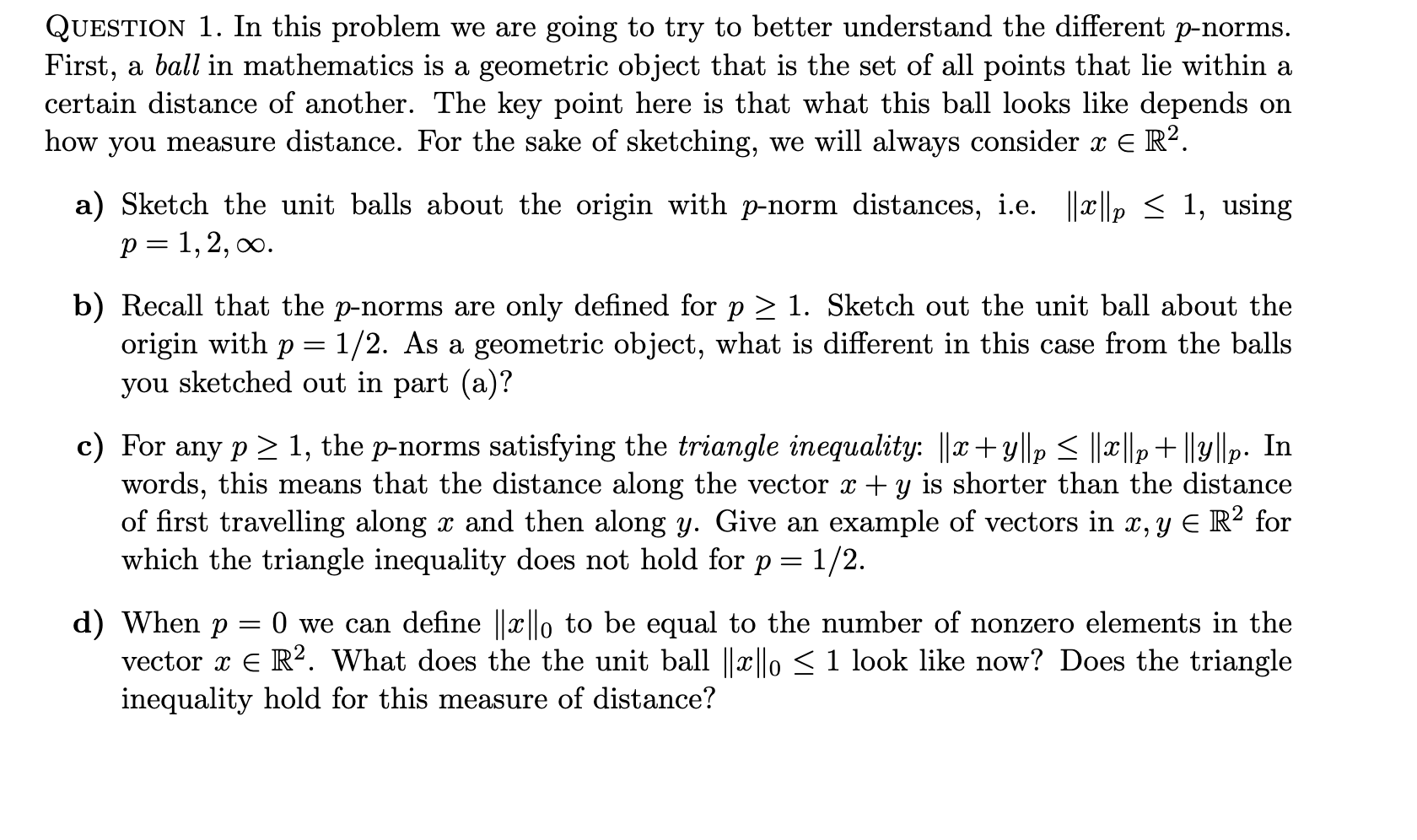
QUESTION 1. In this problem we are going to try to better understand the different pnorms. First, a ball in mathematics is a geometric object that is the set of all points that lie within a certain distance of another. The key point here is that what this ball looks like depends on how you measure distance. For the sake of sketching, we will always consider :9 E R2. a) Sketch the unit balls about the origin with pnorm distances, i.e. ||$||p S 1, using p = l, 2, 00. b) Recall that the pnorms are only defined for p 2 1. Sketch out the unit ball about the origin with p = 1/2. As a geometric object, what is different in this case from the balls you sketched out in part (a)? c) For any 39 2 1, the pnorms satisfying the triangle inequality: llw +pr S |I$||p + llyllp. In words, this means that the distance along the vector :5 + y is shorter than the distance of rst travelling along x and then along y. Give an example of vectors in :r, y 6 R2 for which the triangle inequality does not hold for p = 1/2. (1) When p = 0 we can dene ||2J||0 to be equal to the number of nonzero elements in the vector x E R2. What does the the unit ball ||$||0 S 1 look like now? Does the triangle inequality hold for this measure of distance

Step by Step Solution

There are 3 Steps involved in it

1 Expert Approved Answer
Step: 1 Unlock blur-text-image
Question Has Been Solved by an Expert!

Get step-by-step solutions from verified subject matter experts

Step: 2 Unlock
Step: 3 Unlock

Students Have Also Explored These Related Mathematics Questions!