







Question: Question 1 In this question, we will consider a version of the asset ownership model where the (S)upplier makes a cost-saving investment that does not
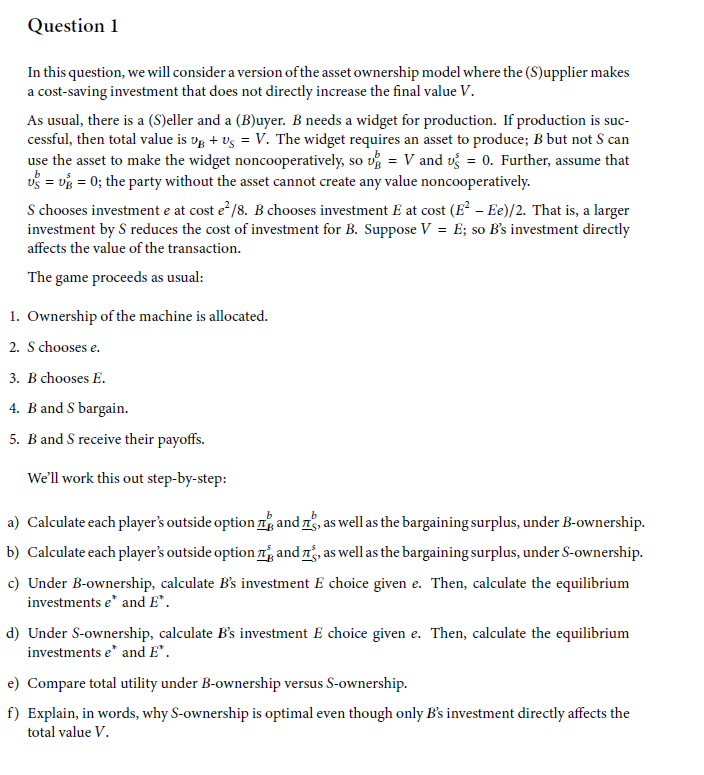
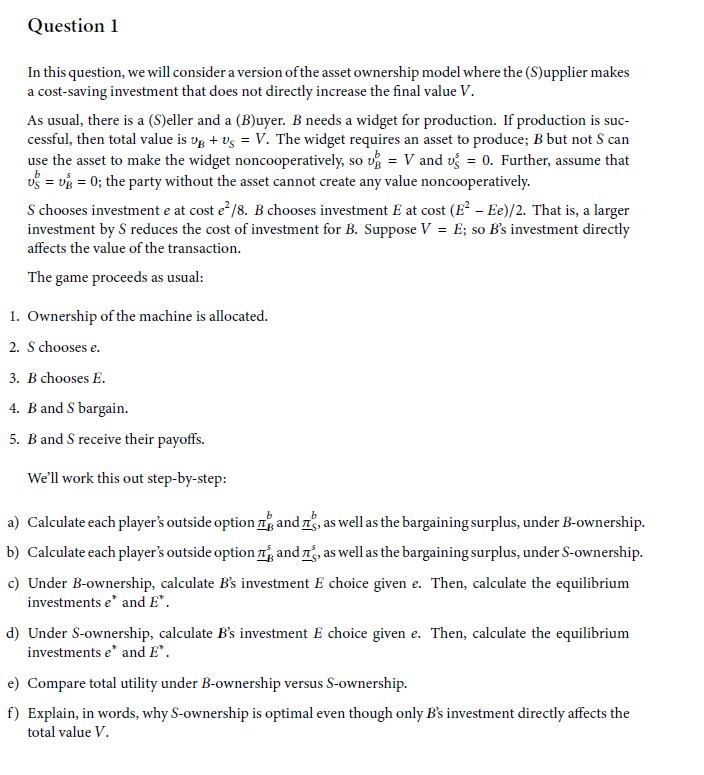
Question 1 In this question, we will consider a version of the asset ownership model where the (S)upplier makes a cost-saving investment that does not directly increase the final value V. As usual, there is a (S)eller and a (B)uyer. B needs a widget for production. If production is suc- cessful, then total value is Up + Us = V. The widget requires an asset to produce; B but not S can use the asset to make the widget noncooperatively, so Up = V and us = 0. Further, assume that us = Up = 0; the party without the asset cannot create any value noncooperatively. S chooses investment e at cost e /8. B chooses investment E at cost (E - Ee)/2. That is, a larger investment by S reduces the cost of investment for B. Suppose V = E; so B's investment directly affects the value of the transaction. The game proceeds as usual: 1. Ownership of the machine is allocated. 2. S chooses e. 3. B chooses E. 4. B and S bargain. 5. B and S receive their payoffs. We'll work this out step-by-step: a) Calculate each player's outside option It; and It's, as well as the bargaining surplus, under B-ownership. b) Calculate each player's outside option n, and ng, as well as the bargaining surplus, under S-ownership. c) Under B-ownership, calculate B's investment E choice given e. Then, calculate the equilibrium investments e and E". d) Under S-ownership, calculate B's investment E choice given e. Then, calculate the equilibrium investments e* and E". e) Compare total utility under B-ownership versus S-ownership. f) Explain, in words, why S-ownership is optimal even though only B's investment directly affects the total value V
Step by Step Solution
There are 3 Steps involved in it

Get step-by-step solutions from verified subject matter experts
 Study Help