







Question: Question 1 In this question, we will look at deriving the PV ordinary annuity formula used in class. Suppose today is time 0, and you
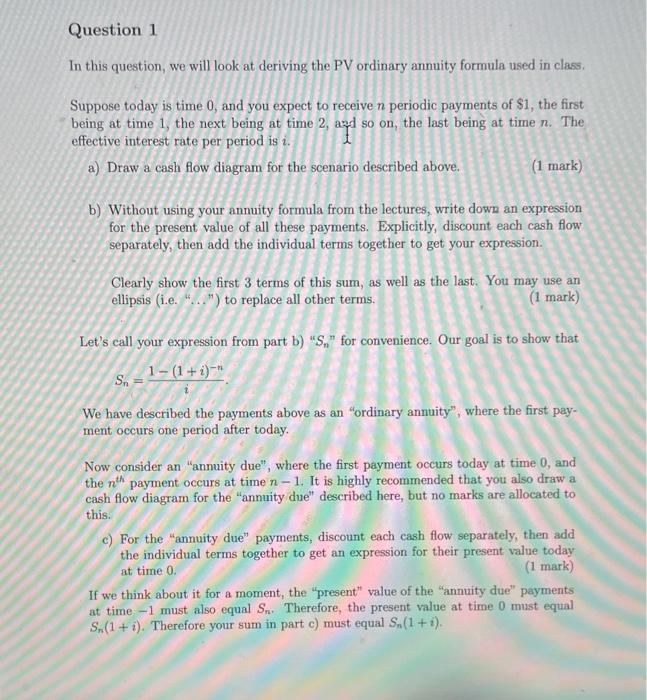
Question 1 In this question, we will look at deriving the PV ordinary annuity formula used in class. Suppose today is time 0, and you expect to receive n periodic payments of $1, the first being at time 1, the next being at time 2, and so on, the last being at time n. The effective interest rate per period is i. a) Draw a cash flow diagram for the scenario described above. (1 mark) b) Without using your annuity formula from the lectures, write down an expression for the present value of all these payments. Explicitly, discount each cash flow separately, then add the individual terms together to get your expression. Clearly show the first 3 terms of this sum, as well as the last. You may use an ellipsis (i.e. "...") to replace all other terms. (1 mark) Let's call your expression from part b) "S," for convenience. Our goal is to show that 1- (1 + i)- SK We have described the payments above as an ordinary annuity", where the first pay- ment occurs one period after today, Now consider an "annuity due", where the first payment occurs today at time 0, and the nt payment occurs at time n-1. It is highly recommended that you also draw a cash flow diagram for the annuity due" described here, but no marks are allocated to this. c) For the "annuity due" payments, discount each cash flow separately, then add the individual terms together to get an expression for their present value today at time 0 (1 mark) If we think about it for a moment, the "present" value of the "annuity due" payments at time -1 must also equal Sn. Therefore, the present value at time 0 must equal S.(1 + i). Therefore your sum in part c) must equal S.(1 + i)
Step by Step Solution
There are 3 Steps involved in it

Get step-by-step solutions from verified subject matter experts
 Study Help