







Question: Question 1. Let f be a differentiable function in the xy-plane, (x0, y0) be a point in the xy-plane and P be the tangent plane
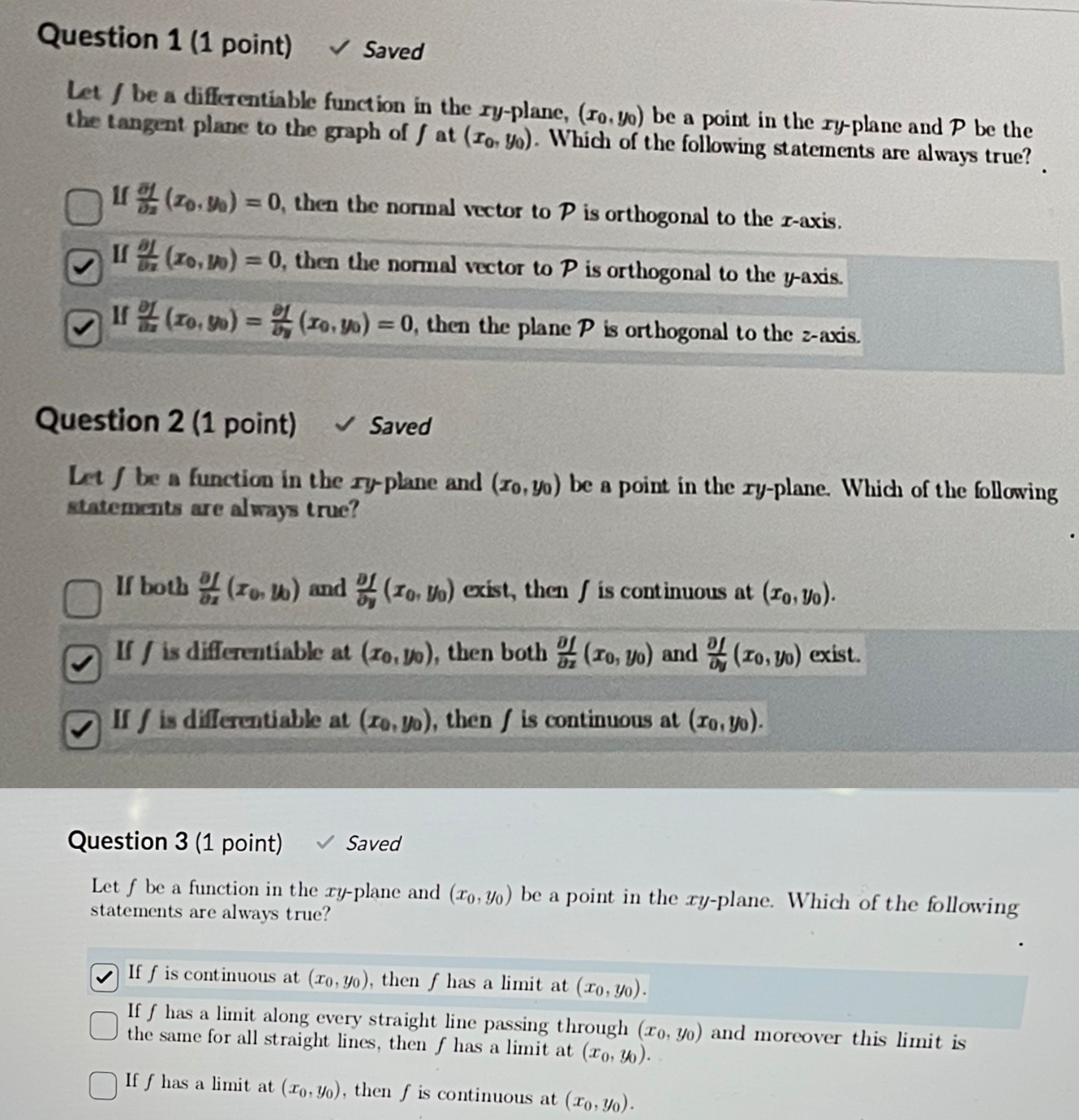
Question 1. Let f be a differentiable function in the xy-plane, (x0, y0) be a point in the xy-plane and P be the tangent plane to the graph of f at (x0, y0). Which of the following statements are always true?Question 2. Let f be a differentiable function in the xy-plane, (x0, y0) be a point in the xy-plane. Which of the following statements are always true?Question 3. Let f be a differentiable function in the xy-plane, (x0, y0) be a point in the xy-plane. Which of the following statements are always true?The selected answers are just my attempts. They are not the correct answers. Each question can have more than one correct answer.
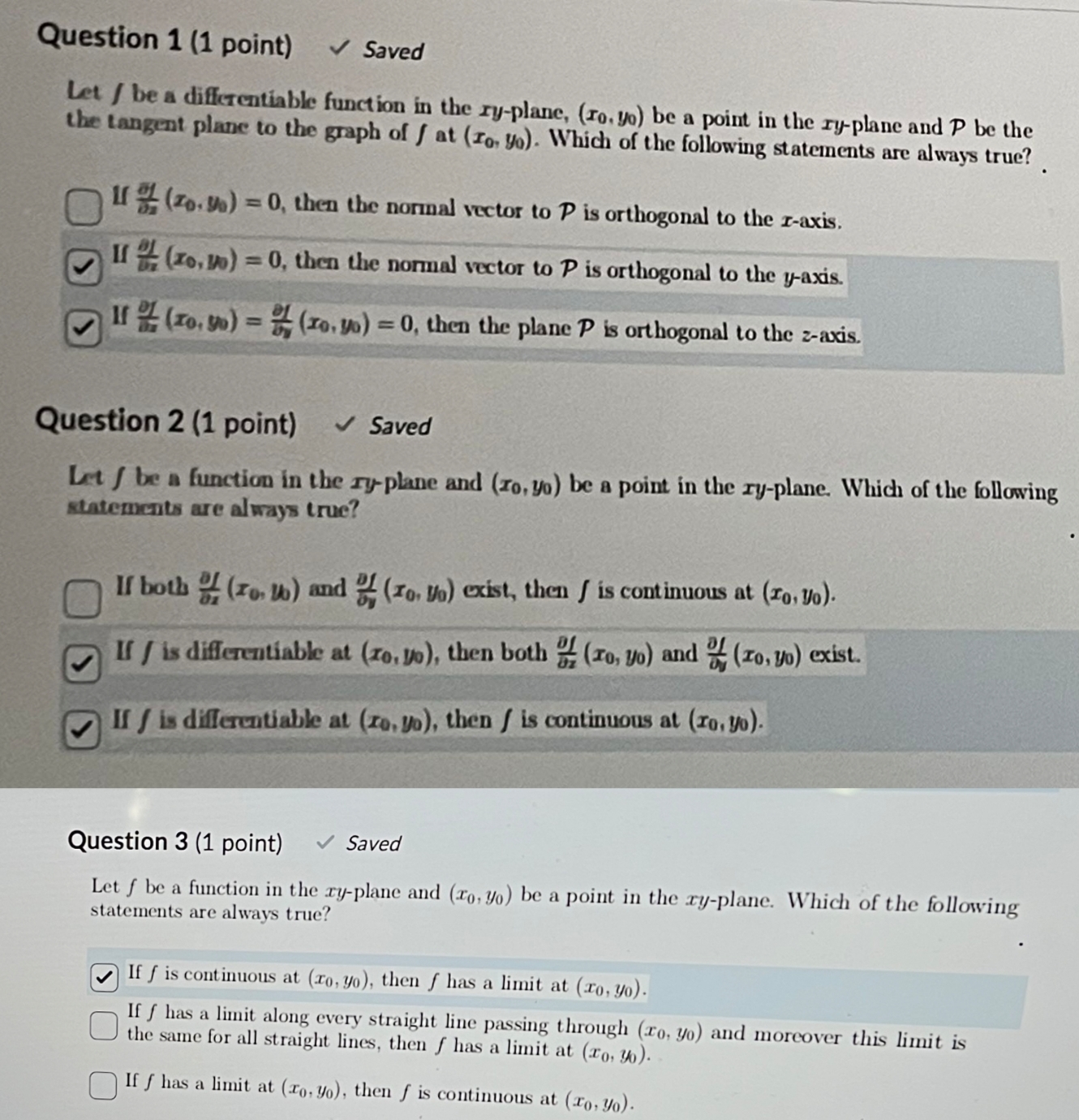
Question 1 (1 point) Saved Let / be a differentiable function in the ry-plane, (ro. yo) be a point in the ry-plane and P be the the tangent plane to the graph of / at (To, yo). Which of the following statements are always true? If " (zo. yo) = 0, then the normal vector to P is orthogonal to the r-axis. If ur (zo, Vo) = 0, then the normal vector to P is orthogonal to the y-axis. If Z (zo, yo) = "/ (ro. yo) = 0, then the plane P is orthogonal to the z-axis. Question 2 (1 point) ~ Saved Let f be a function in the ry-plane and (To, yo) be a point in the ry-plane. Which of the following statements are always true? If both of (To, to) and 2% (To, Vo) exist, then / is continuous at (zo, Vo). If / is differentiable at (To. Do), then both "z (ro, Vo) and of (To, yo) exist. If / is differentiable at (ro, yo), then f is continuous at (ro, yo). Question 3 (1 point) Saved Let f be a function in the ry-plane and (To, yo) be a point in the ry-plane. Which of the following statements are always true? If f is continuous at (To, yo), then f has a limit at (To, yo). If f has a limit along every straight line passing through (To, yo) and moreover this limit is the same for all straight lines, then f has a limit at (To, 3). If f has a limit at (To, yo), then f is continuous at (To, yo)
Step by Step Solution
There are 3 Steps involved in it

Get step-by-step solutions from verified subject matter experts
 Study Help