







Question: Question 1 (Maximum marks 5) Read the Paragraphs written below and identify the Research Gaps (Practical and Theoretical gaps) of the study. Moreover, identify what
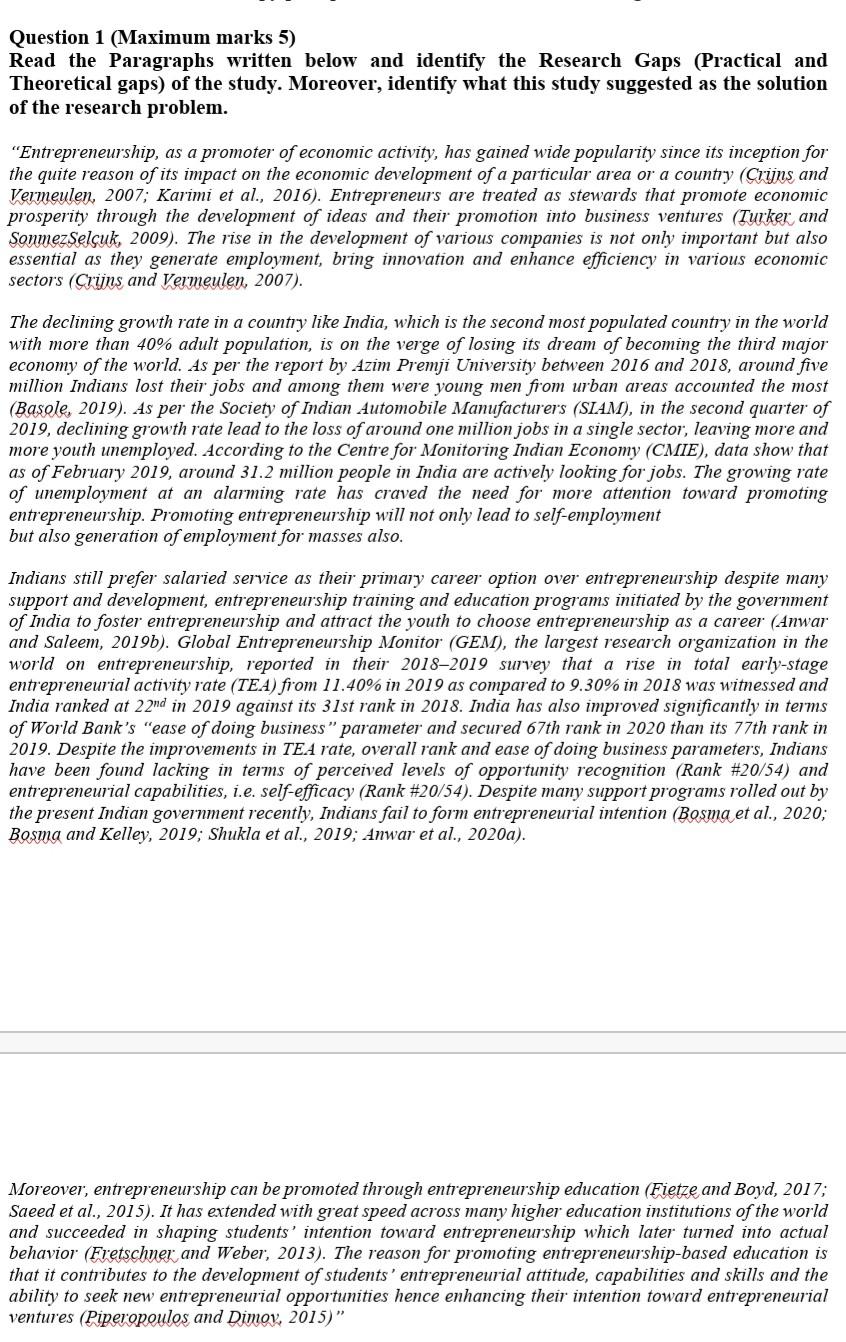
Question 1 (Maximum marks 5) Read the Paragraphs written below and identify the Research Gaps (Practical and Theoretical gaps) of the study. Moreover, identify what this study suggested as the solution of the research problem. Entrepreneurship, as a promoter of economic activity, has gained wide popularity since its inception for the quite reason of its impact on the economic development of a particular area or a country (Crijns and Vermeulen, 2007; Karimi et al., 2016). Entrepreneurs are treated as stewards that promote economic prosperity through the development of ideas and their promotion into business ventures (Turker and SonmezSelcuk, 2009). The rise in the development of various companies is not only important but also essential as they generate employment, bring innovation and enhance efficiency in various economic sectors (Crins and Vermeulen, 2007). The declining growth rate in a country like India, which is the second most populated country in the world with more than 40% adult population, is on the verge of losing its dream of becoming the third major economy of the world. As per the report by Azim Premji University between 2016 and 2018, around five million Indians lost their jobs and among them were young men from urban areas accounted the most (Basole, 2019). As per the Society of Indian Automobile Manufacturers (SIAM), in the second quarter of 2019, declining growth rate lead to the loss of around one million jobs in a single sector, leaving more and more youth unemployed. According to the Centre for Monitoring Indian Economy (CMIE), data show that as of February 2019, around 31.2 million people in India are actively looking for jobs. The growing rate of unemployment at an alarming rate has craved the need for more attention toward promoting entrepreneurship. Promoting entrepreneurship will not only lead to self-employment but also generation of employment for masses also. Indians still prefer salaried service as their primary career option over entrepreneurship despite many support and development, entrepreneurship training and education programs initiated by the government of India to foster entrepreneurship and attract the youth to choose entrepreneurship as a career (Anwar and Saleem, 2019b). Global Entrepreneurship Monitor (GEM), the largest research organization in the world on entrepreneurship, reported in their 2018-2019 survey that a rise in total early-stage entrepreneurial activity rate (TEA) from 11.40% in 2019 as compared to 9.30% in 2018 was witnessed and India ranked at 22nd in 2019 against its 31st rank in 2018. India has also improved significantly in terms of World Bank's "ease of doing business" parameter and secured 67th rank in 2020 than its 77th rank in 2019. Despite the improvements in TEA rate, overall rank and ease of doing business parameters, Indians have been found lacking in terms of perceived levels of opportunity recognition (Rank #20/54) and entrepreneurial capabilities, i.e. self-efficacy (Rank #20/54). Despite many support programs rolled out by the present Indian government recently, Indians fail to form entrepreneurial intention (Bosma et al., 2020; Bosma and Kelley, 2019; Shukla et al., 2019; Anwar et al., 2020a). Moreover, entrepreneurship can be promoted through entrepreneurship education (Fietze and Boyd, 2017; Saeed et al., 2015). It has extended with great speed across many higher education institutions of the world and succeeded in shaping students' intention toward entrepreneurship which later turned into actual behavior (Fretschner and Weber, 2013). The reason for promoting entrepreneurship-based education is that it contributes to the development of students' entrepreneurial attitude, capabilities and skills and the ability to seek new entrepreneurial opportunities hence enhancing their intention toward entrepreneurial ventures (Piperopoulos and Dimov, 2015)
Step by Step Solution
There are 3 Steps involved in it
1 Expert Approved Answer
Step: 1 Unlock

Question Has Been Solved by an Expert!
Get step-by-step solutions from verified subject matter experts
Step: 2 Unlock
Step: 3 Unlock
 Study Help